



 Chat with AI
Exam 16: Monopolistic Competition

Exam 1: Ten Principles of Economics455 Questions
Exam 2: Thinking Like an Economist643 Questions
Exam 3: Interdependence and the Gains From Trade547 Questions
Exam 4: The Market Forces of Supply and Demand693 Questions
Exam 5: Elasticity and Its Application626 Questions
Exam 6: Supply, Demand, and Government Policies668 Questions
Exam 7: Consumers, Producers, and the Efficiency of Markets547 Questions
Exam 8: Applications: the Costs of Taxation509 Questions
Exam 9: Application: International Trade521 Questions
Exam 10: Externalities543 Questions
Exam 11: Public Goods and Common Resources452 Questions
Exam 12: The Design of the Tax System664 Questions
Exam 13: The Costs of Production649 Questions
Exam 14: Firms in Competitive Markets604 Questions
Exam 15: Monopoly662 Questions
Exam 16: Monopolistic Competition649 Questions
Exam 17: Oligopoly522 Questions
Exam 18: The Markets for the Factors of Production592 Questions
Exam 19: Earnings and Discrimination511 Questions
Exam 20: Income Inequality and Poverty478 Questions
Exam 21: The Theory of Consumer Choice570 Questions
Exam 22: Frontiers in Microeconomics461 Questions
Exam 23: Measuring a Nation S Income547 Questions
Exam 24: Measuring the Cost of Living565 Questions
Exam 25: Production and Growth527 Questions
Exam 26: Saving, Investment, and the Financial System637 Questions
Exam 27: Tools of Finance534 Questions
Exam 28: Unemployment and Its Natural Rate701 Questions
Exam 29: The Monetary System540 Questions
Exam 30: Money Growth and Inflation504 Questions
Exam 31: Open-Economy Macroeconomics: Basic Concepts540 Questions
Exam 32: A Macroeconomic Theory of the Open Economy511 Questions
Exam 33: Aggregate Demand and Aggregate Supply572 Questions
Exam 34: The Influence of Monetary and Fiscal Policy on Aggregate Demand523 Questions
Exam 35: The Short-Run Tradeoff Between Inflation and Unemployment536 Questions
Exam 36: Six Debates Over Macroeconomic Policy354 Questions
Select questions type


Suppose there is a market in which the firms hold the following market shares: 25%, 20%, 18%, 15%, 8%, 7%, 4%, 2%, 1%. What is the concentration ratio for this market?
(Short Answer)
4.9/5  (84)
(84) Table 16-6
Beatrice's Birthday Cakes is one bakery among many in the market for birthday cakes. The following table presents cost and revenue data for birthday cakes at Beatrice's. 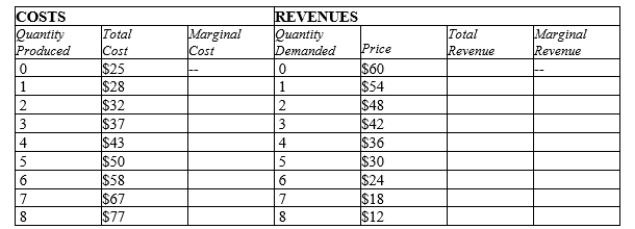 -Refer to Table 16-6. If the government required Beatrice's to produce at the efficient scale of output, how many cakes would Beatrice's sell?
 (Multiple Choice)
4.8/5 (83)
(83) Figure 16-6 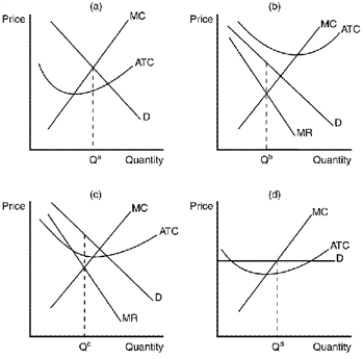 -Refer to Figure 16-6. Which of the graphs depicts a monopolistically competitive firm in long-run equilibrium?
 (Multiple Choice)
4.8/5 (82)
(82) Table 16-2
The following table shows the total output produced by the top six firms as well as the total industry output for each industry. 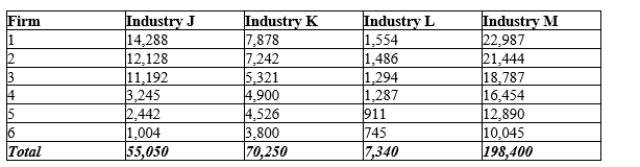 -Refer to Table 16-2. Which industry is the most competitive?
 (Multiple Choice)
4.8/5 (65)
(65) Scenario 16-2
Suppose market demand for a product is given by the equation P = 20 - Q. For this market demand curve, marginal revenue is MR = 20 - 2Q.
-Refer to Scenario 16-2. If the marginal cost of producing this good is 4, what price would a profit-maximizing monopolist charge for the product?
(Multiple Choice)
4.8/5 (83)
(83) A firm in a monopolistically competitive market is usually indifferent to an additional customer walking through the door, since a sale to that customer will not increase the firm's profit.
(True/False)
4.9/5 (69)
(69) The product-variety externality and the business-stealing externality are both spillover costs of new firms entering a monopolistically competitive market.
(True/False)
4.8/5 (79)
(79) Figure 16-14 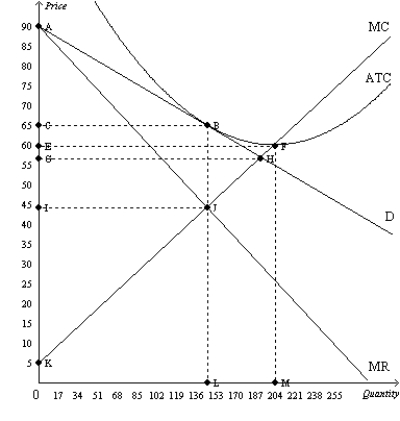 -Refer to Figure 16-14. The difference between the price charged by the monopolistically competitive firm and the price that would be charged if this firm operated in a perfectly competitive market is represented by which line segment?
 (Short Answer)
4.8/5 (76)
(76) Scenario 16-9
Dean goes to the grocery store to buy chips and soda for a party. He purchases brand name products even though generic versions are available at lower prices. His friend John says he was irrational to spend more for a nearly identical product. His friend Martina agreed with Dean's decision to spend more for the brand name products.
-Refer to Scenario 16-9. Which friend is a critic of brand names?
(Short Answer)
4.9/5 (81)
(81) Figure 16-9
The figure is drawn for a monopolistically-competitive firm. 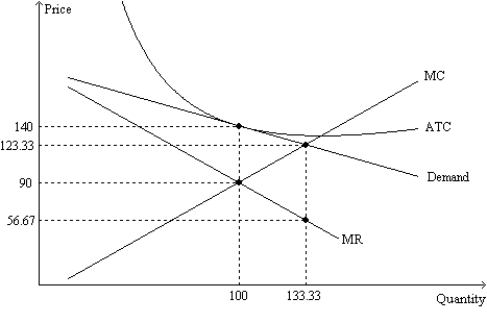 -Refer to Figure 16-9. In response to the situation represented by the figure, we would expect
 (Multiple Choice)
4.9/5 (77)
(77) Scenario 16-8
Burger Bonanza, a major national burger chain, recently decided to spend $4 million on an advertising campaign featuring a world famous actor to promote its new Bomber Burger.
-Refer to Scenario 16-8. What can consumers conclude from Burger Bonanza's willingness to spend $4 million on an advertising campaign?
(Short Answer)
4.9/5 (83)
(83) Results of the study done by Lee Benham on advertising for eyeglasses would suggest that
(Multiple Choice)
4.9/5 (94)
(94) In the short run, a firm operating in a monopolistically competitive market can earn
(Multiple Choice)
4.9/5 (76)
(76) Monopolistically competitive firms, like monopoly firms, maximize their profits by charging a price that exceeds marginal cost.
(True/False)
4.9/5 (73)
(73) Which market structure(s) include(s) many firms with differentiated products who can enter and exit the market freely?
(Short Answer)
4.8/5 (69)
(69) Figure 16-2. The figure is drawn for a monopolistically competitive firm. 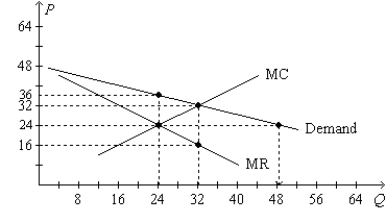 -Refer to Figure 16-2. Suppose you were to add the ATC curve to the diagram to show the firm in a situation of long-run equilibrium. You would draw the ATC curve
 (Multiple Choice)
4.7/5 (71)
(71) Figure 16-11 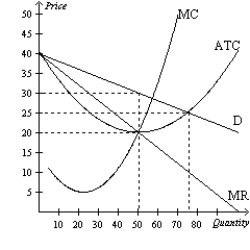 -Refer to Figure 16-11. If this firm profit-maximizes, what price will it charge?
 (Short Answer)
4.9/5 (72)
(72) 
Filters
- Essay(0)
- Multiple Choice(0)
- Short Answer(0)
- True False(0)
- Matching(0)