



 Chat with AI
Exam 16: Monopolistic Competition

Exam 1: Ten Principles of Economics455 Questions
Exam 2: Thinking Like an Economist643 Questions
Exam 3: Interdependence and the Gains From Trade547 Questions
Exam 4: The Market Forces of Supply and Demand693 Questions
Exam 5: Elasticity and Its Application626 Questions
Exam 6: Supply, Demand, and Government Policies668 Questions
Exam 7: Consumers, Producers, and the Efficiency of Markets547 Questions
Exam 8: Applications: the Costs of Taxation509 Questions
Exam 9: Application: International Trade521 Questions
Exam 10: Externalities543 Questions
Exam 11: Public Goods and Common Resources452 Questions
Exam 12: The Design of the Tax System664 Questions
Exam 13: The Costs of Production649 Questions
Exam 14: Firms in Competitive Markets604 Questions
Exam 15: Monopoly662 Questions
Exam 16: Monopolistic Competition649 Questions
Exam 17: Oligopoly522 Questions
Exam 18: The Markets for the Factors of Production592 Questions
Exam 19: Earnings and Discrimination511 Questions
Exam 20: Income Inequality and Poverty478 Questions
Exam 21: The Theory of Consumer Choice570 Questions
Exam 22: Frontiers in Microeconomics461 Questions
Exam 23: Measuring a Nation S Income547 Questions
Exam 24: Measuring the Cost of Living565 Questions
Exam 25: Production and Growth527 Questions
Exam 26: Saving, Investment, and the Financial System637 Questions
Exam 27: Tools of Finance534 Questions
Exam 28: Unemployment and Its Natural Rate701 Questions
Exam 29: The Monetary System540 Questions
Exam 30: Money Growth and Inflation504 Questions
Exam 31: Open-Economy Macroeconomics: Basic Concepts540 Questions
Exam 32: A Macroeconomic Theory of the Open Economy511 Questions
Exam 33: Aggregate Demand and Aggregate Supply572 Questions
Exam 34: The Influence of Monetary and Fiscal Policy on Aggregate Demand523 Questions
Exam 35: The Short-Run Tradeoff Between Inflation and Unemployment536 Questions
Exam 36: Six Debates Over Macroeconomic Policy354 Questions
Select questions type


As developing countries make a transition to market-based economies, one of the first major capital investments is in "Western-quality" hotels. Explain why brand-name hotel accommodations are a critical step in attracting foreign investment.
(Essay)
4.7/5  (80)
(80) If a monopolistically competitive firm can increase its level of production and lower its average total cost of production at the same time then
(Multiple Choice)
4.8/5 (68)
(68) Under which of the following market structures would the highest output of a particular good be produced?
(Multiple Choice)
4.9/5 (67)
(67) When a firm's demand curve is tangent to its average total cost curve, the
(Multiple Choice)
4.9/5 (74)
(74) One thing that both critics of advertising and defenders of advertising agree on is that advertising fosters competition.
(True/False)
4.8/5 (73)
(73) When quality cannot be easily judged in advance, what provides consumers with information about the quality of a product?
(Multiple Choice)
4.8/5 (83)
(83) Figure 16-7 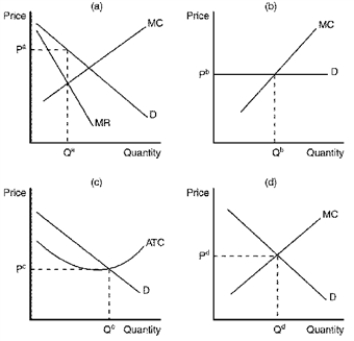 -Refer to Figure 16-7. If a firm in a monopolistically competitive market was producing the level of output depicted as Qd in panel (d), it would
 (Multiple Choice)
4.9/5 (87)
(87) When existing firms lose customers and profits due to entry of a new competitor, a
(Multiple Choice)
4.9/5 (78)
(78) Which of the following is not an argument made by critics of advertising?
(Multiple Choice)
4.8/5 (67)
(67) Figure 16-11 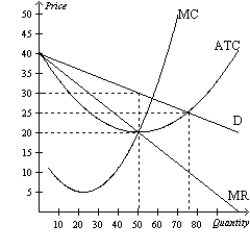 -Refer to Figure 16-11. What, if any, long run adjustment will occur in this industry?
 (Essay)
4.7/5 (78)
(78) Figure 16-2. The figure is drawn for a monopolistically competitive firm. 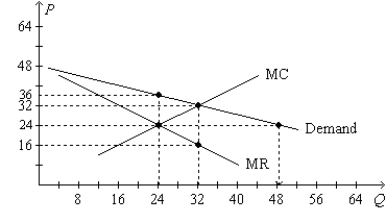 -Refer to Figure 16-2. The firm's profit-maximizing level of output is
 (Multiple Choice)
4.8/5 (85)
(85) Which of the following might be an example of an economic argument against advertising?
(Multiple Choice)
4.8/5 (80)
(80) Advertising during the Super Bowl is an example of information about quality contained primarily in the existence and expense of the advertising.
(True/False)
4.9/5 (82)
(82) Monopolistic competition is characterized by many buyers and sellers, product differentiation, and free entry.
(True/False)
4.9/5 (77)
(77) Considering perfect competition, monopolistic competition, and monopoly, which of the market structures features entry in the long run?
(Essay)
4.8/5 (76)
(76) Figure 16-9
The figure is drawn for a monopolistically-competitive firm. 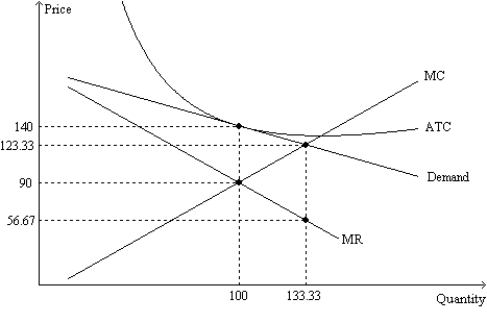 -Refer to Figure 16-9. As the figure is drawn, the firm is in
 (Multiple Choice)
4.9/5 (82)
(82) Figure 16-13 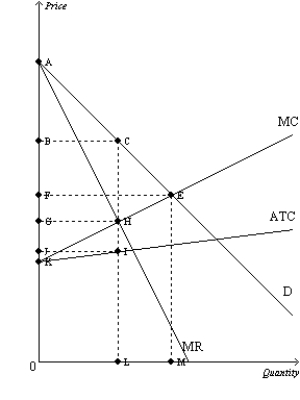 -Refer to Figure 16-13. Which letter represents the profit-maximizing quantity?
 (Short Answer)
4.9/5 (70)
(70) Figure 16-11 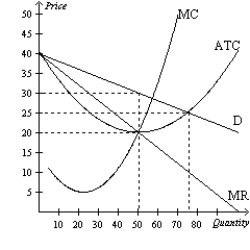 -Refer to Figure 16-11. If this firm profit-maximizes, how much output will it produce?
 (Short Answer)
5.0/5 (90)
(90) In the short run, a firm operating in a monopolistically competitive market
(Multiple Choice)
4.9/5 (62)
(62) 
Filters
- Essay(0)
- Multiple Choice(0)
- Short Answer(0)
- True False(0)
- Matching(0)