



 Chat with AI
Exam 16: Monopolistic Competition

Exam 1: Ten Principles of Economics455 Questions
Exam 2: Thinking Like an Economist643 Questions
Exam 3: Interdependence and the Gains From Trade547 Questions
Exam 4: The Market Forces of Supply and Demand693 Questions
Exam 5: Elasticity and Its Application626 Questions
Exam 6: Supply, Demand, and Government Policies668 Questions
Exam 7: Consumers, Producers, and the Efficiency of Markets547 Questions
Exam 8: Applications: the Costs of Taxation509 Questions
Exam 9: Application: International Trade521 Questions
Exam 10: Externalities543 Questions
Exam 11: Public Goods and Common Resources452 Questions
Exam 12: The Design of the Tax System664 Questions
Exam 13: The Costs of Production649 Questions
Exam 14: Firms in Competitive Markets604 Questions
Exam 15: Monopoly662 Questions
Exam 16: Monopolistic Competition649 Questions
Exam 17: Oligopoly522 Questions
Exam 18: The Markets for the Factors of Production592 Questions
Exam 19: Earnings and Discrimination511 Questions
Exam 20: Income Inequality and Poverty478 Questions
Exam 21: The Theory of Consumer Choice570 Questions
Exam 22: Frontiers in Microeconomics461 Questions
Exam 23: Measuring a Nation S Income547 Questions
Exam 24: Measuring the Cost of Living565 Questions
Exam 25: Production and Growth527 Questions
Exam 26: Saving, Investment, and the Financial System637 Questions
Exam 27: Tools of Finance534 Questions
Exam 28: Unemployment and Its Natural Rate701 Questions
Exam 29: The Monetary System540 Questions
Exam 30: Money Growth and Inflation504 Questions
Exam 31: Open-Economy Macroeconomics: Basic Concepts540 Questions
Exam 32: A Macroeconomic Theory of the Open Economy511 Questions
Exam 33: Aggregate Demand and Aggregate Supply572 Questions
Exam 34: The Influence of Monetary and Fiscal Policy on Aggregate Demand523 Questions
Exam 35: The Short-Run Tradeoff Between Inflation and Unemployment536 Questions
Exam 36: Six Debates Over Macroeconomic Policy354 Questions
Select questions type


Which market structure(s) include(s) many firms with differentiated products who can enter and exit the market freely?
(Short Answer)
4.9/5  (87)
(87) Which of the following conditions is characteristic of a monopolistically competitive firm in long-run equilibrium?
(Multiple Choice)
4.7/5 (81)
(81) If firms in a particular market sell similar or identical products, then the market is
(i)perfectly competitive.
(ii)monopolistically competitive.
(iii)an oligopoly.
(Multiple Choice)
4.9/5 (93)
(93) A new Mexican restaurant opens in the city of Manchester. The other restaurant owners are not happy about this new restaurant because they are experiencing what externality?
(Short Answer)
4.9/5 (86)
(86) Since a firm in a monopolistically competitive market faces a
(Multiple Choice)
4.8/5 (79)
(79) Describe the shape of the monopolistically competitive firm's demand curve.
(Short Answer)
4.7/5 (81)
(81) In Lee Benham's 1972 article examining the impact of advertising on the average price paid for a pair of eyeglasses, Benham found that
(Multiple Choice)
4.8/5 (82)
(82) Table 16-1
The following table shows the percentage of output supplied by the top eight firms in four different industries. 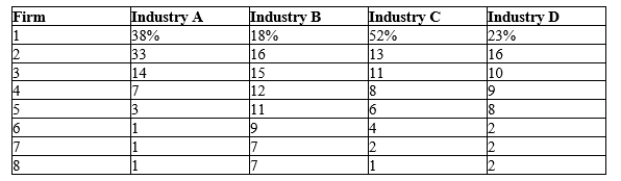 -Refer to Table 16-1. What is the concentration ratio in Industry C?
 (Multiple Choice)
4.7/5 (77)
(77) The free entry and exit of firms in a monopolistically competitive market guarantees that
(Multiple Choice)
4.7/5 (74)
(74) A law that restricts the ability of hotels/motels to advertise on billboards outside of a resort community would likely lead to
(Multiple Choice)
4.9/5 (80)
(80) In which of the following market structures do firms produce the welfare-maximizing level of output?
(Multiple Choice)
4.9/5 (80)
(80) Crude oil is primarily supplied to the world market by a few Middle Eastern countries. Such a market is an example of a(n)(i)imperfectly competitive market.
(ii)monopoly market.
(iii)oligopoly market.
(Multiple Choice)
4.9/5 (92)
(92) Figure 16-12 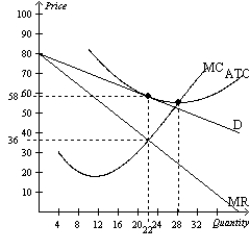 -Refer to Figure 16-12. What is the efficient scale of production?
 (Multiple Choice)
4.9/5 (78)
(78) Figure 16-14 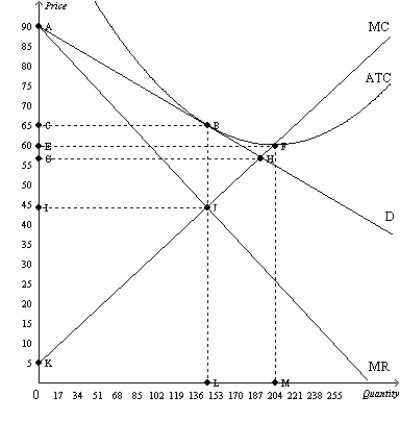 -Refer to Figure 16-14. The difference between the price charged by the monopolistically competitive firm and the price that would be charged if this firm operated in a perfectly competitive market is represented by which line segment?
 (Short Answer)
4.8/5 (78)
(78) Table 16-3
The following table shows the output produced by each of the top eight firms in four industries as well as the total industry output for those industries. 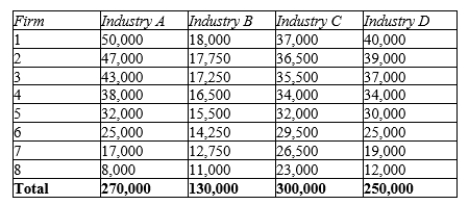 -Refer to Table 16-3. Which industry has the lowest concentration ratio?
 (Multiple Choice)
4.8/5 (82)
(82) A monopolistically competitive firm faces a downward-sloping demand curve because there are few firms in the market.
(True/False)
4.9/5 (79)
(79) Figure 16-9
The figure is drawn for a monopolistically-competitive firm. 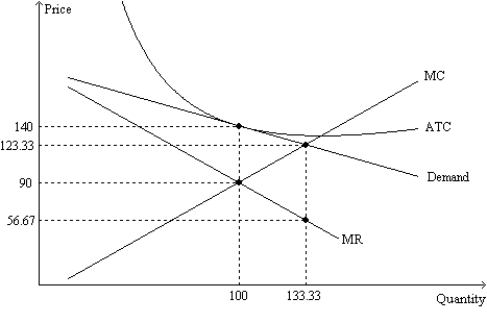 -Refer to Figure 16-9. Given this firm's cost curves, if the firm were perfectly competitive rather than monopolistically competitive, then in a long-run equilibrium it would produce
 (Multiple Choice)
5.0/5 (86)
(86) 
Filters
- Essay(0)
- Multiple Choice(0)
- Short Answer(0)
- True False(0)
- Matching(0)