



 Chat with AI
Exam 16: Monopolistic Competition

Exam 1: Ten Principles of Economics455 Questions
Exam 2: Thinking Like an Economist643 Questions
Exam 3: Interdependence and the Gains From Trade547 Questions
Exam 4: The Market Forces of Supply and Demand693 Questions
Exam 5: Elasticity and Its Application626 Questions
Exam 6: Supply, Demand, and Government Policies668 Questions
Exam 7: Consumers, Producers, and the Efficiency of Markets547 Questions
Exam 8: Applications: the Costs of Taxation509 Questions
Exam 9: Application: International Trade521 Questions
Exam 10: Externalities543 Questions
Exam 11: Public Goods and Common Resources452 Questions
Exam 12: The Design of the Tax System664 Questions
Exam 13: The Costs of Production649 Questions
Exam 14: Firms in Competitive Markets604 Questions
Exam 15: Monopoly662 Questions
Exam 16: Monopolistic Competition649 Questions
Exam 17: Oligopoly522 Questions
Exam 18: The Markets for the Factors of Production592 Questions
Exam 19: Earnings and Discrimination511 Questions
Exam 20: Income Inequality and Poverty478 Questions
Exam 21: The Theory of Consumer Choice570 Questions
Exam 22: Frontiers in Microeconomics461 Questions
Exam 23: Measuring a Nation S Income547 Questions
Exam 24: Measuring the Cost of Living565 Questions
Exam 25: Production and Growth527 Questions
Exam 26: Saving, Investment, and the Financial System637 Questions
Exam 27: Tools of Finance534 Questions
Exam 28: Unemployment and Its Natural Rate701 Questions
Exam 29: The Monetary System540 Questions
Exam 30: Money Growth and Inflation504 Questions
Exam 31: Open-Economy Macroeconomics: Basic Concepts540 Questions
Exam 32: A Macroeconomic Theory of the Open Economy511 Questions
Exam 33: Aggregate Demand and Aggregate Supply572 Questions
Exam 34: The Influence of Monetary and Fiscal Policy on Aggregate Demand523 Questions
Exam 35: The Short-Run Tradeoff Between Inflation and Unemployment536 Questions
Exam 36: Six Debates Over Macroeconomic Policy354 Questions
Select questions type


In a monopolistically competitive market, social welfare would be enhanced if
(Multiple Choice)
4.9/5  (87)
(87) A profit-maximizing firm operating in a monopolistically competitive market that is in a long-run equilibrium has
(Multiple Choice)
4.8/5 (85)
(85) Table 16-5
This table shows the demand schedule, marginal cost, and average total cost for a monopolistically competitive firm. 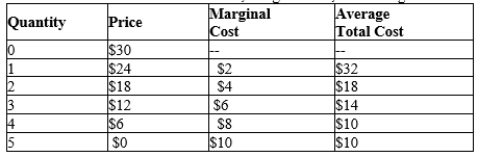 -Refer to Table 16-5. How much profit will this firm earn at the monopolistically competitive price?
 (Multiple Choice)
4.8/5 (73)
(73) Scenario 16-8
Burger Bonanza, a major national burger chain, recently decided to spend $4 million on an advertising campaign featuring a world famous actor to promote its new Bomber Burger.
-Refer to Scenario 16-8. What can consumers conclude from Burger Bonanza's willingness to spend $4 million on an advertising campaign?
(Short Answer)
4.9/5 (69)
(69) The LookGood BePopular (LGBP) Clothing Company embarked on a new advertising campaign in which a group of young beautiful people are having fun eating out at a restaurant wearing the company's clothes. Critics of advertising argue that this advertisement
(Multiple Choice)
4.9/5 (91)
(91) New firms will likely enter a monopolistically competitive market when price exceeds
(Multiple Choice)
4.9/5 (71)
(71) Which market structure(s) is(are) considered highly concentrated?
(Short Answer)
5.0/5 (77)
(77) A profit-maximizing firm in a monopolistically competitive market charges a price equal to marginal cost.
(True/False)
4.9/5 (89)
(89) One way in which monopolistic competition differs from oligopoly is that
(Multiple Choice)
4.7/5 (78)
(78) Evaluate the following statement: "Advertisements that use celebrity endorsements are devoid of any value and do not enhance the efficient functioning of markets."
(Essay)
4.7/5 (76)
(76) Scenario 16-7
Consider the problem facing two firms, YumYum and Bertollini, in the frozen food market. Each firm has just come up with an idea for a new "frozen meal for two" which it would sell for $9. Assume that the marginal cost for each new product is a constant $2, and the only fixed cost is for advertising. Each company knows that if it spends $12 million on advertising it will get 1.5 million consumers to try its new product. YumYum has done market research which suggests that its product does not have any "staying" power in the market. Even though it could get 1.5 million consumers to buy the product once, it is unlikely that they will continue to buy the product in the future. Bertollini's market research suggests that its product is very good, and consumers who try the product will continue to be consumers over the ensuing year. On the basis of its market research, Bertollini estimates that its initial 1.5 million customers will buy one unit of the product each month in the coming year, for a total of 18 million units.
-Refer to Scenario 16-7. Which of the following is most likely?
(Multiple Choice)
5.0/5 (82)
(82) Which market structure would likely have the highest concentration ratio?
(Multiple Choice)
4.9/5 (88)
(88) List five goods that are likely sold in a monopolistically competitive market.
(Essay)
4.7/5 (87)
(87) Which of the following is not a characteristic of monopolistic competition?
(Multiple Choice)
5.0/5 (106)
(106) Figure 16-2. The figure is drawn for a monopolistically competitive firm. 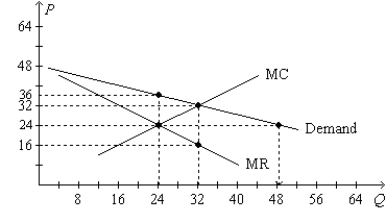 -Refer to Figure 16-2. Suppose ATC = $36 when Q = 24. Then the
 (Multiple Choice)
4.8/5 (67)
(67) A monopolistically competitive market has characteristics that are similar to
(Multiple Choice)
4.8/5 (83)
(83) 
Filters
- Essay(0)
- Multiple Choice(0)
- Short Answer(0)
- True False(0)
- Matching(0)