



 Chat with AI
Exam 16: Monopolistic Competition

Exam 1: Ten Principles of Economics455 Questions
Exam 2: Thinking Like an Economist643 Questions
Exam 3: Interdependence and the Gains From Trade547 Questions
Exam 4: The Market Forces of Supply and Demand693 Questions
Exam 5: Elasticity and Its Application626 Questions
Exam 6: Supply, Demand, and Government Policies668 Questions
Exam 7: Consumers, Producers, and the Efficiency of Markets547 Questions
Exam 8: Applications: the Costs of Taxation509 Questions
Exam 9: Application: International Trade521 Questions
Exam 10: Externalities543 Questions
Exam 11: Public Goods and Common Resources452 Questions
Exam 12: The Design of the Tax System664 Questions
Exam 13: The Costs of Production649 Questions
Exam 14: Firms in Competitive Markets604 Questions
Exam 15: Monopoly662 Questions
Exam 16: Monopolistic Competition649 Questions
Exam 17: Oligopoly522 Questions
Exam 18: The Markets for the Factors of Production592 Questions
Exam 19: Earnings and Discrimination511 Questions
Exam 20: Income Inequality and Poverty478 Questions
Exam 21: The Theory of Consumer Choice570 Questions
Exam 22: Frontiers in Microeconomics461 Questions
Exam 23: Measuring a Nation S Income547 Questions
Exam 24: Measuring the Cost of Living565 Questions
Exam 25: Production and Growth527 Questions
Exam 26: Saving, Investment, and the Financial System637 Questions
Exam 27: Tools of Finance534 Questions
Exam 28: Unemployment and Its Natural Rate701 Questions
Exam 29: The Monetary System540 Questions
Exam 30: Money Growth and Inflation504 Questions
Exam 31: Open-Economy Macroeconomics: Basic Concepts540 Questions
Exam 32: A Macroeconomic Theory of the Open Economy511 Questions
Exam 33: Aggregate Demand and Aggregate Supply572 Questions
Exam 34: The Influence of Monetary and Fiscal Policy on Aggregate Demand523 Questions
Exam 35: The Short-Run Tradeoff Between Inflation and Unemployment536 Questions
Exam 36: Six Debates Over Macroeconomic Policy354 Questions
Select questions type


Monopolistic competition is characterized by a few sellers offering similar products, whereas oligopoly is characterized by many sellers offering differentiated products.
(True/False)
4.9/5  (82)
(82) The administrative burden of regulating price in a monopolistically competitive market is
(Multiple Choice)
5.0/5 (82)
(82) When a firm operates at efficient scale, it is producing at the minimum point on its average total cost curve.
(True/False)
4.9/5 (68)
(68) Scenario 16-1
Suppose the following are the sales for all of the firms in two different industries. 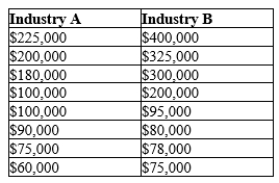 -Refer to Scenario 16-1. Which of the following statements is correct regarding the competitiveness of these two industries?
 (Multiple Choice)
4.9/5 (68)
(68) Scenario 16-8
Burger Bonanza, a major national burger chain, recently decided to spend $4 million on an advertising campaign featuring a world famous actor to promote its new Bomber Burger.
-Refer to Scenario 16-8. What two benefits are conveyed by the brand name Burger Bonanza?
(Essay)
4.8/5 (79)
(79) Figure 16-13 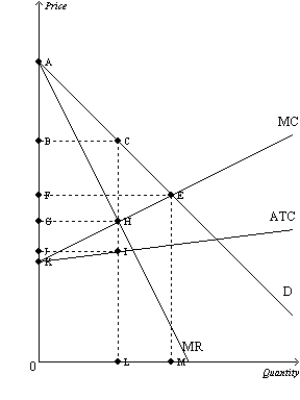 -Refer to Figure 16-13. Use the letters to identify the deadweight loss associated with this firm's profit-maximizing production.
 (Short Answer)
4.9/5 (87)
(87) Scenario 16-3
Peter operates an ice cream shop in the center of Fairfield. He sells several unusual flavors of organic, homemade ice cream so he has a monopoly over his own ice cream, though he competes with many other firms selling ice cream in Fairfield for the same customers. Peter's demand and cost values for sales per day are given in the table below. (Everyone who purchases Peter's ice cream buys a double scoop cone because it's so delicious.) 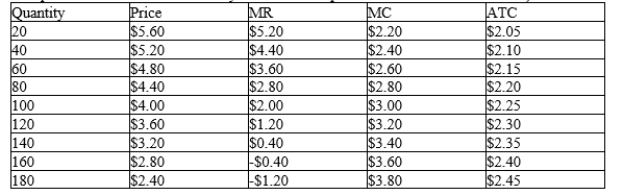 -Refer to Scenario 16-3. When Peter maximizes his profits, what is his total cost per day?
 (Short Answer)
4.8/5 (79)
(79) Figure 16-3
This figure depicts a situation in a monopolistically competitive market. 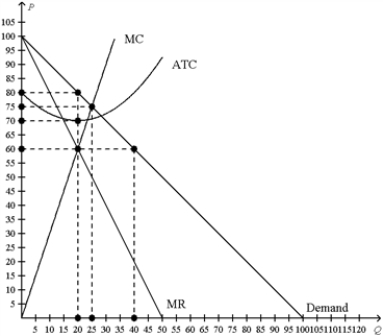 -Refer to Figure 16-3. What is the profit-maximizing price, quantity, and resulting profit?
 (Multiple Choice)
4.9/5 (74)
(74) Scenario 16-6
Ike's Ice Cream has decided to open a new ice cream parlor in Mayville, MS. The market for ice cream parlors is monopolistically competitive.
-Refer to Scenario 16-6. As a result of the new Ike's Ice Cream parlor, existing ice cream shops located in Mayville are likely to experience a
(Multiple Choice)
5.0/5 (69)
(69) A firm that would experience higher average total cost by increasing production is operating with excess capacity.
(True/False)
4.9/5 (92)
(92) Table 16-1
The following table shows the percentage of output supplied by the top eight firms in four different industries. 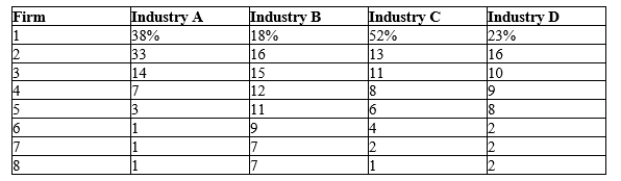 -Refer to Table 16-1. Which industry has the lowest concentration ratio?
 (Multiple Choice)
4.8/5 (83)
(83) Scenario 16-7
Consider the problem facing two firms, YumYum and Bertollini, in the frozen food market. Each firm has just come up with an idea for a new "frozen meal for two" which it would sell for $9. Assume that the marginal cost for each new product is a constant $2, and the only fixed cost is for advertising. Each company knows that if it spends $12 million on advertising it will get 1.5 million consumers to try its new product. YumYum has done market research which suggests that its product does not have any "staying" power in the market. Even though it could get 1.5 million consumers to buy the product once, it is unlikely that they will continue to buy the product in the future. Bertollini's market research suggests that its product is very good, and consumers who try the product will continue to be consumers over the ensuing year. On the basis of its market research, Bertollini estimates that its initial 1.5 million customers will buy one unit of the product each month in the coming year, for a total of 18 million units.
-Refer to Scenario 16-7. On the basis of a theory that people buy a product because it is advertised, the content of advertisements for Bertollini's product
(Multiple Choice)
4.8/5 (77)
(77) In which of the following market structures is(are) there a large number of sellers?
(i)monopolistic competition
(ii)perfect competition
(iii)oligopoly
(Multiple Choice)
4.8/5 (81)
(81) Table 16-4
This table shows the demand schedule, marginal cost, and average total cost for a monopolistically competitive firm. 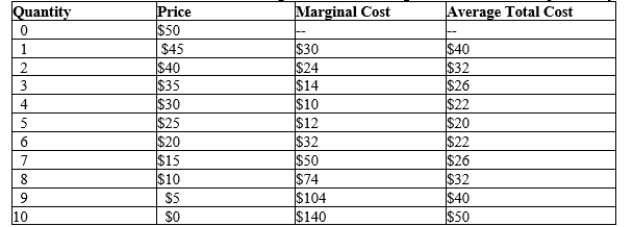 -Refer to Table 16-4. What price will this firm charge to maximize profit?
 (Multiple Choice)
4.8/5 (79)
(79) The general term for market structures that fall somewhere between monopoly and perfect competition is
(Multiple Choice)
4.9/5 (77)
(77) In the long run, a profit-maximizing firm in a monopolistically competitive market operates at
(Multiple Choice)
4.8/5 (76)
(76) Which of the following is a characteristic of monopolistic competition?
(Multiple Choice)
4.7/5 (92)
(92) Figure 16-12 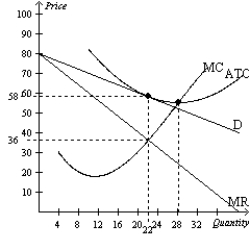 -Refer to Figure 16-12. How much excess capacity does this firm have?
 (Short Answer)
4.8/5 (69)
(69) 
Filters
- Essay(0)
- Multiple Choice(0)
- Short Answer(0)
- True False(0)
- Matching(0)