



 Chat with AI
Exam 16: Monopolistic Competition

Exam 1: Ten Principles of Economics455 Questions
Exam 2: Thinking Like an Economist643 Questions
Exam 3: Interdependence and the Gains From Trade547 Questions
Exam 4: The Market Forces of Supply and Demand693 Questions
Exam 5: Elasticity and Its Application626 Questions
Exam 6: Supply, Demand, and Government Policies668 Questions
Exam 7: Consumers, Producers, and the Efficiency of Markets547 Questions
Exam 8: Applications: the Costs of Taxation509 Questions
Exam 9: Application: International Trade521 Questions
Exam 10: Externalities543 Questions
Exam 11: Public Goods and Common Resources452 Questions
Exam 12: The Design of the Tax System664 Questions
Exam 13: The Costs of Production649 Questions
Exam 14: Firms in Competitive Markets604 Questions
Exam 15: Monopoly662 Questions
Exam 16: Monopolistic Competition649 Questions
Exam 17: Oligopoly522 Questions
Exam 18: The Markets for the Factors of Production592 Questions
Exam 19: Earnings and Discrimination511 Questions
Exam 20: Income Inequality and Poverty478 Questions
Exam 21: The Theory of Consumer Choice570 Questions
Exam 22: Frontiers in Microeconomics461 Questions
Exam 23: Measuring a Nation S Income547 Questions
Exam 24: Measuring the Cost of Living565 Questions
Exam 25: Production and Growth527 Questions
Exam 26: Saving, Investment, and the Financial System637 Questions
Exam 27: Tools of Finance534 Questions
Exam 28: Unemployment and Its Natural Rate701 Questions
Exam 29: The Monetary System540 Questions
Exam 30: Money Growth and Inflation504 Questions
Exam 31: Open-Economy Macroeconomics: Basic Concepts540 Questions
Exam 32: A Macroeconomic Theory of the Open Economy511 Questions
Exam 33: Aggregate Demand and Aggregate Supply572 Questions
Exam 34: The Influence of Monetary and Fiscal Policy on Aggregate Demand523 Questions
Exam 35: The Short-Run Tradeoff Between Inflation and Unemployment536 Questions
Exam 36: Six Debates Over Macroeconomic Policy354 Questions
Select questions type


Professional organizations (for example, the American Medical Association and the American Bar Association) have been active advocates for regulation to restrict the right of professionals to advertise. Describe what economic incentives might exist for existing professionals to restrict advertising.
(Essay)
4.9/5  (76)
(76) As new firms enter a monopolistically competitive market, profits of existing firms
(Multiple Choice)
4.9/5 (76)
(76) Roberto consumes Coke exclusively. He claims that there is a clear taste difference and that competing brands of cola leave an unsavory taste in his mouth. In a blind taste test, Roberto is found to prefer Coke to store-brand cola eight out of ten times. The results of Roberto's taste test would refute claims by critics of brand names that
(Multiple Choice)
4.7/5 (71)
(71) In a monopolistically competitive market, the number of firms adjusts until economic profits are driven to zero.
(True/False)
4.9/5 (87)
(87) Free entry and exit means that the number of firms in the market adjusts until
(Multiple Choice)
4.9/5 (77)
(77) The traditional view of monopolistic competition holds that this type of industrial structure is inefficient because
(Multiple Choice)
4.9/5 (70)
(70) The term excess capacity refers to the fact that a firm produces a lower quantity than it would if it operated at the efficient scale.
(True/False)
4.8/5 (75)
(75) When McDonald's opens a store in Dhaka, Bangladesh, it has a strong incentive to enforce product quality consistent with stores in the United States.
(True/False)
4.8/5 (71)
(71) Which of the following statements regarding brand names in advertising is not correct?
(Multiple Choice)
4.9/5 (74)
(74) To be considered an oligopoly, the market must have a concentration ratio below 50%.
(True/False)
4.8/5 (84)
(84) Table 16-4
This table shows the demand schedule, marginal cost, and average total cost for a monopolistically competitive firm. 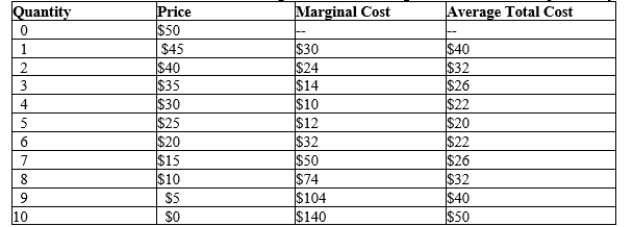 -Refer to Table 16-4. Which of the following is likely to happen in the long run in this market?
 (Multiple Choice)
5.0/5 (72)
(72) Figure 16-1 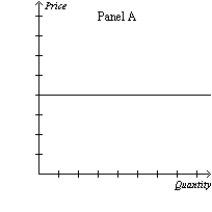
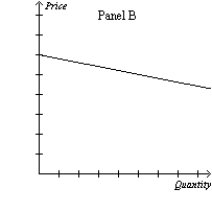
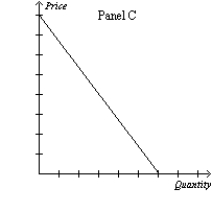
 -Refer to Figure 16-1. Which of the following sets of explanations best describes the differences between the graphs above?
 (Multiple Choice)
4.9/5 (78)
(78) Consider two industries in which firms hold the following market shares:
Industry A: 25%, 20%, 18%, 15%, 8%, 7%, 4%, 2%, 1%
Industry B: 30%, 10%, 9%, 8%, 8%, 8%, 8%, 6%, 6%, 5%, 2%
What are the concentration ratios for each industry? Which is more competitive?
(Short Answer)
4.9/5 (85)
(85) Which of the following correctly lists the products in order from most advertised to least advertised?
(Multiple Choice)
4.8/5 (72)
(72) Which of the following industries has the highest concentration ratio?
(Multiple Choice)
5.0/5 (90)
(90) Evidence suggests that, in markets with differentiated products but little advertising,
(Multiple Choice)
4.8/5 (73)
(73) Examples of monopolistically competitive markets include the markets for
(Multiple Choice)
4.8/5 (75)
(75) Which of the following represents the best government policy to reduce the deadweight loss associated with a monopolistically competitive market?
(Multiple Choice)
4.9/5 (72)
(72) Monopolistic competition is characterized by which of the following attributes?
(i)free entry
(ii)product differentiation
(iii)many sellers
(Multiple Choice)
4.9/5 (84)
(84) 
Filters
- Essay(0)
- Multiple Choice(0)
- Short Answer(0)
- True False(0)
- Matching(0)