



 Chat with AI
Exam 16: Monopolistic Competition

Exam 1: Ten Principles of Economics455 Questions
Exam 2: Thinking Like an Economist643 Questions
Exam 3: Interdependence and the Gains From Trade547 Questions
Exam 4: The Market Forces of Supply and Demand693 Questions
Exam 5: Elasticity and Its Application626 Questions
Exam 6: Supply, Demand, and Government Policies668 Questions
Exam 7: Consumers, Producers, and the Efficiency of Markets547 Questions
Exam 8: Applications: the Costs of Taxation509 Questions
Exam 9: Application: International Trade521 Questions
Exam 10: Externalities543 Questions
Exam 11: Public Goods and Common Resources452 Questions
Exam 12: The Design of the Tax System664 Questions
Exam 13: The Costs of Production649 Questions
Exam 14: Firms in Competitive Markets604 Questions
Exam 15: Monopoly662 Questions
Exam 16: Monopolistic Competition649 Questions
Exam 17: Oligopoly522 Questions
Exam 18: The Markets for the Factors of Production592 Questions
Exam 19: Earnings and Discrimination511 Questions
Exam 20: Income Inequality and Poverty478 Questions
Exam 21: The Theory of Consumer Choice570 Questions
Exam 22: Frontiers in Microeconomics461 Questions
Exam 23: Measuring a Nation S Income547 Questions
Exam 24: Measuring the Cost of Living565 Questions
Exam 25: Production and Growth527 Questions
Exam 26: Saving, Investment, and the Financial System637 Questions
Exam 27: Tools of Finance534 Questions
Exam 28: Unemployment and Its Natural Rate701 Questions
Exam 29: The Monetary System540 Questions
Exam 30: Money Growth and Inflation504 Questions
Exam 31: Open-Economy Macroeconomics: Basic Concepts540 Questions
Exam 32: A Macroeconomic Theory of the Open Economy511 Questions
Exam 33: Aggregate Demand and Aggregate Supply572 Questions
Exam 34: The Influence of Monetary and Fiscal Policy on Aggregate Demand523 Questions
Exam 35: The Short-Run Tradeoff Between Inflation and Unemployment536 Questions
Exam 36: Six Debates Over Macroeconomic Policy354 Questions
Select questions type


Which of the following statements regarding monopolistic competition is not correct?
(Multiple Choice)
4.9/5  (65)
(65) Which market structure(s) is(are) considered highly concentrated?
(Short Answer)
4.8/5 (76)
(76) Monopolistic competition and monopoly are examples of a market structure called imperfect competition.
(True/False)
4.9/5 (75)
(75) When a profit-maximizing firm in a monopolistically competitive market is in long-run equilibrium, marginal cost must lie below average total cost.
(True/False)
4.7/5 (88)
(88) Scenario 16-3
Peter operates an ice cream shop in the center of Fairfield. He sells several unusual flavors of organic, homemade ice cream so he has a monopoly over his own ice cream, though he competes with many other firms selling ice cream in Fairfield for the same customers. Peter's demand and cost values for sales per day are given in the table below. (Everyone who purchases Peter's ice cream buys a double scoop cone because it's so delicious.) 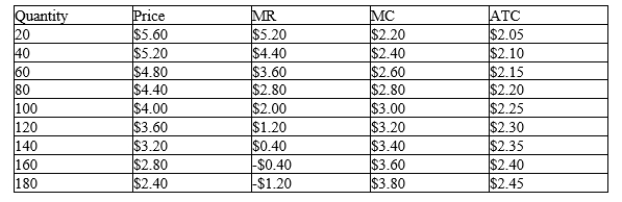 -Refer to Scenario 16-3. What price should Peter charge per double scoop ice cream cone to maximize his profit?
 (Multiple Choice)
4.8/5 (84)
(84) The entry of new firms into a monopolistically competitive market is accompanied by
(Multiple Choice)
5.0/5 (81)
(81) If we observe a great deal more advertising for Mucinex, an over-the-counter drug, than for a Grainger drill press, we can infer that
(Multiple Choice)
4.9/5 (83)
(83) Figure 16-12 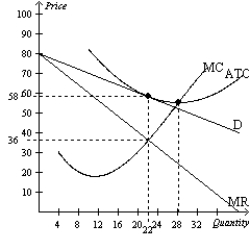 -Refer to Figure 16-12. If this firm profit-maximizes, how much output will it produce?
 (Short Answer)
4.8/5 (70)
(70) Monopolistically competitive firms could reduce the average total cost of producing by increasing output; therefore, these firms have
(Short Answer)
4.7/5 (80)
(80) If firms in a monopolistically competitive market are incurring economic losses, which of the following statements describes the changes that occur as the market adjusts to the long-run equilibrium?
(Multiple Choice)
4.7/5 (71)
(71) Defenders of advertising argue that it is not rational for profit-maximizing firms to spend money on advertising for products that have
(Multiple Choice)
5.0/5 (82)
(82) Figure 16-13 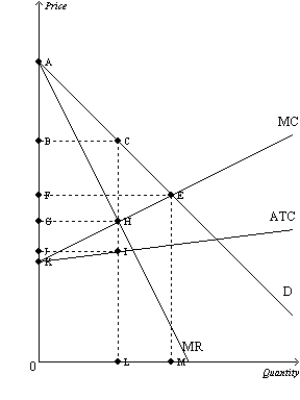 -Refer to Figure 16-13. Which letter represents the profit-maximizing quantity?
 (Short Answer)
4.8/5 (69)
(69) Critics of markets that are characterized by firms that sell brand name products argue that brand names encourage consumers to pay more for branded products that
(Multiple Choice)
4.8/5 (85)
(85) Firms that spend a large amount of money on advertising a particular product are likely to be providing consumers with
(Multiple Choice)
4.9/5 (83)
(83) Figure 16-11 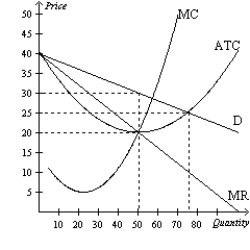 -Refer to Figure 16-11. What, if any, long run adjustment will occur in this industry?
 (Essay)
4.8/5 (82)
(82) Scenario 16-2
Suppose market demand for a product is given by the equation P = 20 - Q. For this market demand curve, marginal revenue is MR = 20 - 2Q.
-Refer to Scenario 16-2. If the marginal cost of producing this good is 0, how much total consumer surplus would consumers receive in this market?
(Multiple Choice)
4.9/5 (73)
(73) The commercial jetliner industry consisting of Boeing and Airbus would best be described as a (an)
(Multiple Choice)
4.9/5 (78)
(78) A monopolistically competitive firm faces the following demand curve for its product:  The firm has total fixed costs of $120 and a constant marginal cost of $12 per unit. We can conclude that
 (Multiple Choice)
4.9/5 (86)
(86) Table 16-1
The following table shows the percentage of output supplied by the top eight firms in four different industries. 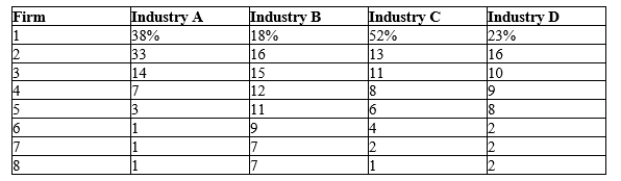 -Refer to Table 16-1. What is the concentration ratio in Industry D?
 (Multiple Choice)
4.9/5 (91)
(91) 
Filters
- Essay(0)
- Multiple Choice(0)
- Short Answer(0)
- True False(0)
- Matching(0)