



 Chat with AI
Exam 15: Monopoly

Exam 1: Ten Principles of Economics455 Questions
Exam 2: Thinking Like an Economist643 Questions
Exam 3: Interdependence and the Gains From Trade547 Questions
Exam 4: The Market Forces of Supply and Demand693 Questions
Exam 5: Elasticity and Its Application626 Questions
Exam 6: Supply, Demand, and Government Policies668 Questions
Exam 7: Consumers, Producers, and the Efficiency of Markets547 Questions
Exam 8: Applications: the Costs of Taxation509 Questions
Exam 9: Application: International Trade521 Questions
Exam 10: Externalities543 Questions
Exam 11: Public Goods and Common Resources452 Questions
Exam 12: The Design of the Tax System664 Questions
Exam 13: The Costs of Production649 Questions
Exam 14: Firms in Competitive Markets604 Questions
Exam 15: Monopoly662 Questions
Exam 16: Monopolistic Competition649 Questions
Exam 17: Oligopoly522 Questions
Exam 18: The Markets for the Factors of Production592 Questions
Exam 19: Earnings and Discrimination511 Questions
Exam 20: Income Inequality and Poverty478 Questions
Exam 21: The Theory of Consumer Choice570 Questions
Exam 22: Frontiers in Microeconomics461 Questions
Exam 23: Measuring a Nation S Income547 Questions
Exam 24: Measuring the Cost of Living565 Questions
Exam 25: Production and Growth527 Questions
Exam 26: Saving, Investment, and the Financial System637 Questions
Exam 27: Tools of Finance534 Questions
Exam 28: Unemployment and Its Natural Rate701 Questions
Exam 29: The Monetary System540 Questions
Exam 30: Money Growth and Inflation504 Questions
Exam 31: Open-Economy Macroeconomics: Basic Concepts540 Questions
Exam 32: A Macroeconomic Theory of the Open Economy511 Questions
Exam 33: Aggregate Demand and Aggregate Supply572 Questions
Exam 34: The Influence of Monetary and Fiscal Policy on Aggregate Demand523 Questions
Exam 35: The Short-Run Tradeoff Between Inflation and Unemployment536 Questions
Exam 36: Six Debates Over Macroeconomic Policy354 Questions
Select questions type


Table 15-21
Tommy's Tie Company, a monopolist, has the following cost and revenue information. Assume that Tommy's is able to engage in perfect price discrimination. 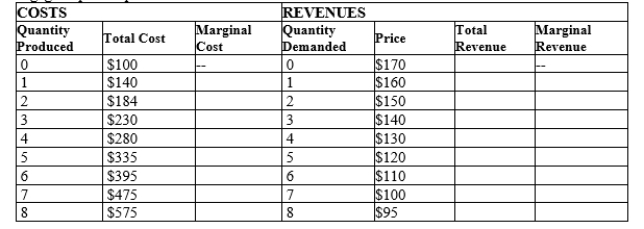 -Refer to Table 15-21. If the monopolist can engage in perfect price discrimination, what is the average revenue when 7 ties are sold?
Free
(Multiple Choice)
4.9/5  (74)
(74) Correct Answer: Verified
D
Table 15-7
Sally owns the only shoe store in town. She has the following cost and revenue information. 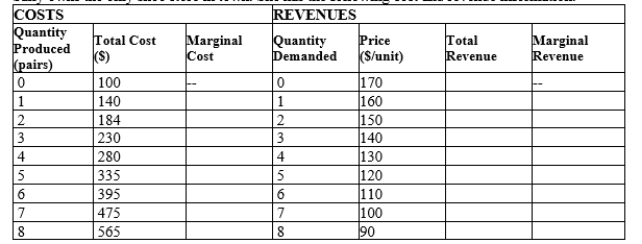 -Refer to Table 15-7. What is the marginal revenue from selling the 2nd pair of shoes?
Free
(Multiple Choice)
4.9/5 (75)
(75) Correct Answer:Verified
VerifiedA
Table 15-3
Consider the following demand and cost information for a monopoly. 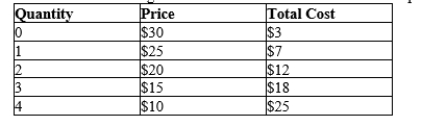 -Refer to Table 15-3. To maximize profit, the monopolist sets price at
Free
(Multiple Choice)
4.9/5 (80)
(80) Correct Answer:Verified
VerifiedC
Round-trip airline tickets are usually cheaper if you stay over a Saturday night before you fly back. What is the reason for this price discrepancy?
(Multiple Choice)
5.0/5 (84)
(84) Table 15-5
A monopolist faces the following demand curve: 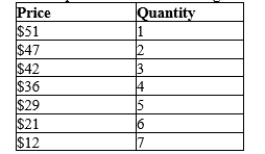 -Refer to Table 15-5. The monopolist has total fixed costs of $60 and has a constant marginal cost of $15. What is the profit-maximizing level of production?
 (Multiple Choice)
4.9/5 (81)
(81) Competitive firms differ from monopolies in which of the following ways?
(i)Competitive firms do not have to worry about the price effect lowering their total revenue.
(ii)Marginal revenue for a competitive firm equals price, while marginal revenue for a monopoly is less than the price it is able to charge.
(iii)Monopolies must lower their price in order to sell more of their product, while competitive firms do not.
(Multiple Choice)
4.9/5 (90)
(90) Figure 15-1 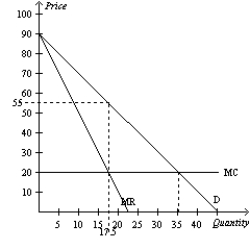 -Refer to Figure 15-1. If the monopolist uses perfect price discrimination, how much profit does the firm earn?
 (Short Answer)
4.9/5 (77)
(77) Figure 15-4 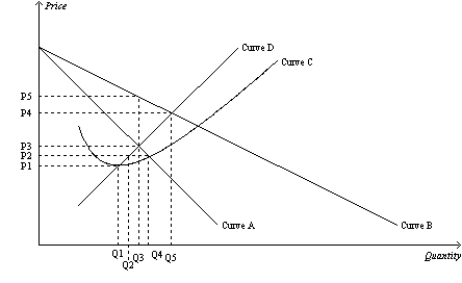 -Refer to Figure 15-4. A profit-maximizing monopoly's total revenue is equal to
 (Multiple Choice)
4.9/5 (78)
(78) Without price discrimination, the monopolist sells every unit at the same price. As a consequence,
(Multiple Choice)
4.9/5 (81)
(81) Figure 15-14 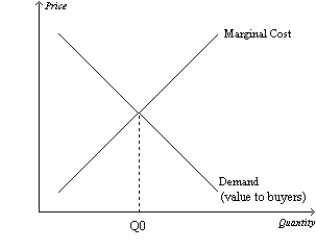 -Refer to Figure 15-14. If the monopoly operates at an output level less than Q0, then an increase in output toward (but not exceeding) Q0 would
 (Multiple Choice)
4.8/5 (85)
(85) What do economists call the business practice of selling the same good at difference prices to different customers?
(Multiple Choice)
4.9/5 (89)
(89) Figure 15-8 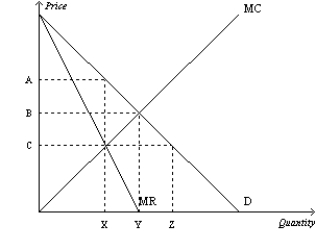 -Refer to Figure 15-8. What area represents the total surplus lost due to monopoly pricing?
 (Multiple Choice)
4.7/5 (88)
(88) Figure 15-17 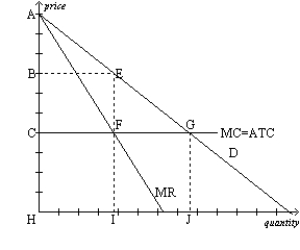 -Refer to Figure 15-17. Which of the following areas represents the consumer surplus from this profit-maximizing monopolist?
 (Multiple Choice)
4.9/5 (88)
(88) Table 15-6
A monopolist faces the following demand curve: 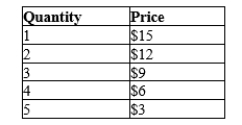 -Refer to Table 15-6. What is the marginal revenue from the sale of the 4th unit?
 (Multiple Choice)
4.9/5 (73)
(73) Figure 15-9 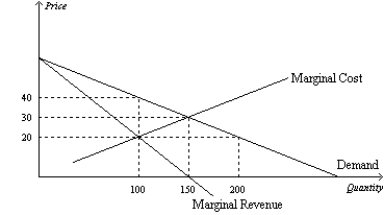 -Refer to Figure 15-9. To maximize total surplus, a benevolent social planner would choose which of the following outcomes?
 (Multiple Choice)
4.7/5 (85)
(85) Natural monopolies differ from other forms of monopoly because they are
(Multiple Choice)
4.8/5 (72)
(72) By offering lower prices to customers who buy a large quantity, a monopoly is price discriminating.
(True/False)
4.9/5 (74)
(74) 
Filters
- Essay(0)
- Multiple Choice(0)
- Short Answer(0)
- True False(0)
- Matching(0)