



 Chat with AI
Exam 15: Monopoly

Exam 1: Ten Principles of Economics455 Questions
Exam 2: Thinking Like an Economist643 Questions
Exam 3: Interdependence and the Gains From Trade547 Questions
Exam 4: The Market Forces of Supply and Demand693 Questions
Exam 5: Elasticity and Its Application626 Questions
Exam 6: Supply, Demand, and Government Policies668 Questions
Exam 7: Consumers, Producers, and the Efficiency of Markets547 Questions
Exam 8: Applications: the Costs of Taxation509 Questions
Exam 9: Application: International Trade521 Questions
Exam 10: Externalities543 Questions
Exam 11: Public Goods and Common Resources452 Questions
Exam 12: The Design of the Tax System664 Questions
Exam 13: The Costs of Production649 Questions
Exam 14: Firms in Competitive Markets604 Questions
Exam 15: Monopoly662 Questions
Exam 16: Monopolistic Competition649 Questions
Exam 17: Oligopoly522 Questions
Exam 18: The Markets for the Factors of Production592 Questions
Exam 19: Earnings and Discrimination511 Questions
Exam 20: Income Inequality and Poverty478 Questions
Exam 21: The Theory of Consumer Choice570 Questions
Exam 22: Frontiers in Microeconomics461 Questions
Exam 23: Measuring a Nation S Income547 Questions
Exam 24: Measuring the Cost of Living565 Questions
Exam 25: Production and Growth527 Questions
Exam 26: Saving, Investment, and the Financial System637 Questions
Exam 27: Tools of Finance534 Questions
Exam 28: Unemployment and Its Natural Rate701 Questions
Exam 29: The Monetary System540 Questions
Exam 30: Money Growth and Inflation504 Questions
Exam 31: Open-Economy Macroeconomics: Basic Concepts540 Questions
Exam 32: A Macroeconomic Theory of the Open Economy511 Questions
Exam 33: Aggregate Demand and Aggregate Supply572 Questions
Exam 34: The Influence of Monetary and Fiscal Policy on Aggregate Demand523 Questions
Exam 35: The Short-Run Tradeoff Between Inflation and Unemployment536 Questions
Exam 36: Six Debates Over Macroeconomic Policy354 Questions
Select questions type


Which of the following statements is (are) true of a monopoly?
(i)A monopoly has the ability to set the price of its product at whatever level it desires.
(ii)A monopoly's total revenue will always increase when it increases the price of its product.
(iii)The more a monopoly increases output, the higher the profits.
(Multiple Choice)
4.8/5  (84)
(84) Figure 15-18 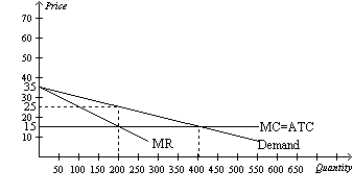 -Refer to Figure 15-18. If there are no fixed costs of production, monopoly profit with perfect price discrimination equals
 (Multiple Choice)
4.8/5 (77)
(77) Which of the following is not an example of price discrimination?
(Multiple Choice)
4.7/5 (78)
(78) Figure 15-4 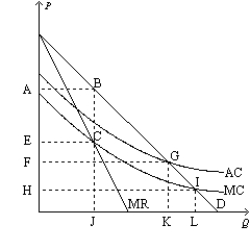 -Refer to Figure 15-4. If this firm profit maximizes, which letter represents the price it will charge?
 (Short Answer)
4.9/5 (76)
(76) Declining average total cost with increased production is one of the defining characteristics of a natural monopoly.
(True/False)
4.9/5 (80)
(80) Figure 15-17 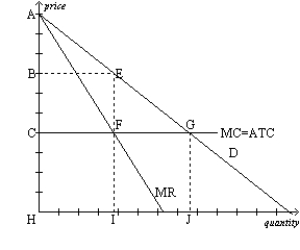 -Refer to Figure 15-17. Which of the following statements best describes the changes that would occur if this firm were to switch from operating as a single price profit-maximizing monopolist to perfect price discrimination?
 (Multiple Choice)
4.7/5 (93)
(93) Table 15-4
A monopolist faces the following demand curve: 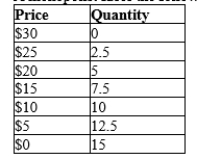 -Refer to Table 15-4. In order to maximize total revenues, the monopolist should produce
 (Multiple Choice)
4.9/5 (69)
(69) Scenario 15-10
Vincent operates a scenic tour business in Boston. He has one bus which can fit 50 people per tour and each tour lasts 2 hours. His total cost of operating one tour is fixed at $450. Vincent's cost is not reduced if he runs a tour with a partially full bus. While his cost is the same for all tours, Vincent charges each passenger his/her willingness to pay: adults $18 per trip, children $10 per trip, and senior citizens $12 per trip. At those rates, on a typical day Vincent's demand is:  Assume that Vincent's customers are always available for the tour; therefore, he can fill his bus for each tour as long as there is sufficient total demand for the day.
-Refer to Scenario 15-10. Vincent is considering changing his pricing strategy. Which of the following options results in the highest profit per day?
Assume that Vincent's customers are always available for the tour; therefore, he can fill his bus for each tour as long as there is sufficient total demand for the day.
-Refer to Scenario 15-10. Vincent is considering changing his pricing strategy. Which of the following options results in the highest profit per day? (Multiple Choice)
4.7/5 (79)
(79) Why might economists prefer private ownership of monopolies over public ownership of monopolies?
(Essay)
4.7/5 (89)
(89) Table 15-21
Tommy's Tie Company, a monopolist, has the following cost and revenue information. Assume that Tommy's is able to engage in perfect price discrimination. 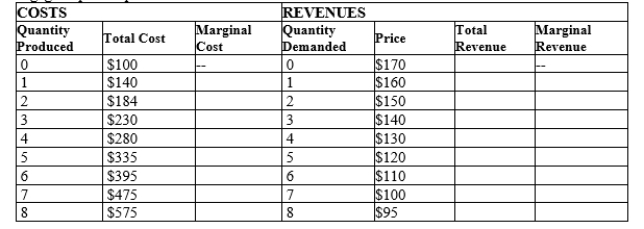 -Refer to Table 15-21. If the monopolist can engage in perfect price discrimination, what is the marginal revenue from selling the 8th tie?
 (Multiple Choice)
4.8/5 (70)
(70) Figure 15-3 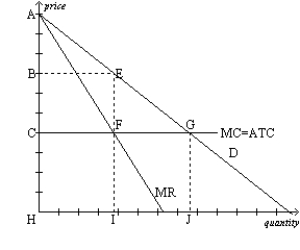 -Refer to Figure 15-3. Use the letters in the figure to identify the area of deadweight loss for the single price monopolist.
 (Short Answer)
4.7/5 (86)
(86) There has been much discussion of deregulating electricity and natural gas delivery companies in the United States. Discuss the likely effect of deregulation on prices in these two industries.
(Essay)
4.8/5 (74)
(74) The socially efficient level of production occurs where the marginal cost curve intersects
(Multiple Choice)
4.9/5 (82)
(82) Figure 15-9 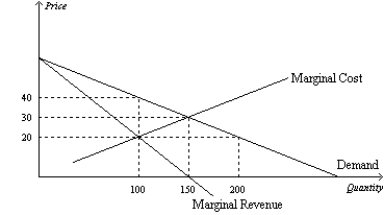 -Refer to Figure 15-9. The monopolist's maximum profit
 (Multiple Choice)
4.9/5 (80)
(80) To maximize total surplus with a monopoly firm, a benevolent social planner would choose the level of output where
(Multiple Choice)
4.8/5 (88)
(88) Table 15-18
A monopolist faces the following demand curve: 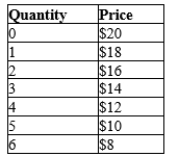 Suppose marginal cost is constant at $8 per unit.
-Refer to Table 15-18. The monopolist's marginal revenue is
Suppose marginal cost is constant at $8 per unit.
-Refer to Table 15-18. The monopolist's marginal revenue is (Multiple Choice)
4.9/5 (76)
(76) 
Filters
- Essay(0)
- Multiple Choice(0)
- Short Answer(0)
- True False(0)
- Matching(0)