



 Chat with AI
Exam 15: Monopoly

Exam 1: Ten Principles of Economics455 Questions
Exam 2: Thinking Like an Economist643 Questions
Exam 3: Interdependence and the Gains From Trade547 Questions
Exam 4: The Market Forces of Supply and Demand693 Questions
Exam 5: Elasticity and Its Application626 Questions
Exam 6: Supply, Demand, and Government Policies668 Questions
Exam 7: Consumers, Producers, and the Efficiency of Markets547 Questions
Exam 8: Applications: the Costs of Taxation509 Questions
Exam 9: Application: International Trade521 Questions
Exam 10: Externalities543 Questions
Exam 11: Public Goods and Common Resources452 Questions
Exam 12: The Design of the Tax System664 Questions
Exam 13: The Costs of Production649 Questions
Exam 14: Firms in Competitive Markets604 Questions
Exam 15: Monopoly662 Questions
Exam 16: Monopolistic Competition649 Questions
Exam 17: Oligopoly522 Questions
Exam 18: The Markets for the Factors of Production592 Questions
Exam 19: Earnings and Discrimination511 Questions
Exam 20: Income Inequality and Poverty478 Questions
Exam 21: The Theory of Consumer Choice570 Questions
Exam 22: Frontiers in Microeconomics461 Questions
Exam 23: Measuring a Nation S Income547 Questions
Exam 24: Measuring the Cost of Living565 Questions
Exam 25: Production and Growth527 Questions
Exam 26: Saving, Investment, and the Financial System637 Questions
Exam 27: Tools of Finance534 Questions
Exam 28: Unemployment and Its Natural Rate701 Questions
Exam 29: The Monetary System540 Questions
Exam 30: Money Growth and Inflation504 Questions
Exam 31: Open-Economy Macroeconomics: Basic Concepts540 Questions
Exam 32: A Macroeconomic Theory of the Open Economy511 Questions
Exam 33: Aggregate Demand and Aggregate Supply572 Questions
Exam 34: The Influence of Monetary and Fiscal Policy on Aggregate Demand523 Questions
Exam 35: The Short-Run Tradeoff Between Inflation and Unemployment536 Questions
Exam 36: Six Debates Over Macroeconomic Policy354 Questions
Select questions type


A monopoly chooses to supply the market with a quantity of a product that is determined by the intersection of the
(Multiple Choice)
5.0/5  (62)
(62) After the patent runs out on a brand name drug, generic drugs enter the market. What happens next in the market?
(Multiple Choice)
4.9/5 (86)
(86) The George Stigler quote, "...the degree of 'market failure' for the American economy is much smaller than the 'political failure' arising from the imperfections of economic policies ..." illustrates the advantage of which type of public policy toward monopolies?
(Multiple Choice)
4.8/5 (89)
(89) Which of the following statements is true?
(i)When a competitive firm sells an additional unit of output, its revenue increases by an amount less than the price.
(ii)When a monopoly firm sells an additional unit of output, its revenue increases by an amount less than the price.
(iii)Average revenue is the same as price for both competitive and monopoly firms.
(Multiple Choice)
4.8/5 (83)
(83) Which of the following strategies is not an effective strategy to reduce monopoly inefficiency?
(Multiple Choice)
4.9/5 (83)
(83) Economic welfare is generally measured by
(i)profit.
(ii)total surplus.
(iii)the price consumers pay for the product.
(Multiple Choice)
4.8/5 (79)
(79) Table 15-21
Tommy's Tie Company, a monopolist, has the following cost and revenue information. Assume that Tommy's is able to engage in perfect price discrimination. 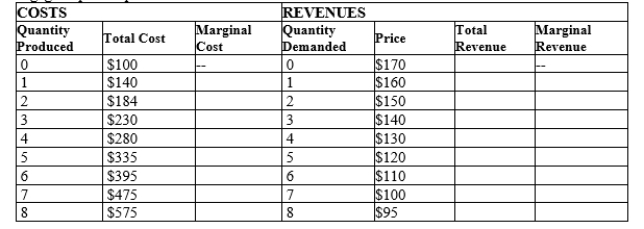 -Refer to Table 15-21. If the monopolist can engage in perfect price discrimination, what is the quantity that maximizes economic profit?
 (Multiple Choice)
4.9/5 (72)
(72) Antitrust laws give the Justice Department the authority to challenge potential mergers between companies in an effort to safeguard society from monopoly power.
(True/False)
4.8/5 (82)
(82) Scenario 15-9
Suppose executives at an art museum know that 100 adults are willing to pay $12 for admission to the museum on a weekday. Suppose the executives also know that 200 students are willing to pay $8 for admission on a weekday. The cost of operating the museum on a weekday is $2,000.
-Refer to Scenario 15-9. How much profit will the museum earn if it engages in price discrimination?
(Multiple Choice)
4.8/5 (76)
(76) Granting a pharmaceutical company a patent for a new medicine will lead to
(i)a product that is priced higher than it would be without the exclusive rights.
(ii)incentives for pharmaceutical companies to invest in research and development.
(iii)higher quantities of output than without the patent.
(Multiple Choice)
4.9/5 (84)
(84) Figure 15-1 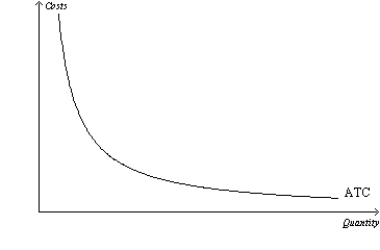 -Refer to Figure 15-1. Considering the relationship between average total cost and marginal cost, the marginal cost curve for this firm
 (Multiple Choice)
4.8/5 (60)
(60) Additional firms often do not try to compete with a natural monopoly because
(Multiple Choice)
4.9/5 (85)
(85) Scenario 15-6
The concert promoters of a heavy-metal band, WeR2Loud, know that there are two types of concert-goers: die-hard fans and casual fans. For a particular WeR2Loud concert, there are 1,000 die-hard fans who will pay $150 for a ticket and 500 casual fans who will pay $50 for a ticket. There are 1,500 seats available at the concert venue. Suppose the cost of putting on the concert is $50,000, which includes the cost of the band, lighting, security, etc.
-Refer to Scenario 15-6. How much additional profit can the concert promoters earn by charging each customer their willingness to pay relative to charging a flat price of $150 per ticket?
(Multiple Choice)
4.8/5 (86)
(86) If the ABC company owns the exclusive rights to mine land in Afghanistan for Lapis Lazuli, a rare stone used in jewelry which is found only in Afghanistan, the company benefits from a barrier to entry.
(True/False)
4.8/5 (83)
(83) Sizable economic profits can persist over time under monopoly if the monopolist
(Multiple Choice)
4.9/5 (74)
(74) During the life of a drug patent, the monopoly pharmaceutical firm maximizes profit by producing the quantity at which marginal revenue equals marginal cost.
(True/False)
4.9/5 (76)
(76) 
Filters
- Essay(0)
- Multiple Choice(0)
- Short Answer(0)
- True False(0)
- Matching(0)