



 Chat with AI
Exam 15: Monopoly

Exam 1: Ten Principles of Economics455 Questions
Exam 2: Thinking Like an Economist643 Questions
Exam 3: Interdependence and the Gains From Trade547 Questions
Exam 4: The Market Forces of Supply and Demand693 Questions
Exam 5: Elasticity and Its Application626 Questions
Exam 6: Supply, Demand, and Government Policies668 Questions
Exam 7: Consumers, Producers, and the Efficiency of Markets547 Questions
Exam 8: Applications: the Costs of Taxation509 Questions
Exam 9: Application: International Trade521 Questions
Exam 10: Externalities543 Questions
Exam 11: Public Goods and Common Resources452 Questions
Exam 12: The Design of the Tax System664 Questions
Exam 13: The Costs of Production649 Questions
Exam 14: Firms in Competitive Markets604 Questions
Exam 15: Monopoly662 Questions
Exam 16: Monopolistic Competition649 Questions
Exam 17: Oligopoly522 Questions
Exam 18: The Markets for the Factors of Production592 Questions
Exam 19: Earnings and Discrimination511 Questions
Exam 20: Income Inequality and Poverty478 Questions
Exam 21: The Theory of Consumer Choice570 Questions
Exam 22: Frontiers in Microeconomics461 Questions
Exam 23: Measuring a Nation S Income547 Questions
Exam 24: Measuring the Cost of Living565 Questions
Exam 25: Production and Growth527 Questions
Exam 26: Saving, Investment, and the Financial System637 Questions
Exam 27: Tools of Finance534 Questions
Exam 28: Unemployment and Its Natural Rate701 Questions
Exam 29: The Monetary System540 Questions
Exam 30: Money Growth and Inflation504 Questions
Exam 31: Open-Economy Macroeconomics: Basic Concepts540 Questions
Exam 32: A Macroeconomic Theory of the Open Economy511 Questions
Exam 33: Aggregate Demand and Aggregate Supply572 Questions
Exam 34: The Influence of Monetary and Fiscal Policy on Aggregate Demand523 Questions
Exam 35: The Short-Run Tradeoff Between Inflation and Unemployment536 Questions
Exam 36: Six Debates Over Macroeconomic Policy354 Questions
Select questions type


Figure 15-7 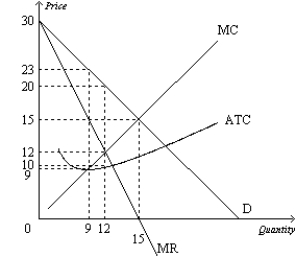 -Refer to Figure 15-7. In order to maximize profits, the monopolist should charge a price of
 (Multiple Choice)
4.7/5  (88)
(88) Figure 15-2 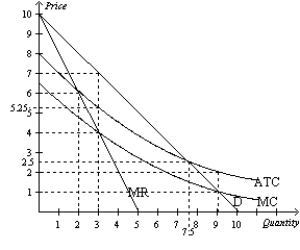 -Refer to Figure 15-2. What type of monopoly is shown in the figure?
 (Short Answer)
4.8/5 (70)
(70) Figure 15-19 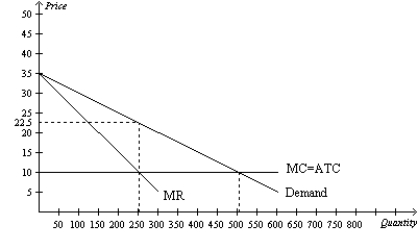 -Refer to Figure 15-19. If there are no fixed costs of production, monopoly profit without price discrimination equals
 (Multiple Choice)
4.9/5 (85)
(85) Average revenue for a monopoly is the total revenue divided by the quantity produced.
(True/False)
4.8/5 (69)
(69) What happens to the price and quantity sold of a drug when its patent runs out?
(i)The price will fall.
(ii)The quantity sold will fall.
(iii)The marginal cost of producing the drug will rise.
(Multiple Choice)
4.9/5 (84)
(84) If the government regulates the price that a natural monopolist can charge to be equal to the firm's average total cost, the firm will
(Multiple Choice)
4.8/5 (70)
(70) A monopolist's profit is equal to (Price - Marginal Cost) × Quantity.
(True/False)
4.9/5 (66)
(66) Figure 15-4 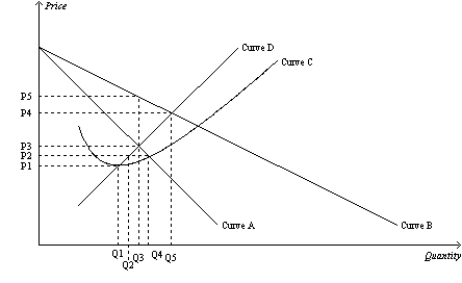 -Refer to Figure 15-4. Profit will be maximized by charging a price equal to
 (Multiple Choice)
4.8/5 (72)
(72) Scenario 15-4
Suppose a monopolist has a demand curve that can be expressed as P=90-Q. The monopolist's marginal revenue curve can be expressed as MR=90-2Q. The monopolist has constant marginal costs and average total costs of $10.
-Refer to Scenario 15-4. The profit-maximizing monopolist will earn profits of
(Multiple Choice)
4.9/5 (75)
(75) A monopoly creates a deadweight loss to society because it produces less output than the socially efficient level.
(True/False)
5.0/5 (94)
(94) Consider a profit-maximizing monopoly pricing under the following conditions. The profit-maximizing quantity is 40 units, the profit-maximizing price is $160, and the marginal cost of the 40th unit is $120. If the good were produced in a perfectly competitive market, the equilibrium quantity would be 50, and the equilibrium price would be $150. The demand curve and marginal cost curves are linear. What is the value of the deadweight loss created by the monopolist?
(Multiple Choice)
4.9/5 (66)
(66) Scenario 15-5
An airline knows that there are two types of travelers: business travelers and vacationers. For a particular flight, there are 100 business travelers who will pay $600 for a ticket while there are 50 vacationers who will pay $300 for a ticket. There are 150 seats available on the plane. Suppose the cost to the airline of providing the flight is $20,000, which includes the cost of the pilots, flight attendants, fuel, etc.
-Refer to Scenario 15-5. How much profit will the airline earn if it sets the price of each ticket at $300?
(Multiple Choice)
4.9/5 (80)
(80) A profit-maximizing monopolist charges a price of $14. The intersection of the marginal revenue curve and the marginal cost curve occurs where output is 15 units and marginal cost is $7. What is the monopolist's profit?
(Multiple Choice)
4.7/5 (85)
(85) Figure 15-4 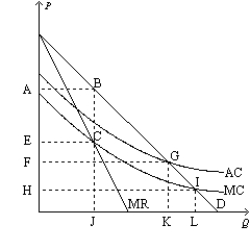 -Refer to Figure 15-4. If a regulator requires this firm to charge a socially optimal price, how much deadweight loss results?
 (Short Answer)
4.9/5 (68)
(68) 
Filters
- Essay(0)
- Multiple Choice(0)
- Short Answer(0)
- True False(0)
- Matching(0)