



 Chat with AI
Exam 15: Monopoly

Exam 1: Ten Principles of Economics455 Questions
Exam 2: Thinking Like an Economist643 Questions
Exam 3: Interdependence and the Gains From Trade547 Questions
Exam 4: The Market Forces of Supply and Demand693 Questions
Exam 5: Elasticity and Its Application626 Questions
Exam 6: Supply, Demand, and Government Policies668 Questions
Exam 7: Consumers, Producers, and the Efficiency of Markets547 Questions
Exam 8: Applications: the Costs of Taxation509 Questions
Exam 9: Application: International Trade521 Questions
Exam 10: Externalities543 Questions
Exam 11: Public Goods and Common Resources452 Questions
Exam 12: The Design of the Tax System664 Questions
Exam 13: The Costs of Production649 Questions
Exam 14: Firms in Competitive Markets604 Questions
Exam 15: Monopoly662 Questions
Exam 16: Monopolistic Competition649 Questions
Exam 17: Oligopoly522 Questions
Exam 18: The Markets for the Factors of Production592 Questions
Exam 19: Earnings and Discrimination511 Questions
Exam 20: Income Inequality and Poverty478 Questions
Exam 21: The Theory of Consumer Choice570 Questions
Exam 22: Frontiers in Microeconomics461 Questions
Exam 23: Measuring a Nation S Income547 Questions
Exam 24: Measuring the Cost of Living565 Questions
Exam 25: Production and Growth527 Questions
Exam 26: Saving, Investment, and the Financial System637 Questions
Exam 27: Tools of Finance534 Questions
Exam 28: Unemployment and Its Natural Rate701 Questions
Exam 29: The Monetary System540 Questions
Exam 30: Money Growth and Inflation504 Questions
Exam 31: Open-Economy Macroeconomics: Basic Concepts540 Questions
Exam 32: A Macroeconomic Theory of the Open Economy511 Questions
Exam 33: Aggregate Demand and Aggregate Supply572 Questions
Exam 34: The Influence of Monetary and Fiscal Policy on Aggregate Demand523 Questions
Exam 35: The Short-Run Tradeoff Between Inflation and Unemployment536 Questions
Exam 36: Six Debates Over Macroeconomic Policy354 Questions
Select questions type


For a monopoly market, total surplus can be defined as the value of the good to
(Multiple Choice)
4.8/5  (67)
(67) Figure 15-22
The diagram depicts the market situation for a monopoly pastry shop called Bearclaws. 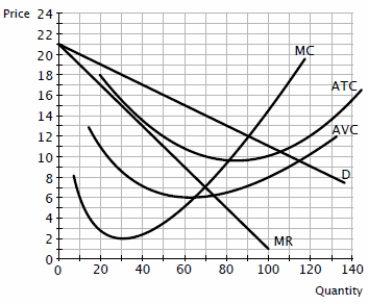 -Refer to Figure 15-22. Based upon the information shown, what price will Bearclaws charge to maximize profits?
 (Multiple Choice)
4.9/5 (69)
(69) Suppose a profit-maximizing monopolist faces a constant marginal cost of $10, produces an output level of 100 units, and charges a price of $50. The socially efficient level of output is 200 units. Assume that the demand curve and marginal revenue curve are the typical downward-sloping straight lines. The monopoly deadweight loss equals $2,000.
(True/False)
4.8/5 (80)
(80) Even with market power, monopolists cannot achieve any level of profit they desire because they will sell lower quantities at higher prices.
(True/False)
4.8/5 (87)
(87) "Monopolists do not worry about efficient production and minimizing costs since they can just pass along any increase in costs to their consumers." This statement is
(Multiple Choice)
4.8/5 (73)
(73) Table 15-4
A monopolist faces the following demand curve: 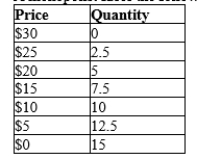 -Refer to Table 15-4. In order to maximize profits, the monopolist should produce
 (Multiple Choice)
4.9/5 (94)
(94) Table 15-16
A monopolist faces the following demand curve: 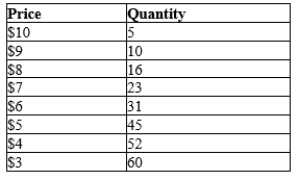 -Refer to Table 15-16. The monopolist has total fixed costs of $40 and a constant marginal cost of $5. At the profit-maximizing level of output, the monopolist's average total cost is
 (Multiple Choice)
4.8/5 (91)
(91) Table 15-19
A monopolist faces the following demand curve: 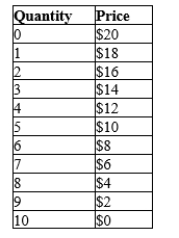 -Refer to Table 15-19. If a monopolist faces a constant marginal cost of $7, how much output should the firm produce?
 (Multiple Choice)
5.0/5 (84)
(84) Scenario 15-1
Vincent operates a scenic tour business in Boston. He has one bus which can fit 50 people per tour and each tour lasts 2 hours. His total cost of operating one tour is fixed at $450. Vincent's cost is not reduced if he runs a tour with a partially full bus. While his cost is the same for all tours, Vincent charges each passenger his/her willingness to pay: adults $18 per trip, children $10 per trip, and senior citizens $12 per trip. At those rates, on a typical day Vincent's demand is:
Passenger Type
Willingness to Pay
Demand per day
Adults
$18
70
Children
$10
25
Senior Citizens
$12
55
Assume that Vincent's customers are always available for the tour; therefore, he can fill his bus for each tour as long as there is sufficient total demand for the day.
-Refer to Scenario 15-1. One of Vincent's friends tells him he would be more profitable if he charged a single price of $12. Assuming no changes in consumer demand, what would Vincent's profit be if he charged every customer $12?
(Short Answer)
4.9/5 (78)
(78) Microsoft's government-granted exclusive right to make and sell the Windows operating system is called a
(Short Answer)
4.9/5 (84)
(84) Compared to the monopoly outcome with a single price, imperfect price discrimination
(i)sometimes raises total surplus.
(ii)sometimes lowers total surplus.
(iii)always leads to a lower quantity of output.
(Multiple Choice)
4.9/5 (86)
(86) Table 15-7
Sally owns the only shoe store in town. She has the following cost and revenue information. 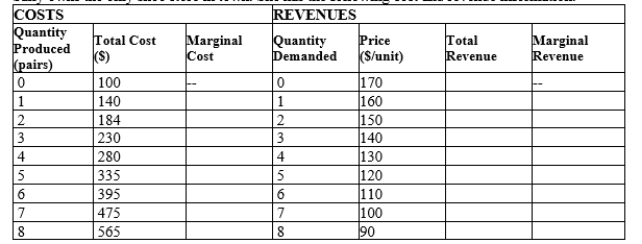 -Refer to Table 15-7. What is the marginal revenue from selling the 8th pair of shoes?
 (Multiple Choice)
4.9/5 (87)
(87) If government regulation sets the maximum price for a natural monopoly equal to its marginal cost, then the natural monopolist will
(Multiple Choice)
4.8/5 (76)
(76) Government intervention always reduces monopoly deadweight loss.
(True/False)
4.8/5 (90)
(90) Table 15-12
The following table provides information on the price, quantity, and average total cost for a monopoly. 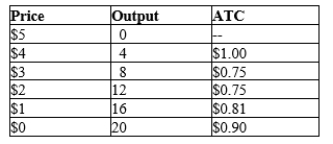 -Refer to Table 15-12. If the firm produces the profit-maximizing level of output, it will earn profits of
 (Multiple Choice)
4.7/5 (92)
(92) 
Filters
- Essay(0)
- Multiple Choice(0)
- Short Answer(0)
- True False(0)
- Matching(0)