



 Chat with AI
Exam 15: Monopoly

Exam 1: Ten Principles of Economics455 Questions
Exam 2: Thinking Like an Economist643 Questions
Exam 3: Interdependence and the Gains From Trade547 Questions
Exam 4: The Market Forces of Supply and Demand693 Questions
Exam 5: Elasticity and Its Application626 Questions
Exam 6: Supply, Demand, and Government Policies668 Questions
Exam 7: Consumers, Producers, and the Efficiency of Markets547 Questions
Exam 8: Applications: the Costs of Taxation509 Questions
Exam 9: Application: International Trade521 Questions
Exam 10: Externalities543 Questions
Exam 11: Public Goods and Common Resources452 Questions
Exam 12: The Design of the Tax System664 Questions
Exam 13: The Costs of Production649 Questions
Exam 14: Firms in Competitive Markets604 Questions
Exam 15: Monopoly662 Questions
Exam 16: Monopolistic Competition649 Questions
Exam 17: Oligopoly522 Questions
Exam 18: The Markets for the Factors of Production592 Questions
Exam 19: Earnings and Discrimination511 Questions
Exam 20: Income Inequality and Poverty478 Questions
Exam 21: The Theory of Consumer Choice570 Questions
Exam 22: Frontiers in Microeconomics461 Questions
Exam 23: Measuring a Nation S Income547 Questions
Exam 24: Measuring the Cost of Living565 Questions
Exam 25: Production and Growth527 Questions
Exam 26: Saving, Investment, and the Financial System637 Questions
Exam 27: Tools of Finance534 Questions
Exam 28: Unemployment and Its Natural Rate701 Questions
Exam 29: The Monetary System540 Questions
Exam 30: Money Growth and Inflation504 Questions
Exam 31: Open-Economy Macroeconomics: Basic Concepts540 Questions
Exam 32: A Macroeconomic Theory of the Open Economy511 Questions
Exam 33: Aggregate Demand and Aggregate Supply572 Questions
Exam 34: The Influence of Monetary and Fiscal Policy on Aggregate Demand523 Questions
Exam 35: The Short-Run Tradeoff Between Inflation and Unemployment536 Questions
Exam 36: Six Debates Over Macroeconomic Policy354 Questions
Select questions type


Table 15-18
A monopolist faces the following demand curve: 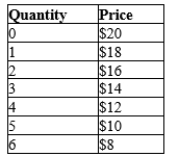 Suppose marginal cost is constant at $8 per unit.
-Refer to Table 15-18. The monopolist's marginal revenue from selling the second unit of output is
Suppose marginal cost is constant at $8 per unit.
-Refer to Table 15-18. The monopolist's marginal revenue from selling the second unit of output is (Multiple Choice)
4.8/5  (83)
(83) Scenario 15-8
Mega Media Cable TV is able to purchase an exclusive right to sell a premium sports channel in its market area. Let's assume that Mega Media pays $100,000 a year for the exclusive marketing rights to the sports channel. Since Mega Media has already installed cable to all of the homes in its market area, the marginal cost of delivering the sports channel to subscribers is zero. The manager of Mega Media needs to know what price to charge for the sports channel service to maximize her profit. Before setting price, she hires an economist to estimate demand for the sports channel. The economist discovers that there are two types of subscribers who value premium sporting channels. First are the 3,000 die-hard sports fans who will pay as much as $150 a year for the new channel. Second, the premium sports channel will appeal to 20,000 occasional sports viewers who will pay as much as $25 a year for a subscription to it.
-Refer to Scenario 15-8. How much profit will Mega Media Cable TV earn if it sets the price at $25?
(Multiple Choice)
4.8/5 (87)
(87) Figure 15-3 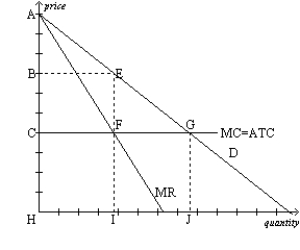 -Refer to Figure 15-3. Which letter represents the profit-maximizing quantity chosen by the single price monopolist?
 (Short Answer)
4.8/5 (82)
(82) When a single firm can supply a good or service to an entire market at a lower cost than could two or more firms, the industry is known as a
(Short Answer)
4.8/5 (73)
(73) The supply curve for a monopolist, in the short run, is defined in the same way as that for a competitive firm: it is the portion of the marginal cost curve above average variable cost.
(True/False)
4.9/5 (73)
(73) Table 15-19
A monopolist faces the following demand curve: 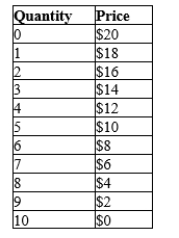 -Refer to Table 15-19. If a monopolist faces a constant marginal cost of $9, how much output should the firm produce?
 (Multiple Choice)
5.0/5 (66)
(66) Scenario 15-4
Suppose a monopolist has a demand curve that can be expressed as P=90-Q. The monopolist's marginal revenue curve can be expressed as MR=90-2Q. The monopolist has constant marginal costs and average total costs of $10.
-Refer to Scenario 15-4. The profit-maximizing monopolist will produce an output level of
(Multiple Choice)
4.8/5 (75)
(75) Due to the nature of the patent laws on pharmaceuticals, the market for such drugs
(Multiple Choice)
4.9/5 (76)
(76) The three main sources of barriers to entry are monopoly resources, government regulation, and the firm's production process.
(True/False)
4.9/5 (84)
(84) One characteristic of a monopoly market is that the product is virtually identical to products produced by competing firms.
(True/False)
4.8/5 (76)
(76) Monopolies are socially inefficient because the price they charge is
(Multiple Choice)
4.8/5 (72)
(72) Comparing firms in perfectly competitive markets to monopoly firms, which results in a deadweight loss?
(Short Answer)
4.9/5 (79)
(79) Like competitive firms, monopolies choose to produce a quantity in which marginal revenue equals marginal cost.
(True/False)
4.8/5 (89)
(89) The socially efficient quantity is found where the demand curve intersects the marginal cost curve.
(True/False)
4.9/5 (65)
(65) Which of the following would be most likely to have monopoly power?
(Multiple Choice)
4.7/5 (80)
(80) The output effect describes the situation when a monopolist sells more output and, all else equal, total revenue
(Multiple Choice)
4.9/5 (61)
(61) 
Filters
- Essay(0)
- Multiple Choice(0)
- Short Answer(0)
- True False(0)
- Matching(0)