



 Chat with AI
Exam 15: Monopoly

Exam 1: Ten Principles of Economics455 Questions
Exam 2: Thinking Like an Economist643 Questions
Exam 3: Interdependence and the Gains From Trade547 Questions
Exam 4: The Market Forces of Supply and Demand693 Questions
Exam 5: Elasticity and Its Application626 Questions
Exam 6: Supply, Demand, and Government Policies668 Questions
Exam 7: Consumers, Producers, and the Efficiency of Markets547 Questions
Exam 8: Applications: the Costs of Taxation509 Questions
Exam 9: Application: International Trade521 Questions
Exam 10: Externalities543 Questions
Exam 11: Public Goods and Common Resources452 Questions
Exam 12: The Design of the Tax System664 Questions
Exam 13: The Costs of Production649 Questions
Exam 14: Firms in Competitive Markets604 Questions
Exam 15: Monopoly662 Questions
Exam 16: Monopolistic Competition649 Questions
Exam 17: Oligopoly522 Questions
Exam 18: The Markets for the Factors of Production592 Questions
Exam 19: Earnings and Discrimination511 Questions
Exam 20: Income Inequality and Poverty478 Questions
Exam 21: The Theory of Consumer Choice570 Questions
Exam 22: Frontiers in Microeconomics461 Questions
Exam 23: Measuring a Nation S Income547 Questions
Exam 24: Measuring the Cost of Living565 Questions
Exam 25: Production and Growth527 Questions
Exam 26: Saving, Investment, and the Financial System637 Questions
Exam 27: Tools of Finance534 Questions
Exam 28: Unemployment and Its Natural Rate701 Questions
Exam 29: The Monetary System540 Questions
Exam 30: Money Growth and Inflation504 Questions
Exam 31: Open-Economy Macroeconomics: Basic Concepts540 Questions
Exam 32: A Macroeconomic Theory of the Open Economy511 Questions
Exam 33: Aggregate Demand and Aggregate Supply572 Questions
Exam 34: The Influence of Monetary and Fiscal Policy on Aggregate Demand523 Questions
Exam 35: The Short-Run Tradeoff Between Inflation and Unemployment536 Questions
Exam 36: Six Debates Over Macroeconomic Policy354 Questions
Select questions type


When we compare economic welfare in a monopoly market to a competitive market, the profits earned by the monopolist represent
(Multiple Choice)
4.8/5  (72)
(72) A market force that can prevent firms from price discriminating is
(Multiple Choice)
4.9/5 (70)
(70) Assume that a monopolist decides to maximize revenue rather than profit. How does this operating objective change the size of the deadweight loss? If you are a "benevolent" manager of a monopoly firm and are interested in reducing the deadweight loss of monopoly, should you maximize profits or maximize revenue? Explain your answer.
(Essay)
4.7/5 (73)
(73) Figure 15-9 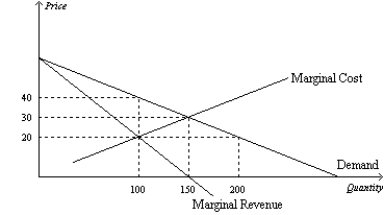 -Refer to Figure 15-9. The deadweight loss caused by a profit-maximizing monopoly amounts to
 (Multiple Choice)
4.8/5 (80)
(80) A monopolist can sell 300 units of output for $45 per unit. Alternatively, it can sell 301 units of output for $44.60 per unit. The marginal revenue of the 301st unit of output is
(Multiple Choice)
4.9/5 (79)
(79) Figure 15-1 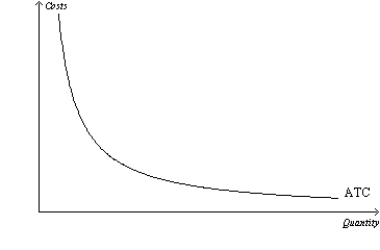 -Refer to Figure 15-1. Considering the relationship between average total cost and marginal cost, the marginal cost curve for this firm must
 (Multiple Choice)
4.8/5 (94)
(94) Which of the following is an example of public ownership of a monopoly?
(Multiple Choice)
4.8/5 (81)
(81) Reduced competition through merging of companies will raise social welfare
(Multiple Choice)
4.9/5 (76)
(76) If a monopolist can practice perfect price discrimination, the monopolist will
(Multiple Choice)
4.8/5 (90)
(90) For a monopoly, marginal revenue is often greater than the price it charges for its good.
(True/False)
5.0/5 (64)
(64) Figure 15-4 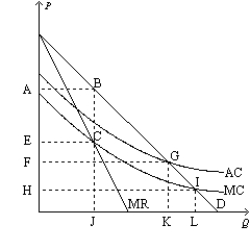 -Refer to Figure 15-4. If a regulator requires this firm to charge a fair return price, which letter represents the amount of output it will produce?
 (Short Answer)
4.8/5 (78)
(78) In many countries, the government chooses to "internalize" the monopoly by owning monopoly providers of goods and services. (In some cases these firms are "nationalized," and the government actually buys or confiscates firms that operate in monopoly markets). What would be the advantages and disadvantages of such an approach to ensure that the "best interest of society" is promoted in these markets? Explain your answer.
(Essay)
4.8/5 (76)
(76) Figure 15-22
The diagram depicts the market situation for a monopoly pastry shop called Bearclaws. 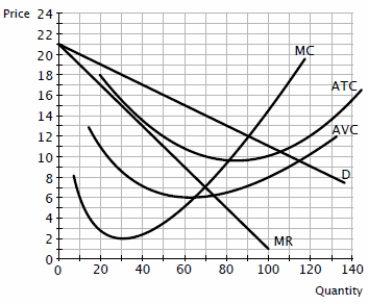 -Refer to Figure 15-22. Based upon the information shown, how many units will Bearclaws produce to maximize profits?
 (Multiple Choice)
4.9/5 (70)
(70) The government may choose to do nothing to reduce monopoly inefficiency because the "fix" may be worse than the problem.
(True/False)
4.8/5 (77)
(77) Table 15-8
The following table provides information on the price, quantity, and average total cost for a monopoly. 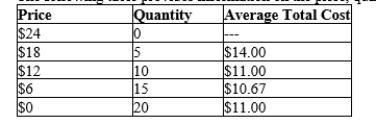 -Refer to Table 15-8. What is the additional cost to the firm when the monopolist lowers the price from $18 to $12?
 (Multiple Choice)
4.7/5 (83)
(83) 
Filters
- Essay(0)
- Multiple Choice(0)
- Short Answer(0)
- True False(0)
- Matching(0)