



 Chat with AI
Exam 15: Monopoly

Exam 1: Ten Principles of Economics455 Questions
Exam 2: Thinking Like an Economist643 Questions
Exam 3: Interdependence and the Gains From Trade547 Questions
Exam 4: The Market Forces of Supply and Demand693 Questions
Exam 5: Elasticity and Its Application626 Questions
Exam 6: Supply, Demand, and Government Policies668 Questions
Exam 7: Consumers, Producers, and the Efficiency of Markets547 Questions
Exam 8: Applications: the Costs of Taxation509 Questions
Exam 9: Application: International Trade521 Questions
Exam 10: Externalities543 Questions
Exam 11: Public Goods and Common Resources452 Questions
Exam 12: The Design of the Tax System664 Questions
Exam 13: The Costs of Production649 Questions
Exam 14: Firms in Competitive Markets604 Questions
Exam 15: Monopoly662 Questions
Exam 16: Monopolistic Competition649 Questions
Exam 17: Oligopoly522 Questions
Exam 18: The Markets for the Factors of Production592 Questions
Exam 19: Earnings and Discrimination511 Questions
Exam 20: Income Inequality and Poverty478 Questions
Exam 21: The Theory of Consumer Choice570 Questions
Exam 22: Frontiers in Microeconomics461 Questions
Exam 23: Measuring a Nation S Income547 Questions
Exam 24: Measuring the Cost of Living565 Questions
Exam 25: Production and Growth527 Questions
Exam 26: Saving, Investment, and the Financial System637 Questions
Exam 27: Tools of Finance534 Questions
Exam 28: Unemployment and Its Natural Rate701 Questions
Exam 29: The Monetary System540 Questions
Exam 30: Money Growth and Inflation504 Questions
Exam 31: Open-Economy Macroeconomics: Basic Concepts540 Questions
Exam 32: A Macroeconomic Theory of the Open Economy511 Questions
Exam 33: Aggregate Demand and Aggregate Supply572 Questions
Exam 34: The Influence of Monetary and Fiscal Policy on Aggregate Demand523 Questions
Exam 35: The Short-Run Tradeoff Between Inflation and Unemployment536 Questions
Exam 36: Six Debates Over Macroeconomic Policy354 Questions
Select questions type


Authors are allowed to be monopolists in the sale of their books in order to
(Multiple Choice)
4.9/5  (79)
(79) The assessment by George Stigler concerning the tradeoffs between "market failure" and "political failure" in the American economy provides support for which of the following solutions to the problems of monopolies?
(Multiple Choice)
5.0/5 (91)
(91) The profit that a monopolist earns represents a loss to society that is measured through deadweight loss.
(True/False)
4.8/5 (94)
(94) The deadweight loss associated with a monopoly occurs because the monopolist
(Multiple Choice)
4.8/5 (88)
(88) A profit-maximizing monopolist will produce the level of output at which
(Multiple Choice)
4.9/5 (59)
(59) A monopolist is able to choose whatever price that it wishes and is only constrained by its greed.
(True/False)
4.8/5 (64)
(64) It is difficult in a natural monopoly market for the firm to achieve both efficiency and zero economic profit simultaneously, even with regulation.
(True/False)
4.9/5 (89)
(89) Monopolists can achieve any level of profit they desire because they have unlimited market power.
(True/False)
5.0/5 (82)
(82) Figure 15-1 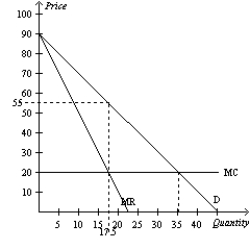 -Refer to Figure 15-1. If the monopolist uses perfect price discrimination, what price will it charge?
 (Essay)
5.0/5 (81)
(81) An industry is a natural monopoly when
(i)the government assists the firm in maintaining the monopoly.
(ii)a single firm owns a key resource.
(iii)a single firm can supply a good or service to an entire market at a smaller cost than could two or more firms.
(Multiple Choice)
4.8/5 (92)
(92) When a single firm can supply a product to an entire market at a lower cost than could two or more firms, the industry is called a
(Multiple Choice)
4.8/5 (65)
(65) Figure 15-9 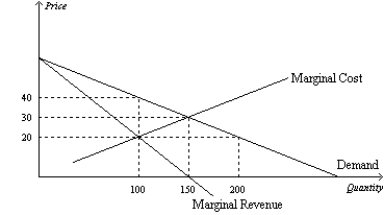 -Refer to Figure 15-9. To maximize its profit, a monopolist would choose which of the following outcomes?
 (Multiple Choice)
4.9/5 (77)
(77) Which of the following would be most likely to have monopoly power?
(Multiple Choice)
4.8/5 (82)
(82) If a profit-maximizing monopolist faces a downward-sloping market demand curve, its
(Multiple Choice)
4.9/5 (74)
(74) Scenario 15-1
Vincent operates a scenic tour business in Boston. He has one bus which can fit 50 people per tour and each tour lasts 2 hours. His total cost of operating one tour is fixed at $450. Vincent's cost is not reduced if he runs a tour with a partially full bus. While his cost is the same for all tours, Vincent charges each passenger his/her willingness to pay: adults $18 per trip, children $10 per trip, and senior citizens $12 per trip. At those rates, on a typical day Vincent's demand is:
Passenger Type
Willingness to Pay
Demand per day
Adults
$18
70
Children
$10
25
Senior Citizens
$12
55
Assume that Vincent's customers are always available for the tour; therefore, he can fill his bus for each tour as long as there is sufficient total demand for the day.
-Refer to Scenario 15-1. Vincent uses a pricing practice called
(Short Answer)
4.8/5 (89)
(89) As long as as a monopolist is able to control the resale of its product, then it can successfully practice price discrimination.
(True/False)
4.7/5 (77)
(77) Scenario 15-1
Consider a transportation corporation named Reading's that has just completed the development of a new light rail system in Minneapolis. Currently, there are plenty of seats on the train, and it is never crowded. Its capacity far exceeds the needs of the city. After just a few years of operation, the shareholders of Reading's experienced incredibly high rates of return on their investment due to the profitability of the corporation.
-Refer to Scenario 15-1. Which of the following statements is most likely to be true?
(i)New entrants to the market know they will have a smaller market share than Reading's currently has.
(ii)Reading's is most likely experiencing decreasing average total cost.
(iii)Reading's is a natural monopoly.
(Multiple Choice)
4.9/5 (79)
(79) If government officials break up a natural monopoly into four smaller firms, then
(Multiple Choice)
4.8/5 (73)
(73) 
Filters
- Essay(0)
- Multiple Choice(0)
- Short Answer(0)
- True False(0)
- Matching(0)