



 Chat with AI
Exam 15: Monopoly

Exam 1: Ten Principles of Economics455 Questions
Exam 2: Thinking Like an Economist643 Questions
Exam 3: Interdependence and the Gains From Trade547 Questions
Exam 4: The Market Forces of Supply and Demand693 Questions
Exam 5: Elasticity and Its Application626 Questions
Exam 6: Supply, Demand, and Government Policies668 Questions
Exam 7: Consumers, Producers, and the Efficiency of Markets547 Questions
Exam 8: Applications: the Costs of Taxation509 Questions
Exam 9: Application: International Trade521 Questions
Exam 10: Externalities543 Questions
Exam 11: Public Goods and Common Resources452 Questions
Exam 12: The Design of the Tax System664 Questions
Exam 13: The Costs of Production649 Questions
Exam 14: Firms in Competitive Markets604 Questions
Exam 15: Monopoly662 Questions
Exam 16: Monopolistic Competition649 Questions
Exam 17: Oligopoly522 Questions
Exam 18: The Markets for the Factors of Production592 Questions
Exam 19: Earnings and Discrimination511 Questions
Exam 20: Income Inequality and Poverty478 Questions
Exam 21: The Theory of Consumer Choice570 Questions
Exam 22: Frontiers in Microeconomics461 Questions
Exam 23: Measuring a Nation S Income547 Questions
Exam 24: Measuring the Cost of Living565 Questions
Exam 25: Production and Growth527 Questions
Exam 26: Saving, Investment, and the Financial System637 Questions
Exam 27: Tools of Finance534 Questions
Exam 28: Unemployment and Its Natural Rate701 Questions
Exam 29: The Monetary System540 Questions
Exam 30: Money Growth and Inflation504 Questions
Exam 31: Open-Economy Macroeconomics: Basic Concepts540 Questions
Exam 32: A Macroeconomic Theory of the Open Economy511 Questions
Exam 33: Aggregate Demand and Aggregate Supply572 Questions
Exam 34: The Influence of Monetary and Fiscal Policy on Aggregate Demand523 Questions
Exam 35: The Short-Run Tradeoff Between Inflation and Unemployment536 Questions
Exam 36: Six Debates Over Macroeconomic Policy354 Questions
Select questions type


Scenario 15-1
Consider a transportation corporation named Reading's that has just completed the development of a new light rail system in Minneapolis. Currently, there are plenty of seats on the train, and it is never crowded. Its capacity far exceeds the needs of the city. After just a few years of operation, the shareholders of Reading's experienced incredibly high rates of return on their investment due to the profitability of the corporation.
-Refer to Scenario 15-1. Which of the following statements is most likely to be true?
(i)New entrants to the market know they will have a smaller market share than Reading's currently has.
(ii)Reading's is a natural monopoly.
(iii)Reading's is most likely experiencing increasing average total cost.
(Multiple Choice)
4.9/5  (86)
(86) Some prescription drugs sell for more in the United States than they do in other countries. Which of the following statements about this issue is most likely to be true?
(Multiple Choice)
4.9/5 (75)
(75) Government intervention is always preferable to doing nothing when reducing the social inefficiencies of monopoly.
(True/False)
4.8/5 (83)
(83) When the government creates a monopoly, the social loss may include
(Multiple Choice)
4.8/5 (79)
(79) Figure 15-17 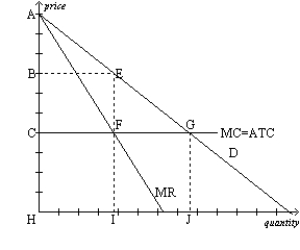 -Refer to Figure 15-17. Which of the following areas represents the deadweight loss from this profit-maximizing monopolist?
 (Multiple Choice)
4.9/5 (65)
(65) When a monopolist is able to sell its product at different prices, it is engaging in
(Multiple Choice)
4.7/5 (80)
(80) Figure 15-19 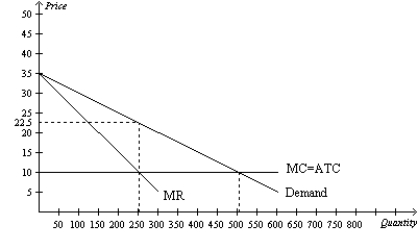 -Refer to Figure 15-19. If the monopoly firm perfectly price discriminates, then the deadweight loss amounts to
 (Multiple Choice)
4.9/5 (78)
(78) When a monopolist chooses the output that maximizes profits, we know that MR = MC and also that P > MR. This is inefficient because
(Multiple Choice)
4.9/5 (72)
(72) Table 15-18
A monopolist faces the following demand curve: 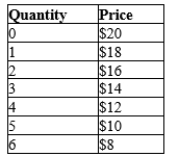 Suppose marginal cost is constant at $8 per unit.
-Refer to Table 15-18 The monopolist's profit-maximizing level of output is
Suppose marginal cost is constant at $8 per unit.
-Refer to Table 15-18 The monopolist's profit-maximizing level of output is (Multiple Choice)
4.7/5 (75)
(75) During the holiday season, high-end retailers frequently place a high price on merchandise on weekends and discount the price during the week. They do this because they believe that two groups of customers exist: shoppers with little free time and bargain hunters. Bargain hunters have time to shop around and frequently shop during the week. What do economists call this price strategy used by high-end retailers?
(Multiple Choice)
4.8/5 (91)
(91) Figure 15-18 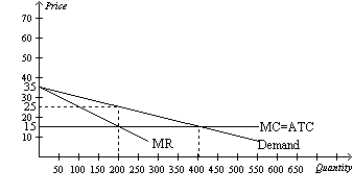 -Refer to Figure 15-18. If there are no fixed costs of production, monopoly profit without price discrimination equals
 (Multiple Choice)
4.8/5 (76)
(76) Because natural monopolies have a declining average cost curve, regulating natural monopolies by setting price equal to marginal cost would
(Multiple Choice)
4.9/5 (78)
(78) Which of the following is not a characteristic of a monopoly?
(Multiple Choice)
4.9/5 (89)
(89) A monopolist that can practice perfect price discrimination will not impose a deadweight loss on society.
(True/False)
4.9/5 (85)
(85) For a monopolist, when does marginal revenue exceed average revenue?
(Multiple Choice)
4.8/5 (89)
(89) Selling a good at a price determined by the intersection of the demand curve and the marginal cost curve is consistent with the
(i)socially-optimal level of output.
(ii)market solution for profit-maximizing competitive firms.
(iii)market solution for a profit-maximizing monopoly.
(Multiple Choice)
4.9/5 (81)
(81) Scenario 15-5
An airline knows that there are two types of travelers: business travelers and vacationers. For a particular flight, there are 100 business travelers who will pay $600 for a ticket while there are 50 vacationers who will pay $300 for a ticket. There are 150 seats available on the plane. Suppose the cost to the airline of providing the flight is $20,000, which includes the cost of the pilots, flight attendants, fuel, etc.
-Refer to Scenario 15-5. How much additional profit can the airline earn by charging each customer their willingness to pay relative to charging a flat price of $300 per ticket?
(Multiple Choice)
4.9/5 (84)
(84) Table 15-2
Tanya has the following demand curve for selling taffy. Assume that Tanya has a marginal cost of $3 per unit. 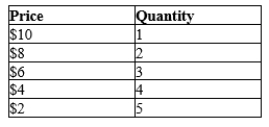 -Refer to Table 15-2. What is Tanya's profit-maximizing price?
 (Multiple Choice)
4.9/5 (79)
(79) Table 15-17
A monopolist faces the following demand curve: 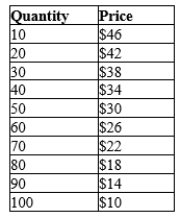 -Refer to Table 15-17. If the marginal cost of production is constant at $18 per unit, this profit-maximizing monopolist will choose to produce
 (Multiple Choice)
4.7/5 (79)
(79) 
Filters
- Essay(0)
- Multiple Choice(0)
- Short Answer(0)
- True False(0)
- Matching(0)