



 Chat with AI
Exam 15: Monopoly

Exam 1: Ten Principles of Economics455 Questions
Exam 2: Thinking Like an Economist643 Questions
Exam 3: Interdependence and the Gains From Trade547 Questions
Exam 4: The Market Forces of Supply and Demand693 Questions
Exam 5: Elasticity and Its Application626 Questions
Exam 6: Supply, Demand, and Government Policies668 Questions
Exam 7: Consumers, Producers, and the Efficiency of Markets547 Questions
Exam 8: Applications: the Costs of Taxation509 Questions
Exam 9: Application: International Trade521 Questions
Exam 10: Externalities543 Questions
Exam 11: Public Goods and Common Resources452 Questions
Exam 12: The Design of the Tax System664 Questions
Exam 13: The Costs of Production649 Questions
Exam 14: Firms in Competitive Markets604 Questions
Exam 15: Monopoly662 Questions
Exam 16: Monopolistic Competition649 Questions
Exam 17: Oligopoly522 Questions
Exam 18: The Markets for the Factors of Production592 Questions
Exam 19: Earnings and Discrimination511 Questions
Exam 20: Income Inequality and Poverty478 Questions
Exam 21: The Theory of Consumer Choice570 Questions
Exam 22: Frontiers in Microeconomics461 Questions
Exam 23: Measuring a Nation S Income547 Questions
Exam 24: Measuring the Cost of Living565 Questions
Exam 25: Production and Growth527 Questions
Exam 26: Saving, Investment, and the Financial System637 Questions
Exam 27: Tools of Finance534 Questions
Exam 28: Unemployment and Its Natural Rate701 Questions
Exam 29: The Monetary System540 Questions
Exam 30: Money Growth and Inflation504 Questions
Exam 31: Open-Economy Macroeconomics: Basic Concepts540 Questions
Exam 32: A Macroeconomic Theory of the Open Economy511 Questions
Exam 33: Aggregate Demand and Aggregate Supply572 Questions
Exam 34: The Influence of Monetary and Fiscal Policy on Aggregate Demand523 Questions
Exam 35: The Short-Run Tradeoff Between Inflation and Unemployment536 Questions
Exam 36: Six Debates Over Macroeconomic Policy354 Questions
Select questions type


Figure 15-2 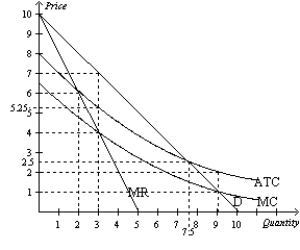 -Refer to Figure 15-2. If a regulator requires the firm to charge a marginal cost price, what is the amount of profit or loss earned by the firm?
 (Short Answer)
4.9/5  (84)
(84) Figure 15-2
-Refer to Figure 15-2. If a regulator requires the firm to charge a marginal cost price, what price will the firm charge?
-Refer to Figure 15-2. If a regulator requires the firm to charge a marginal cost price, what price will the firm charge? (Short Answer)
4.9/5 (81)
(81) Figure 15-2
-Refer to Figure 15-2. If a regulator requires the firm to charge an average cost price, what is the amount of profit or loss earned by the firm?
-Refer to Figure 15-2. If a regulator requires the firm to charge an average cost price, what is the amount of profit or loss earned by the firm? (Short Answer)
5.0/5 (83)
(83) Figure 15-17 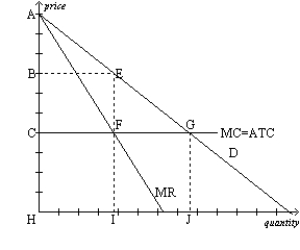 -Refer to Figure 15-17. If this firm were able to perfectly price discriminate, which of the following areas would represent the profit to this perfectly discriminating monopolist?
 (Multiple Choice)
4.8/5 (78)
(78) What is the defining characteristic of a natural monopoly? Give an example of a natural monopoly.
(Essay)
4.8/5 (76)
(76) Figure 15-3 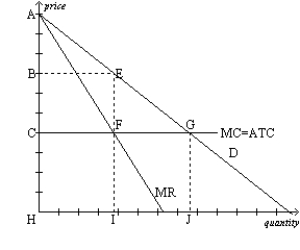 -Refer to Figure 15-3. Use the letters in the figure to identify the profit area for the single price monopolist.
 (Short Answer)
4.7/5 (75)
(75) When a monopolist increases the number of units it sells, there are two effects on revenue. They are the
(Multiple Choice)
4.8/5 (77)
(77) Figure 15-6 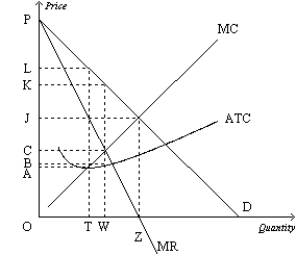 -Refer to Figure 15-6. What area measures the monopolist's profit?
 (Multiple Choice)
4.8/5 (93)
(93) Table 15-5
A monopolist faces the following demand curve: 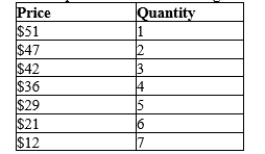 -Refer to Table 15-5. The monopolist has total fixed costs of $60 and has a constant marginal cost of $15. What is the profit-maximizing price?
 (Multiple Choice)
4.8/5 (85)
(85) When a monopolist increases the amount of output that it produces and sells, the price of its output
(Multiple Choice)
4.9/5 (71)
(71) In the market for "home heating" consumers typically have several options (e.g., electricity, heating fuel, natural gas, propane, etc.), yet we often think of firms in this industry as behaving like monopolists. Discuss the context in which your electricity provider is a monopolist. Is this characterization universally applicable? Explain your answer.
(Essay)
4.9/5 (74)
(74) Figure 15-13 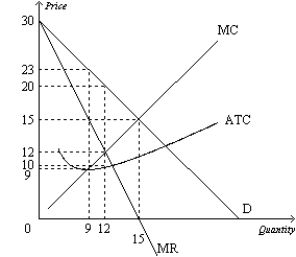 -Refer to Figure 15-13. A profit-maximizing monopolist would create a deadweight loss to society valued at
 (Multiple Choice)
4.8/5 (90)
(90) Which of the following is an example of a barrier to entry?
(Multiple Choice)
4.8/5 (78)
(78) In both perfectly competitive and monopoly markets, the price per unit of a good is equal to the
(Short Answer)
4.8/5 (88)
(88) 
Filters
- Essay(0)
- Multiple Choice(0)
- Short Answer(0)
- True False(0)
- Matching(0)