



 Chat with AI
Exam 15: Monopoly

Exam 1: Ten Principles of Economics455 Questions
Exam 2: Thinking Like an Economist643 Questions
Exam 3: Interdependence and the Gains From Trade547 Questions
Exam 4: The Market Forces of Supply and Demand693 Questions
Exam 5: Elasticity and Its Application626 Questions
Exam 6: Supply, Demand, and Government Policies668 Questions
Exam 7: Consumers, Producers, and the Efficiency of Markets547 Questions
Exam 8: Applications: the Costs of Taxation509 Questions
Exam 9: Application: International Trade521 Questions
Exam 10: Externalities543 Questions
Exam 11: Public Goods and Common Resources452 Questions
Exam 12: The Design of the Tax System664 Questions
Exam 13: The Costs of Production649 Questions
Exam 14: Firms in Competitive Markets604 Questions
Exam 15: Monopoly662 Questions
Exam 16: Monopolistic Competition649 Questions
Exam 17: Oligopoly522 Questions
Exam 18: The Markets for the Factors of Production592 Questions
Exam 19: Earnings and Discrimination511 Questions
Exam 20: Income Inequality and Poverty478 Questions
Exam 21: The Theory of Consumer Choice570 Questions
Exam 22: Frontiers in Microeconomics461 Questions
Exam 23: Measuring a Nation S Income547 Questions
Exam 24: Measuring the Cost of Living565 Questions
Exam 25: Production and Growth527 Questions
Exam 26: Saving, Investment, and the Financial System637 Questions
Exam 27: Tools of Finance534 Questions
Exam 28: Unemployment and Its Natural Rate701 Questions
Exam 29: The Monetary System540 Questions
Exam 30: Money Growth and Inflation504 Questions
Exam 31: Open-Economy Macroeconomics: Basic Concepts540 Questions
Exam 32: A Macroeconomic Theory of the Open Economy511 Questions
Exam 33: Aggregate Demand and Aggregate Supply572 Questions
Exam 34: The Influence of Monetary and Fiscal Policy on Aggregate Demand523 Questions
Exam 35: The Short-Run Tradeoff Between Inflation and Unemployment536 Questions
Exam 36: Six Debates Over Macroeconomic Policy354 Questions
Select questions type


For a monopoly firm, the shape and position of the demand curve play a role in determining the
(i)profit-maximizing price.
(ii)shape and position of the marginal-cost curve.
(iii)shape and position of the marginal-revenue curve.
(Multiple Choice)
4.7/5  (79)
(79) Figure 15-18 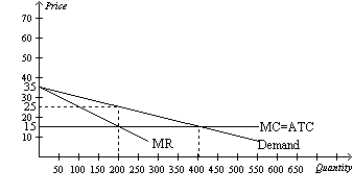 -Refer to Figure 15-18. If the monopoly firm perfectly price discriminates, then consumer surplus amounts to
 (Multiple Choice)
4.9/5 (73)
(73) Comparing firms in perfectly competitive markets to monopoly firms, which produces more output?
(Short Answer)
4.7/5 (89)
(89) Figure 15-1 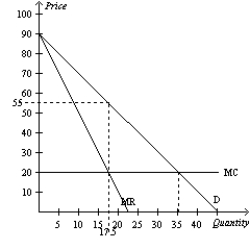 -Refer to Figure 15-1. If the monopolist uses perfect price discrimination, how much deadweight loss results?
 (Short Answer)
4.9/5 (75)
(75) Figure 15-5 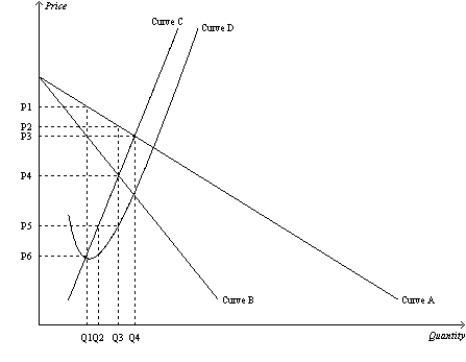 -Refer to Figure 15-5. A profit-maximizing monopoly will charge a price of
 (Multiple Choice)
4.8/5 (78)
(78) A monopolist maximizes profit by producing an output level where marginal cost equals price.
(True/False)
4.8/5 (83)
(83) Suppose ABC Aluminum Inc. owns 80% of the world's bauxite, a mineral used in the production of aluminum. Which of the following reasons describes the fundamental barrier to entry for the aluminum industry?
(Multiple Choice)
4.8/5 (87)
(87) Which of the following is an example of price discrimination?
(Multiple Choice)
4.7/5 (86)
(86) Monopoly pricing prevents some mutually beneficial trades from taking place. These unrealized, mutually beneficial trades are
(Multiple Choice)
4.9/5 (76)
(76) Customers who purchase an audio CD from Sally's Sounds are charged 20% more than customers who purchase the audio CD from the Sally's Sounds website. This is an example of
(Multiple Choice)
4.9/5 (81)
(81) When the marginal revenue curve is drawn for a monopolist, the curve
(Multiple Choice)
4.9/5 (83)
(83) One example of price discrimination occurs in the publishing industry when a publisher initially releases an expensive hardcover edition of a popular novel and later releases a cheaper paperback edition. Use this example to demonstrate the benefits and potential pitfalls of a price discrimination pricing strategy.
(Essay)
5.0/5 (80)
(80) Comparing firms in perfectly competitive markets to monopoly firms, which charges a price equal to marginal cost?
(Short Answer)
4.9/5 (86)
(86) Figure 15-22
The diagram depicts the market situation for a monopoly pastry shop called Bearclaws. 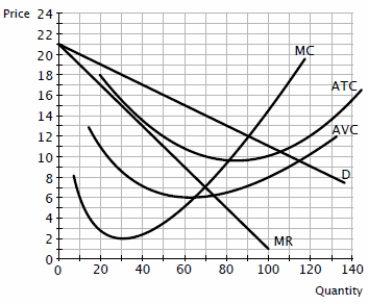 -Refer to Figure 15-22. Based upon the information shown, what is total revenue for Bearclaws, given that it maximizes profits?
 (Multiple Choice)
4.9/5 (98)
(98) Scenario 15-5
An airline knows that there are two types of travelers: business travelers and vacationers. For a particular flight, there are 100 business travelers who will pay $600 for a ticket while there are 50 vacationers who will pay $300 for a ticket. There are 150 seats available on the plane. Suppose the cost to the airline of providing the flight is $20,000, which includes the cost of the pilots, flight attendants, fuel, etc.
-Refer to Scenario 15-5. How much profit will the airline earn if it sets the price of each ticket at $600?
(Multiple Choice)
4.8/5 (89)
(89) When a certain monopoly sets its price at $8 it sells 64 units. When the monopoly sets its price at $9 it sells 62 units. The marginal revenue for the firm over this range is
(Multiple Choice)
4.9/5 (89)
(89) Scenario 15-8
Mega Media Cable TV is able to purchase an exclusive right to sell a premium sports channel in its market area. Let's assume that Mega Media pays $100,000 a year for the exclusive marketing rights to the sports channel. Since Mega Media has already installed cable to all of the homes in its market area, the marginal cost of delivering the sports channel to subscribers is zero. The manager of Mega Media needs to know what price to charge for the sports channel service to maximize her profit. Before setting price, she hires an economist to estimate demand for the sports channel. The economist discovers that there are two types of subscribers who value premium sporting channels. First are the 3,000 die-hard sports fans who will pay as much as $150 a year for the new channel. Second, the premium sports channel will appeal to 20,000 occasional sports viewers who will pay as much as $25 a year for a subscription to it.
-Refer to Scenario 15-8. If Mega Media Cable TV is unable to price discriminate, what price will it choose to maximize its profit, and what is the amount of the profit?
(Multiple Choice)
4.8/5 (78)
(78) 
Filters
- Essay(0)
- Multiple Choice(0)
- Short Answer(0)
- True False(0)
- Matching(0)