



 Chat with AI
Exam 21: The Theory of Consumer Choice

Exam 1: Ten Principles of Economics455 Questions
Exam 2: Thinking Like an Economist643 Questions
Exam 3: Interdependence and the Gains From Trade547 Questions
Exam 4: The Market Forces of Supply and Demand693 Questions
Exam 5: Elasticity and Its Application626 Questions
Exam 6: Supply, Demand, and Government Policies668 Questions
Exam 7: Consumers, Producers, and the Efficiency of Markets547 Questions
Exam 8: Applications: the Costs of Taxation509 Questions
Exam 9: Application: International Trade521 Questions
Exam 10: Externalities543 Questions
Exam 11: Public Goods and Common Resources452 Questions
Exam 12: The Design of the Tax System664 Questions
Exam 13: The Costs of Production649 Questions
Exam 14: Firms in Competitive Markets604 Questions
Exam 15: Monopoly662 Questions
Exam 16: Monopolistic Competition649 Questions
Exam 17: Oligopoly522 Questions
Exam 18: The Markets for the Factors of Production592 Questions
Exam 19: Earnings and Discrimination511 Questions
Exam 20: Income Inequality and Poverty478 Questions
Exam 21: The Theory of Consumer Choice570 Questions
Exam 22: Frontiers in Microeconomics461 Questions
Exam 23: Measuring a Nation S Income547 Questions
Exam 24: Measuring the Cost of Living565 Questions
Exam 25: Production and Growth527 Questions
Exam 26: Saving, Investment, and the Financial System637 Questions
Exam 27: Tools of Finance534 Questions
Exam 28: Unemployment and Its Natural Rate701 Questions
Exam 29: The Monetary System540 Questions
Exam 30: Money Growth and Inflation504 Questions
Exam 31: Open-Economy Macroeconomics: Basic Concepts540 Questions
Exam 32: A Macroeconomic Theory of the Open Economy511 Questions
Exam 33: Aggregate Demand and Aggregate Supply572 Questions
Exam 34: The Influence of Monetary and Fiscal Policy on Aggregate Demand523 Questions
Exam 35: The Short-Run Tradeoff Between Inflation and Unemployment536 Questions
Exam 36: Six Debates Over Macroeconomic Policy354 Questions
Select questions type


Figure 21-24 The figure shows three indifference curves and a budget constraint for a certain consumer named Steve. 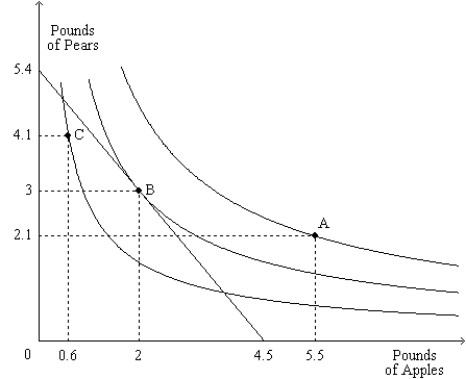 -Refer to Figure 21-24. At his optimum, Steve is buying
 (Multiple Choice)
4.9/5  (72)
(72) When considering household savings, the relative price between consuming when young and consuming when old is the
(Multiple Choice)
4.8/5 (82)
(82) Suppose the price of good X falls. As a result, the quantity demanded for good X increases for a particular consumer. For this consumer, the substitution effect induced the consumer to purchase more X while the income effect induced the consumer to purchase less X. We can infer that X is a(n)
(Multiple Choice)
4.8/5 (72)
(72) When two goods are perfect complements, the indifference curves are right angles.
(True/False)
4.8/5 (76)
(76) The direction of the substitution effect is not influenced by whether the good is normal or inferior.
(True/False)
4.9/5 (92)
(92) Suppose a consumer spends her income on two goods: music CDs and DVDs. The consumer has $200 to allocate to these two goods, the price of a CD is $10, and the price of a DVD is $20. What is the maximum number of CDs the consumer can purchase?
(Multiple Choice)
4.7/5 (84)
(84) Figure 21-15 On the graph, Qx represents the quantity of good x and Qy represents the quantity of good y. The lines drawn on the graph represent three of Barbara's indifference curves. 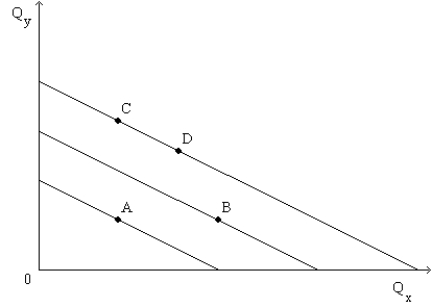 -Refer to Figure 21-15. For Barbara, the marginal rate of substitution between goods y
And x
-Refer to Figure 21-15. For Barbara, the marginal rate of substitution between goods y
And x (Multiple Choice)
4.9/5 (71)
(71) Suppose a consumer has an income of $800 per month and that she spends her entire income each month on beer and bratwurst. The price of a pint of beer is $5, and the price of a bratwurst is $4. Which of the following combinations of beers and bratwursts represents a point that would lie to the exterior of the consumer's budget constraint?
(Multiple Choice)
4.9/5 (90)
(90) The substitution effect of a price change is depicted by a
(Multiple Choice)
5.0/5 (76)
(76) Suppose an individual is choosing between Netflix and Redbox movies. He has $16 a month to spend on movies. The price of a Redbox movie is $1 while Netflix offers unlimited movies for a monthly fee of $8. Which of the following represents this individual's budget line?
(Multiple Choice)
4.8/5 (72)
(72) Figure 21-15 On the graph, Qx represents the quantity of good x and Qy represents the quantity of good y. The lines drawn on the graph represent three of Barbara's indifference curves.
-Refer to Figure 21-15. Barbara is happier at
-Refer to Figure 21-15. Barbara is happier at (Multiple Choice)
4.8/5 (95)
(95) Figure 21-23 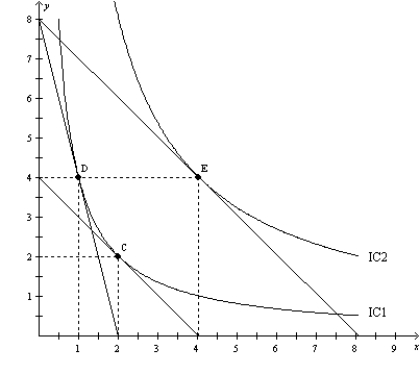 -Refer to Figure 21-23. When the price of X is $80, the price of Y is $20, and the consumer's income is $160, the consumer's optimal choice is D. Then the price of X decreases to $20. The substitution effect can be illustrated as the movement from
 (Multiple Choice)
4.9/5 (80)
(80) If Chad's labor-supply curve is upward-sloping, then, for Chad,
(Multiple Choice)
4.8/5 (67)
(67) Higher indifference curves are preferred to lower ones as long as the
(Multiple Choice)
4.8/5 (72)
(72) Scenario 21-3
Scott knows that he will ultimately face retirement. Assume that Scott will experience two periods in his life, one in which he works and earns income, and one in which he is retired and earns no income. Scott can earn $250,000 during his working period and nothing in his retirement period. He must both save and consume in his work period with an interest rate of 10 percent on savings.
-Refer to Scenario 21-3. If the interest rate on savings increases,
(Multiple Choice)
4.9/5 (92)
(92) Mark spends his weekly income on gin and cocktail olives. The price of gin has risen from $7 to $9 per bottle, the price of cocktail olives has fallen from $6 to $5 per jar, and Mark's income has stayed fixed at $46 per week. If you measure gin on the vertical axis and cocktail olives on the horizontal axis, then the budget constraint
(Multiple Choice)
4.9/5 (72)
(72) A consumer maximizes utility when she consumes at a point where
(Multiple Choice)
4.9/5 (87)
(87) Figure 21-2 The downward-sloping line on the figure represents a consumer's budget
constraint. 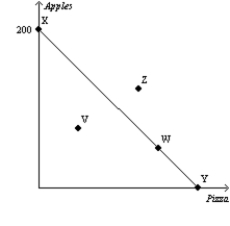 -Refer to Figure 21-2. If the consumer's income is $100, then what is the price of an apple?
 (Multiple Choice)
4.8/5 (85)
(85) A family on a trip budgets $1,000 for meals and gasoline. If the price of a meal for the family is $50 and if gasoline costs $3.50 per gallon, then how many meals can the family buy if they buy 100 gallons of gasoline?
(Multiple Choice)
4.7/5 (77)
(77) Is it possible for a normal good to be a Giffen good? Briefly explain.
(Essay)
4.9/5 (74)
(74) 
Filters
- Essay(0)
- Multiple Choice(0)
- Short Answer(0)
- True False(0)
- Matching(0)