



 Chat with AI
Exam 21: The Theory of Consumer Choice

Exam 1: Ten Principles of Economics455 Questions
Exam 2: Thinking Like an Economist643 Questions
Exam 3: Interdependence and the Gains From Trade547 Questions
Exam 4: The Market Forces of Supply and Demand693 Questions
Exam 5: Elasticity and Its Application626 Questions
Exam 6: Supply, Demand, and Government Policies668 Questions
Exam 7: Consumers, Producers, and the Efficiency of Markets547 Questions
Exam 8: Applications: the Costs of Taxation509 Questions
Exam 9: Application: International Trade521 Questions
Exam 10: Externalities543 Questions
Exam 11: Public Goods and Common Resources452 Questions
Exam 12: The Design of the Tax System664 Questions
Exam 13: The Costs of Production649 Questions
Exam 14: Firms in Competitive Markets604 Questions
Exam 15: Monopoly662 Questions
Exam 16: Monopolistic Competition649 Questions
Exam 17: Oligopoly522 Questions
Exam 18: The Markets for the Factors of Production592 Questions
Exam 19: Earnings and Discrimination511 Questions
Exam 20: Income Inequality and Poverty478 Questions
Exam 21: The Theory of Consumer Choice570 Questions
Exam 22: Frontiers in Microeconomics461 Questions
Exam 23: Measuring a Nation S Income547 Questions
Exam 24: Measuring the Cost of Living565 Questions
Exam 25: Production and Growth527 Questions
Exam 26: Saving, Investment, and the Financial System637 Questions
Exam 27: Tools of Finance534 Questions
Exam 28: Unemployment and Its Natural Rate701 Questions
Exam 29: The Monetary System540 Questions
Exam 30: Money Growth and Inflation504 Questions
Exam 31: Open-Economy Macroeconomics: Basic Concepts540 Questions
Exam 32: A Macroeconomic Theory of the Open Economy511 Questions
Exam 33: Aggregate Demand and Aggregate Supply572 Questions
Exam 34: The Influence of Monetary and Fiscal Policy on Aggregate Demand523 Questions
Exam 35: The Short-Run Tradeoff Between Inflation and Unemployment536 Questions
Exam 36: Six Debates Over Macroeconomic Policy354 Questions
Select questions type


A decrease in income will cause a consumer's budget constraint to
(Multiple Choice)
4.9/5  (75)
(75) Suppose a consumer spends her income on two goods: iTunes music downloads and books. The consumer has $100 to allocate to these two goods, the price of a downloaded song is $1, and the price of a book is $20. What is the maximum number of books the consumer can purchase?
(Multiple Choice)
4.9/5 (75)
(75) If an indifference curve is bowed in toward the origin, the marginal rate of substitution is
(Multiple Choice)
4.7/5 (89)
(89) Figure 21-10 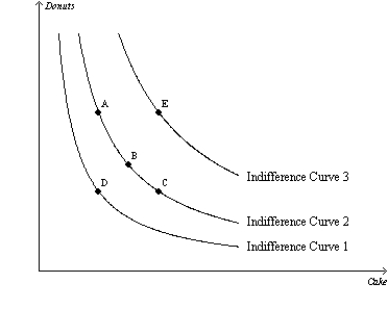 -Refer to Figure 21-10. Which of the following comparisons is correct regarding the marginal rate of substitution (MRS) of donuts for cake?
 (Multiple Choice)
4.8/5 (81)
(81) The substitution effect of a wage decrease in the work-leisure model results in the worker choosing to
(Multiple Choice)
4.9/5 (79)
(79) Figure 21-7 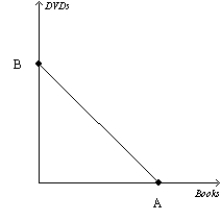 -Refer to Figure 21-7. Suppose a consumer has $200 in income, the price of a book is $5, and the price of a DVD is $10. What is the value of B?
 (Multiple Choice)
4.9/5 (88)
(88) The substitution effect of an increase in the interest rate will result in an increase in
(Multiple Choice)
4.8/5 (81)
(81) Figure 21-8 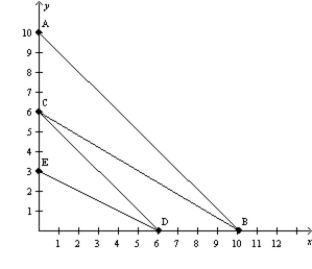 -Refer to Figure 21-8. You have $600 to spend on good X and good Y. If good X costs $100 and good Y costs $100, your budget constraint is
 (Multiple Choice)
4.9/5 (81)
(81) Figure 21-32 The figure shows three indifference curves and a budget constraint for a consumer named Hannah. When young, Hannah works and earns income. When old, she is retired and earns no income. 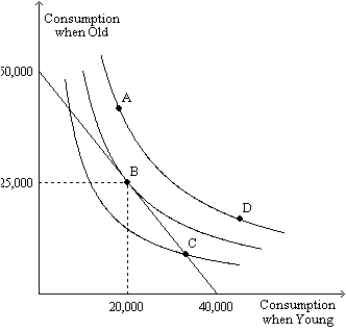 -Refer to Figure 21-32. From the figure we can determine how much income Hannah earns when young and we can determine the interest rate. Could the interest rate rise to a level at which Hannah could afford to be at point A?
 (Essay)
4.8/5 (92)
(92) Michael faces tradeoffs between consuming in the current period when he is young and consuming in a future period when he is old. Michael experiences a decrease in the current interest rate he earns on his savings. Michael will save
(Multiple Choice)
4.7/5 (79)
(79) Figure 21-24 The figure shows three indifference curves and a budget constraint for a certain consumer named Steve. 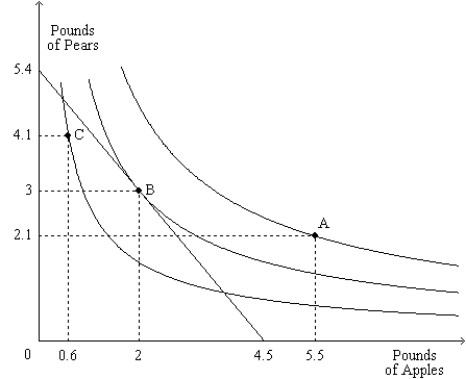 -Refer to Figure 21-24. If the price of a pound of pears is $3, then Steve's income is
 (Multiple Choice)
5.0/5 (85)
(85) Figure 21-25 The figure pertains to a particular consumer. On the axes, X represents the quantity of good X and Y represents the quantity of good Y. 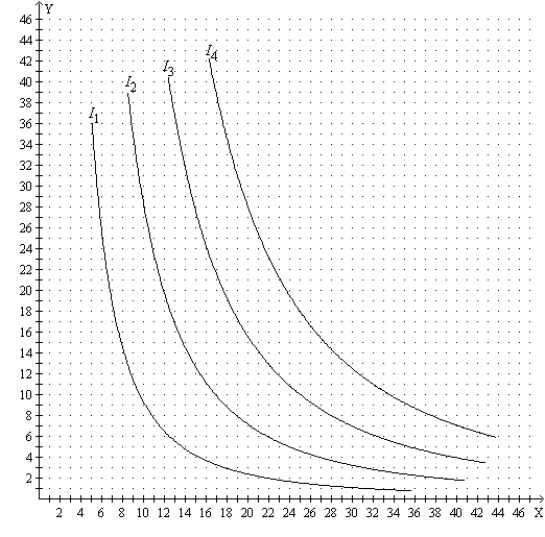 -Refer to Figure 21-25. Suppose the price of good X is $10, the price of good Y is $5, and the consumer's income is $210. Then the consumer's optimal choice is represented by a point on which curve?
 (Multiple Choice)
5.0/5 (75)
(75) Using the graph shown, construct a demand curve for M&M's given an income of $10. 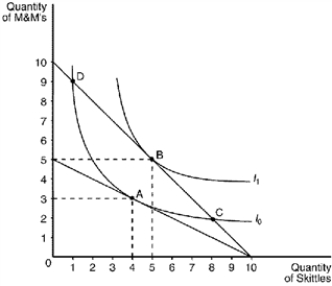
(Essay)
4.8/5 (79)
(79) Figure 21-9 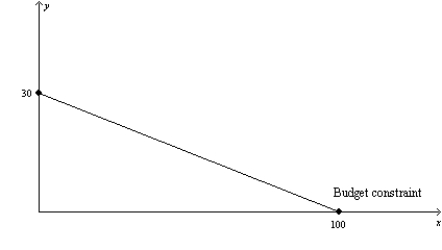 -Refer to Figure 21-9. If the consumer has $600 in income, what is the price of good X?
 (Multiple Choice)
4.7/5 (91)
(91) Irene is a vegetarian, so she does not eat pork. That is, pork provides no additional utility to Irene. She loves broccoli, however. If we illustrate Irene's indifference curves by drawing broccoli on the horizontal axis and pork on the vertical axis, her indifference curves will
(Multiple Choice)
4.8/5 (74)
(74) When we draw Katie's indifference curves to represent her preferences for books and movies, we find that her indifference curves are upward-sloping. What does this tell us about Katie's preferences?
(Essay)
4.9/5 (82)
(82) Billie spends all of her income on soccer balls and jeans, and the price of a pair of jeans is three times the price of soccer balls. In order to maximize total utility, Billie should
(Multiple Choice)
5.0/5 (91)
(91) 
Filters
- Essay(0)
- Multiple Choice(0)
- Short Answer(0)
- True False(0)
- Matching(0)