



 Chat with AI
Exam 21: The Theory of Consumer Choice

Exam 1: Ten Principles of Economics455 Questions
Exam 2: Thinking Like an Economist643 Questions
Exam 3: Interdependence and the Gains From Trade547 Questions
Exam 4: The Market Forces of Supply and Demand693 Questions
Exam 5: Elasticity and Its Application626 Questions
Exam 6: Supply, Demand, and Government Policies668 Questions
Exam 7: Consumers, Producers, and the Efficiency of Markets547 Questions
Exam 8: Applications: the Costs of Taxation509 Questions
Exam 9: Application: International Trade521 Questions
Exam 10: Externalities543 Questions
Exam 11: Public Goods and Common Resources452 Questions
Exam 12: The Design of the Tax System664 Questions
Exam 13: The Costs of Production649 Questions
Exam 14: Firms in Competitive Markets604 Questions
Exam 15: Monopoly662 Questions
Exam 16: Monopolistic Competition649 Questions
Exam 17: Oligopoly522 Questions
Exam 18: The Markets for the Factors of Production592 Questions
Exam 19: Earnings and Discrimination511 Questions
Exam 20: Income Inequality and Poverty478 Questions
Exam 21: The Theory of Consumer Choice570 Questions
Exam 22: Frontiers in Microeconomics461 Questions
Exam 23: Measuring a Nation S Income547 Questions
Exam 24: Measuring the Cost of Living565 Questions
Exam 25: Production and Growth527 Questions
Exam 26: Saving, Investment, and the Financial System637 Questions
Exam 27: Tools of Finance534 Questions
Exam 28: Unemployment and Its Natural Rate701 Questions
Exam 29: The Monetary System540 Questions
Exam 30: Money Growth and Inflation504 Questions
Exam 31: Open-Economy Macroeconomics: Basic Concepts540 Questions
Exam 32: A Macroeconomic Theory of the Open Economy511 Questions
Exam 33: Aggregate Demand and Aggregate Supply572 Questions
Exam 34: The Influence of Monetary and Fiscal Policy on Aggregate Demand523 Questions
Exam 35: The Short-Run Tradeoff Between Inflation and Unemployment536 Questions
Exam 36: Six Debates Over Macroeconomic Policy354 Questions
Select questions type


The theory of consumer choice provides the foundation for understanding the
(Multiple Choice)
4.9/5  (77)
(77) Figure 21-14 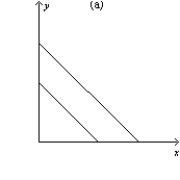
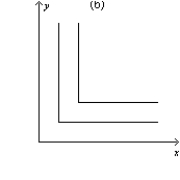
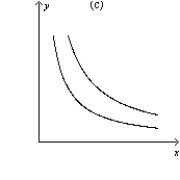 -Refer to Figure 21-14. Which of the graphs illustrates indifference curves for which the marginal rate of substitution is undefined?
 (Multiple Choice)
5.0/5 (89)
(89) Figure 21-3
In each case, the budget constraint moves from BC-1 to BC-2. 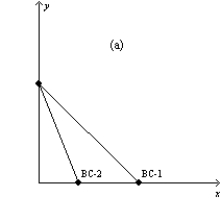
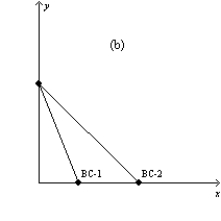
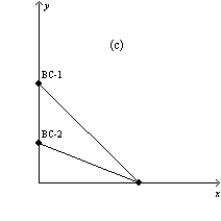
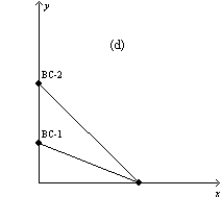 -Refer to Figure 21-3. Which of the graphs in the figure could reflect a simultaneous decrease in the prices of both goods?
(i)graph a
(ii)graph b
(iii)graph c
(iv)graph d
-Refer to Figure 21-3. Which of the graphs in the figure could reflect a simultaneous decrease in the prices of both goods?
(i)graph a
(ii)graph b
(iii)graph c
(iv)graph d (Multiple Choice)
4.9/5 (89)
(89) Janet prefers cashews to almonds. She prefers macadamia nuts to peanuts, but she is indifferent between almonds and peanuts. Which of the following statements can we say for sure?
(Multiple Choice)
4.8/5 (72)
(72) Figure 21-6 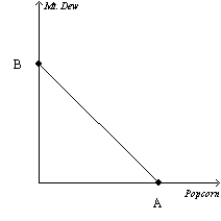 -Refer to Figure 21-6. Suppose a consumer has $100 in income, the price of Mt. Dew is $2, and the value of A is 200. What is the price of popcorn?
 (Multiple Choice)
4.7/5 (77)
(77) If income increases and prices are unchanged, the consumer's budget constraint
(Multiple Choice)
4.8/5 (79)
(79) Because people are more willing to trade away goods that they have in abundance and less willing to trade away goods of which they have little, indifference curves are ___________.
(Short Answer)
4.9/5 (88)
(88) Figure 21-19 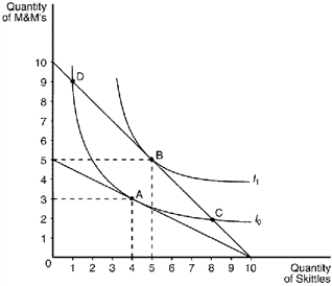 -Refer to Figure 21-19. Assume that the consumer depicted in the figure has an income of $20. The price of Skittles is $2 and the price of M&M's is $4. The consumer's optimal choice is point
 (Multiple Choice)
4.9/5 (73)
(73) Figure 21-18 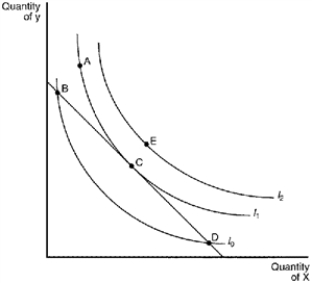 -Refer to Figure 21-18. Bundle D represents a point where
 (Multiple Choice)
4.9/5 (86)
(86) Answer the following questions based on the table. A consumer is able to consume the following bundles of rice and beans when the price of rice is $2 and the price of beans is $3.
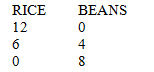 a.How much is this consumer's income?
b.Draw a budget constraint given this information. Label it B.
c.Construct a new budget constraint showing the change if the price of rice falls $1. Label this C.
d.Given the original prices for rice ($2) and beans ($3), construct a new budget constraint if this consumer's income increased to $48. Label this D.
a.How much is this consumer's income?
b.Draw a budget constraint given this information. Label it B.
c.Construct a new budget constraint showing the change if the price of rice falls $1. Label this C.
d.Given the original prices for rice ($2) and beans ($3), construct a new budget constraint if this consumer's income increased to $48. Label this D. (Essay)
4.9/5 (68)
(68) The income effect of an increase in the interest rate will result in an increase in consumption when
(Multiple Choice)
4.8/5 (75)
(75) If a consumer experiences a decrease in income, the new budget constraint will have the same slope as the old budget constraint.
(True/False)
4.9/5 (80)
(80) Figure 21-31 The figure shows two indifference curves and two budget constraints for a consumer named Kevin. 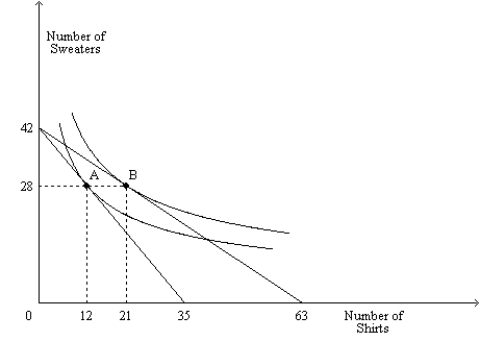 -Refer to Figure 21-31. Suppose Kevin is optimally purchasing 12 shirts and 28 sweaters, and he is spending $648 on shirts. What is the price of a sweater?
 (Essay)
4.8/5 (82)
(82) A consumer's indifference curves are straight lines when, for the consumer, the goods in question are __________.
(Short Answer)
4.9/5 (81)
(81) Bundle J contains 10 units of good X and 5 units of good Y. Bundle K contains 5 units of good X and 10 units of good Y. Bundle L contains 10 units of good X and 10 units of good Y. Assume that the consumer's preferences satisfy the four properties of indifference curves. The price of X is $1, the price of Y is $2, and the consumer has an income of $20. Which bundle will the consumer choose?
(Multiple Choice)
4.9/5 (90)
(90) An optimizing consumer will select the consumption bundle in which the marginal rate of substitution
(Multiple Choice)
4.8/5 (82)
(82) Hold the prices of goods, as well as Amy's preferences, constant. If Amy's income increases, then
(Multiple Choice)
4.9/5 (75)
(75) For Brent, the income effect of a wage increase is stronger than the substitution effect. In response to a wage increase, will Brent work more hours or will he work fewer hours?
(Essay)
4.8/5 (91)
(91) The theory of consumer choice most closely examines which of the following Ten Principles of Economics?
(Multiple Choice)
4.7/5 (76)
(76) The following diagram shows two budget lines: A and B. 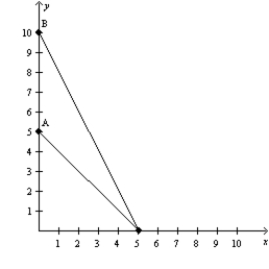 Which of the following could explain the change in the budget line from A to B?
 (Multiple Choice)
4.9/5 (74)
(74) 
Filters
- Essay(0)
- Multiple Choice(0)
- Short Answer(0)
- True False(0)
- Matching(0)