



 Chat with AI
Exam 21: The Theory of Consumer Choice

Exam 1: Ten Principles of Economics455 Questions
Exam 2: Thinking Like an Economist643 Questions
Exam 3: Interdependence and the Gains From Trade547 Questions
Exam 4: The Market Forces of Supply and Demand693 Questions
Exam 5: Elasticity and Its Application626 Questions
Exam 6: Supply, Demand, and Government Policies668 Questions
Exam 7: Consumers, Producers, and the Efficiency of Markets547 Questions
Exam 8: Applications: the Costs of Taxation509 Questions
Exam 9: Application: International Trade521 Questions
Exam 10: Externalities543 Questions
Exam 11: Public Goods and Common Resources452 Questions
Exam 12: The Design of the Tax System664 Questions
Exam 13: The Costs of Production649 Questions
Exam 14: Firms in Competitive Markets604 Questions
Exam 15: Monopoly662 Questions
Exam 16: Monopolistic Competition649 Questions
Exam 17: Oligopoly522 Questions
Exam 18: The Markets for the Factors of Production592 Questions
Exam 19: Earnings and Discrimination511 Questions
Exam 20: Income Inequality and Poverty478 Questions
Exam 21: The Theory of Consumer Choice570 Questions
Exam 22: Frontiers in Microeconomics461 Questions
Exam 23: Measuring a Nation S Income547 Questions
Exam 24: Measuring the Cost of Living565 Questions
Exam 25: Production and Growth527 Questions
Exam 26: Saving, Investment, and the Financial System637 Questions
Exam 27: Tools of Finance534 Questions
Exam 28: Unemployment and Its Natural Rate701 Questions
Exam 29: The Monetary System540 Questions
Exam 30: Money Growth and Inflation504 Questions
Exam 31: Open-Economy Macroeconomics: Basic Concepts540 Questions
Exam 32: A Macroeconomic Theory of the Open Economy511 Questions
Exam 33: Aggregate Demand and Aggregate Supply572 Questions
Exam 34: The Influence of Monetary and Fiscal Policy on Aggregate Demand523 Questions
Exam 35: The Short-Run Tradeoff Between Inflation and Unemployment536 Questions
Exam 36: Six Debates Over Macroeconomic Policy354 Questions
Select questions type


The opportunity cost of current household consumption is the
(Multiple Choice)
4.8/5  (76)
(76) Figure 21-6 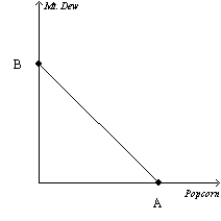 -Refer to Figure 21-6. Suppose the price of popcorn is $2, the price of Mt. Dew is $4, the value of A is 30, and the value of B is 15. How much income does the consumer have?
 (Multiple Choice)
4.9/5 (96)
(96) Figure 21-10 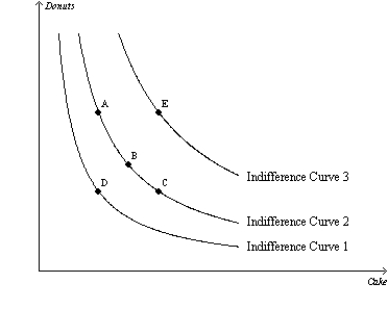 -Refer to Figure 21-10. When comparing bundle B to bundle C, the consumer
 (Multiple Choice)
4.8/5 (81)
(81) The marginal rate of substitution between goods A and B measures the price of A relative to the price of B.
(True/False)
4.9/5 (91)
(91) When we derive the demand curve for a good, we should remember that the
(Multiple Choice)
4.8/5 (88)
(88) Consumer theory provides the foundation for understanding demand curves because
(Multiple Choice)
4.8/5 (80)
(80) As more units of an item are purchased, everything else equal, marginal satisfaction from consuming additional units will tend to
(Multiple Choice)
4.9/5 (56)
(56) Suppose a consumer consumes two goods, X and Y. The slope of the budget constraint equals the
(Multiple Choice)
4.8/5 (72)
(72) If a consumer purchases more of good B when his income rises, good B is an inferior good.
(True/False)
4.8/5 (63)
(63) Grace consumes two goods: iced tea and spaghetti. The price of iced tea is $2 per bottle. Her income is $500 per month. Grace spends all her income each month. She purchases 50 bottles of iced tea and 100 servings of spaghetti. What is the price of a serving of spaghetti?
(Multiple Choice)
4.8/5 (75)
(75) Traci consumes two goods, lemonade and pretzels. Lemonade costs $2 per glass, and she consumes it to the point where the marginal utility she receives from her last glass of lemonade is 4. Pretzels cost $3 per bag. The relationship between the marginal utility Traci gets from eating a bag of pretzels and the number of bags she eats per month is as follows:  If Traci is maximizing her utility, how many bags of pretzels does she buy each month?
 (Multiple Choice)
4.9/5 (75)
(75) The following diagram shows a budget constraint for a particular consumer. 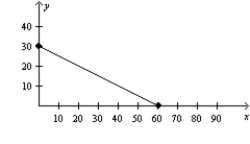 If the price of X is $12, then what is the price of Y?
 (Multiple Choice)
4.9/5 (62)
(62) Traci consumes two goods, lemonade and pretzels. Lemonade costs $1 per glass, and she consumes it to the point where the marginal utility she receives from her last glass of lemonade is 3. Pretzels cost $2 per bag. The relationship between the marginal utility Traci gets from eating a bag of pretzels and the number of bags she eats per month is as follows:  If Traci is maximizing his utility, how much does she spend on pretzels each month?
 (Multiple Choice)
4.9/5 (87)
(87) Suppose that Elmer's hourly wage increases, and he decides to work fewer hours. For Elmer, the substitution effect of the wage change is
(Multiple Choice)
4.9/5 (85)
(85) On a graph we draw a consumer's budget constraint, measuring the number of apples on the horizontal axis and the number of light bulbs on the vertical axis. If the slope of the budget constraint is -2, then
(Multiple Choice)
4.8/5 (77)
(77) In order to represent a consumer's choices on a graph, we draw her budget constraint as well as her __________ curves.
(Short Answer)
4.8/5 (81)
(81) 
Filters
- Essay(0)
- Multiple Choice(0)
- Short Answer(0)
- True False(0)
- Matching(0)