



 Chat with AI
Exam 21: The Theory of Consumer Choice

Exam 1: Ten Principles of Economics455 Questions
Exam 2: Thinking Like an Economist643 Questions
Exam 3: Interdependence and the Gains From Trade547 Questions
Exam 4: The Market Forces of Supply and Demand693 Questions
Exam 5: Elasticity and Its Application626 Questions
Exam 6: Supply, Demand, and Government Policies668 Questions
Exam 7: Consumers, Producers, and the Efficiency of Markets547 Questions
Exam 8: Applications: the Costs of Taxation509 Questions
Exam 9: Application: International Trade521 Questions
Exam 10: Externalities543 Questions
Exam 11: Public Goods and Common Resources452 Questions
Exam 12: The Design of the Tax System664 Questions
Exam 13: The Costs of Production649 Questions
Exam 14: Firms in Competitive Markets604 Questions
Exam 15: Monopoly662 Questions
Exam 16: Monopolistic Competition649 Questions
Exam 17: Oligopoly522 Questions
Exam 18: The Markets for the Factors of Production592 Questions
Exam 19: Earnings and Discrimination511 Questions
Exam 20: Income Inequality and Poverty478 Questions
Exam 21: The Theory of Consumer Choice570 Questions
Exam 22: Frontiers in Microeconomics461 Questions
Exam 23: Measuring a Nation S Income547 Questions
Exam 24: Measuring the Cost of Living565 Questions
Exam 25: Production and Growth527 Questions
Exam 26: Saving, Investment, and the Financial System637 Questions
Exam 27: Tools of Finance534 Questions
Exam 28: Unemployment and Its Natural Rate701 Questions
Exam 29: The Monetary System540 Questions
Exam 30: Money Growth and Inflation504 Questions
Exam 31: Open-Economy Macroeconomics: Basic Concepts540 Questions
Exam 32: A Macroeconomic Theory of the Open Economy511 Questions
Exam 33: Aggregate Demand and Aggregate Supply572 Questions
Exam 34: The Influence of Monetary and Fiscal Policy on Aggregate Demand523 Questions
Exam 35: The Short-Run Tradeoff Between Inflation and Unemployment536 Questions
Exam 36: Six Debates Over Macroeconomic Policy354 Questions
Select questions type


If an indifference curve is bowed out away from the origin, the marginal rate of substitution is
(Multiple Choice)
4.8/5  (91)
(91) The two "goods" used when economists analyze labor supply are
(Multiple Choice)
4.8/5 (71)
(71) Figure 21-30 The graph shows two budget constraints for a consumer.  -Refer to Figure 21-30. Suppose the price of a hamburger is $10 and Budget Constraint A applies. What is the consumer's income? What is the price of a light bulb?
 (Essay)
4.9/5 (81)
(81) Suppose that you have $100 today and expect to receive $100 one year from today. Your money market account pays an annual interest rate of 25%, and you may borrow money at that interest rate. Consider the budget constraint between "spending today" on the horizontal axis and "spending a year from today" on the vertical axis. What is the slope of this budget constraint?
(Multiple Choice)
4.7/5 (93)
(93) Figure 21-24 The figure shows three indifference curves and a budget constraint for a certain consumer named Steve. 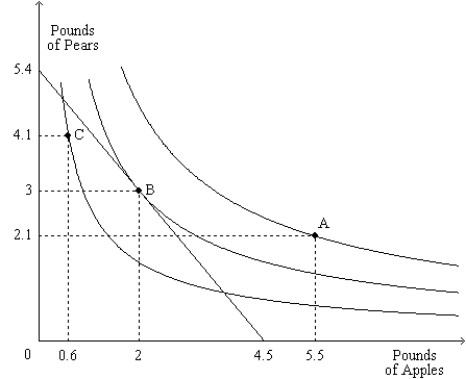 -Refer to Figure 21-24. At his optimum, Steve is willing to give up about
 (Multiple Choice)
4.8/5 (80)
(80) Figure 21-13 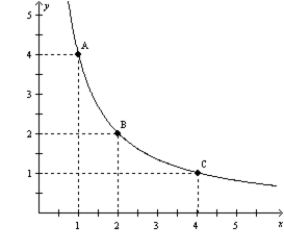 -Refer to Figure 21-13. As the consumer moves from A to B to C, the consumer's total utility
 (Multiple Choice)
4.7/5 (70)
(70) When the price of a good increases, all else equal, the higher price
(Multiple Choice)
4.9/5 (74)
(74) The rate at which a consumer is willing to trade one good for another to maintain the same level of satisfaction is affected by the
(Multiple Choice)
4.8/5 (79)
(79) For a typical consumer, most indifference curves are downward sloping.
(True/False)
4.8/5 (94)
(94) Figure 21-32 The figure shows three indifference curves and a budget constraint for a consumer named Hannah. When young, Hannah works and earns income. When old, she is retired and earns no income. 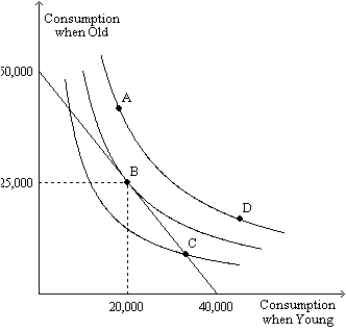 -Refer to Figure 21-32. Of the four labeled points, which is (are) affordable to Hannah?
 (Short Answer)
4.8/5 (85)
(85) When the indifference curve is tangent to the budget constraint,
(Multiple Choice)
4.9/5 (80)
(80) Figure 21-22 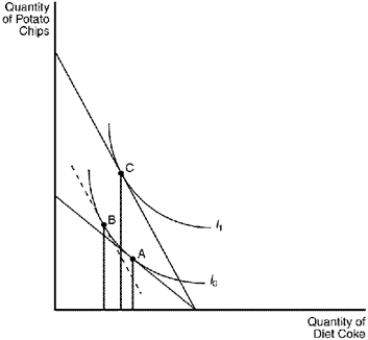 -Refer to Figure 21-22. If the consumer were initially at point A in the figure, a movement from point B to point C as a result of a decrease in the price of potato chips represents the
 (Multiple Choice)
4.8/5 (74)
(74) Figure 21-5
(a)
(b) 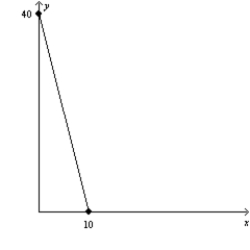
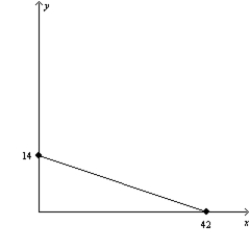 -Refer to Figure 21-5. In graph (b), what is the price of good Y relative to the price of good X (i.e., PY/PX)?
 (Multiple Choice)
4.9/5 (80)
(80) Traci consumes two goods, lemonade and pretzels. Lemonade costs $1 per glass, and she consumes it to the point where the marginal utility she receives from her last glass of lemonade is 3. Pretzels cost $2 per bag. The relationship between the marginal utility Traci gets from eating a bag of pretzels and the number of bags she eats per month is as follows:  If Traci is maximizing his utility, how many bags of pretzels does he buy each month?
 (Multiple Choice)
4.9/5 (76)
(76) Which of the following best describes why indifference curves cannot cross?
(Multiple Choice)
4.9/5 (79)
(79) Suppose a consumer consumes two goods, X and Y. The relative price of the two goods equals the
(Multiple Choice)
4.9/5 (97)
(97) Which of the following is a property of a typical indifference curve?
(Multiple Choice)
4.7/5 (71)
(71) Scenario 21-4 Frank spends all of his income of $240 per month on shirts and hats. The price of a shirt is $40 and the price of a hat is $30.
-Refer to Scenario 21-4. What is the slope of Frank's budget constraint if it is drawn with the quantity of shirts on the horizontal axis and the quantity of hats on the vertical axis?
(Essay)
4.9/5 (92)
(92) 
Filters
- Essay(0)
- Multiple Choice(0)
- Short Answer(0)
- True False(0)
- Matching(0)