



 Chat with AI
Exam 21: The Theory of Consumer Choice

Exam 1: Ten Principles of Economics455 Questions
Exam 2: Thinking Like an Economist643 Questions
Exam 3: Interdependence and the Gains From Trade547 Questions
Exam 4: The Market Forces of Supply and Demand693 Questions
Exam 5: Elasticity and Its Application626 Questions
Exam 6: Supply, Demand, and Government Policies668 Questions
Exam 7: Consumers, Producers, and the Efficiency of Markets547 Questions
Exam 8: Applications: the Costs of Taxation509 Questions
Exam 9: Application: International Trade521 Questions
Exam 10: Externalities543 Questions
Exam 11: Public Goods and Common Resources452 Questions
Exam 12: The Design of the Tax System664 Questions
Exam 13: The Costs of Production649 Questions
Exam 14: Firms in Competitive Markets604 Questions
Exam 15: Monopoly662 Questions
Exam 16: Monopolistic Competition649 Questions
Exam 17: Oligopoly522 Questions
Exam 18: The Markets for the Factors of Production592 Questions
Exam 19: Earnings and Discrimination511 Questions
Exam 20: Income Inequality and Poverty478 Questions
Exam 21: The Theory of Consumer Choice570 Questions
Exam 22: Frontiers in Microeconomics461 Questions
Exam 23: Measuring a Nation S Income547 Questions
Exam 24: Measuring the Cost of Living565 Questions
Exam 25: Production and Growth527 Questions
Exam 26: Saving, Investment, and the Financial System637 Questions
Exam 27: Tools of Finance534 Questions
Exam 28: Unemployment and Its Natural Rate701 Questions
Exam 29: The Monetary System540 Questions
Exam 30: Money Growth and Inflation504 Questions
Exam 31: Open-Economy Macroeconomics: Basic Concepts540 Questions
Exam 32: A Macroeconomic Theory of the Open Economy511 Questions
Exam 33: Aggregate Demand and Aggregate Supply572 Questions
Exam 34: The Influence of Monetary and Fiscal Policy on Aggregate Demand523 Questions
Exam 35: The Short-Run Tradeoff Between Inflation and Unemployment536 Questions
Exam 36: Six Debates Over Macroeconomic Policy354 Questions
Select questions type


Scenario 21-3
Scott knows that he will ultimately face retirement. Assume that Scott will experience two periods in his life, one in which he works and earns income, and one in which he is retired and earns no income. Scott can earn $250,000 during his working period and nothing in his retirement period. He must both save and consume in his work period with an interest rate of 10 percent on savings.
-Refer to Scenario 21-3. If the interest rate on savings increases, it is possible that
(Multiple Choice)
4.8/5  (65)
(65) An optimizing consumer will select a consumption bundle in which
(Multiple Choice)
4.9/5 (79)
(79) Figure 21-31 The figure shows two indifference curves and two budget constraints for a consumer named Kevin. 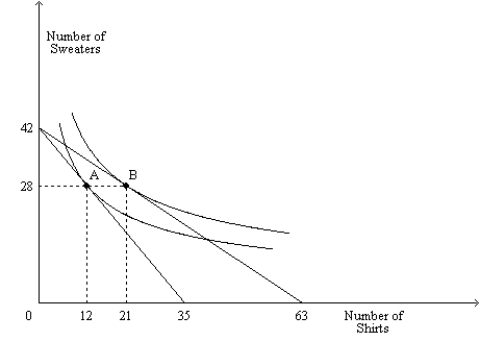 -Refer to Figure 21-31. If the price of a shirt is $20 and point B is Kevin's optimum, then what is Kevin's income?
 (Essay)
5.0/5 (86)
(86) John is planning ahead for retirement in a two-period world. When John is young he will earn $1 million, and when John is old and retired he will be given $50,000 from Social Security. If the interest rate between the two time periods is 7 percent, what is the slope of John's budget constraint when considering the consumption possibilities between the two periods if consumption when young is graphed on the horizontal axis and consumption when old is graphed on the vertical axis?
(Multiple Choice)
4.8/5 (85)
(85) Given a consumer's indifference map, the demand curve for a good can
(Multiple Choice)
4.9/5 (79)
(79) Figure 21-19 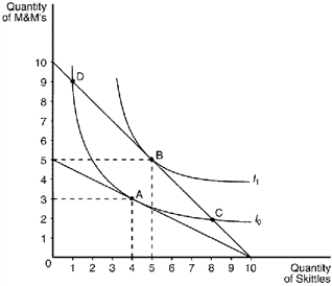 -Refer to Figure 21-19. Assume that the consumer depicted in the figure faces prices and income such that she optimizes at point B. According to the graph, which of the following would cause the consumer to move to point A?
 (Multiple Choice)
4.8/5 (69)
(69) Figure 21-8 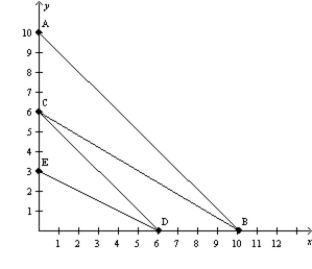 -Refer to Figure 21-8. If the price of good X is $5, and your budget constraint is DE, what is the price of good Y?
 (Multiple Choice)
4.9/5 (74)
(74) Figure 21-14 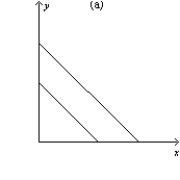
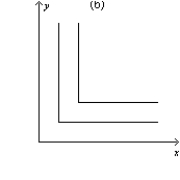
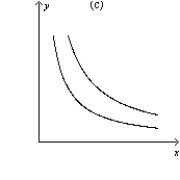 -Refer to Figure 21-14. Which of the graphs shown may represent indifference curves?
 (Multiple Choice)
4.8/5 (74)
(74) A consumer's budget constraint is drawn with the quantity of pizza measured along the horizontal axis and the price of Pepsi measured along the vertical axis. If the market is offering the consumer the trade-off of 3 pints of Pepsi for 1 pizza, then what is the slope of the consumer's budget constraint?
(Essay)
5.0/5 (77)
(77) Figure 21-14
-Refer to Figure 21-14. Which of the graphs shown represent indifference curves for perfect substitutes?
-Refer to Figure 21-14. Which of the graphs shown represent indifference curves for perfect substitutes? (Multiple Choice)
4.7/5 (85)
(85) Assume that a consumer faces the following budget constraints. 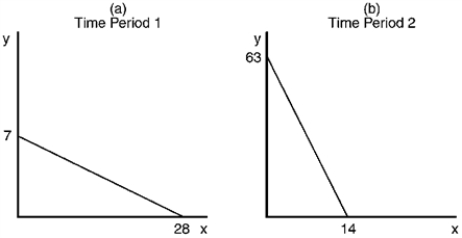 a.Assuming that income is the same on both occasions, describe the difference in relative prices between Panel A and Panel B.
b.If income in Panel B is $126, what is the price of good X?
c.If income in Panel A is $84, what is the price of good Y?
d.Assuming that the price of good X is the same on both occasions, describe the difference in income and price of good Y between Panel A and Panel B.
a.Assuming that income is the same on both occasions, describe the difference in relative prices between Panel A and Panel B.
b.If income in Panel B is $126, what is the price of good X?
c.If income in Panel A is $84, what is the price of good Y?
d.Assuming that the price of good X is the same on both occasions, describe the difference in income and price of good Y between Panel A and Panel B. (Essay)
4.9/5 (84)
(84) Figure 21-20
The following graph illustrates a representative consumer's preferences for marshmallows and chocolate chip cookies: 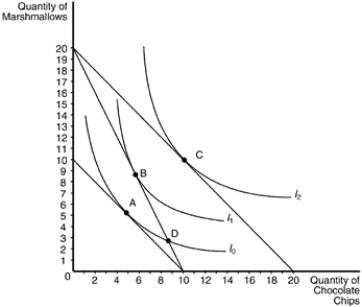 -Refer to Figure 21-20. Assume that the consumer has an income of $80. If the price of chocolate chips is $4 and the price of marshmallows is $4, the optimizing consumer would choose to purchase
 (Multiple Choice)
4.8/5 (79)
(79) Scenario 21-1
Suppose the price of hot wings is $10, the price of beer is $1, and the consumer's income is $50. In addition, suppose the consumer's budget constraint illustrates hot wings on the horizontal axis and beer on the vertical axis.
-Refer to Scenario 21-1. If the price of beer doubles to $2, then the
(Multiple Choice)
4.8/5 (69)
(69) The slope of a consumer's budget constraint is unaffected by a change in income.
(True/False)
4.9/5 (90)
(90) Suppose a consumer knows that at her current bundle, MUx/Px > MUy/Py. Is this individual choosing a bundle that maximizes utility?
(Multiple Choice)
4.8/5 (81)
(81) Figure 21-6 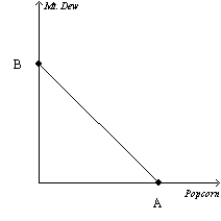 -Refer to Figure 21-6. Suppose a consumer has $200 in income, the price of popcorn is $1, and the price of Mt. Dew is $2. What is the value of B?
 (Multiple Choice)
4.9/5 (78)
(78) A consumer has preferences over two goods, X and Y. Suppose we graph this consumer's preferences (which satisfy the usual properties of indifference curves) and budget constraint on a diagram with X on the horizontal axis and Y on the vertical axis. At the consumer's current consumption bundle, the consumer is spending all available income, and the marginal rate of substitution is less than the slope of the budget constraint. We can conclude that the consumer
(Multiple Choice)
4.9/5 (92)
(92) If John's marginal utility derived from the consumption of another candy bar is 1 and the price of the candy bar is $1.50, then
(Multiple Choice)
4.8/5 (71)
(71) Figure 21-30 The graph shows two budget constraints for a consumer.  -Refer to Figure 21-30. What particular change would result in a rotation of the budget constraint from Budget Constraint A to Budget Constraint B?
 (Essay)
4.8/5 (83)
(83) 
Filters
- Essay(0)
- Multiple Choice(0)
- Short Answer(0)
- True False(0)
- Matching(0)