



 Chat with AI
Exam 21: The Theory of Consumer Choice

Exam 1: Ten Principles of Economics455 Questions
Exam 2: Thinking Like an Economist643 Questions
Exam 3: Interdependence and the Gains From Trade547 Questions
Exam 4: The Market Forces of Supply and Demand693 Questions
Exam 5: Elasticity and Its Application626 Questions
Exam 6: Supply, Demand, and Government Policies668 Questions
Exam 7: Consumers, Producers, and the Efficiency of Markets547 Questions
Exam 8: Applications: the Costs of Taxation509 Questions
Exam 9: Application: International Trade521 Questions
Exam 10: Externalities543 Questions
Exam 11: Public Goods and Common Resources452 Questions
Exam 12: The Design of the Tax System664 Questions
Exam 13: The Costs of Production649 Questions
Exam 14: Firms in Competitive Markets604 Questions
Exam 15: Monopoly662 Questions
Exam 16: Monopolistic Competition649 Questions
Exam 17: Oligopoly522 Questions
Exam 18: The Markets for the Factors of Production592 Questions
Exam 19: Earnings and Discrimination511 Questions
Exam 20: Income Inequality and Poverty478 Questions
Exam 21: The Theory of Consumer Choice570 Questions
Exam 22: Frontiers in Microeconomics461 Questions
Exam 23: Measuring a Nation S Income547 Questions
Exam 24: Measuring the Cost of Living565 Questions
Exam 25: Production and Growth527 Questions
Exam 26: Saving, Investment, and the Financial System637 Questions
Exam 27: Tools of Finance534 Questions
Exam 28: Unemployment and Its Natural Rate701 Questions
Exam 29: The Monetary System540 Questions
Exam 30: Money Growth and Inflation504 Questions
Exam 31: Open-Economy Macroeconomics: Basic Concepts540 Questions
Exam 32: A Macroeconomic Theory of the Open Economy511 Questions
Exam 33: Aggregate Demand and Aggregate Supply572 Questions
Exam 34: The Influence of Monetary and Fiscal Policy on Aggregate Demand523 Questions
Exam 35: The Short-Run Tradeoff Between Inflation and Unemployment536 Questions
Exam 36: Six Debates Over Macroeconomic Policy354 Questions
Select questions type


Evaluate the following statement, "Warren Buffet is the second richest person in the world. He doesn't face any constraint on his ability to purchase commodities he wants."
(Essay)
4.8/5  (87)
(87) Figure 21-32 The figure shows three indifference curves and a budget constraint for a consumer named Hannah. When young, Hannah works and earns income. When old, she is retired and earns no income. 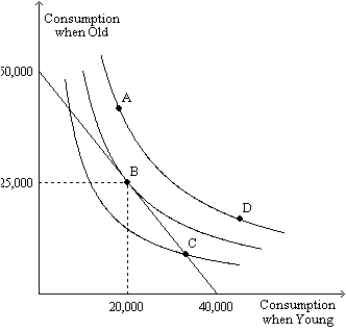 -Refer to Figure 21-32. Which of the four labeled points is Hannah's optimum?
 (Short Answer)
4.8/5 (91)
(91) Jake experiences an increase in his wages. The hours of labor that he supplies to the market would decrease if
(Multiple Choice)
4.9/5 (85)
(85) Figure 21-12 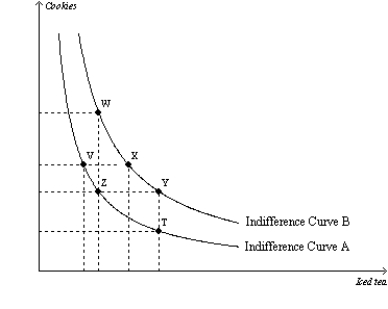 -Refer to Figure 21-12. If the consumer moves from bundle V to bundle X, the
 (Multiple Choice)
5.0/5 (87)
(87) If leisure were an inferior good, then labor supply curves
(Multiple Choice)
5.0/5 (88)
(88) Assume Victoria's indifference curves are bowed outward but her indifference curves satisfy the other three properties of indifference curves. As Victoria moves from right to left along the horizontal axis, her marginal rate of substitution
(Multiple Choice)
4.7/5 (67)
(67) For Antonio, the income effect of an interest-rate increase is stronger than the substitution effect. In response to a higher interest rate, will Antonio save more or will he save less?
(Essay)
4.8/5 (78)
(78) The slope of the budget constraint reveals the relative price of good X compared to good Y.
(True/False)
4.8/5 (71)
(71) Figure 21-10 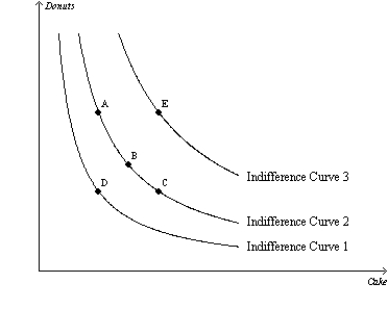 -Refer to Figure 21-10. Which of the following statements is not correct?
 (Multiple Choice)
4.9/5 (92)
(92) Giffen goods have positively-sloped demand curves because they are
(Multiple Choice)
4.8/5 (83)
(83) A consumer consumes two normal goods, sandwiches and milk. When the price of milk is $0.50 per glass, the consumer purchases 40 glasses. When the price rises to $0.65 per glass, the consumer purchases 30 glasses. We can use the information provided by the consumer's optimum choices to derive the
(Multiple Choice)
4.8/5 (78)
(78) Figure 21-21 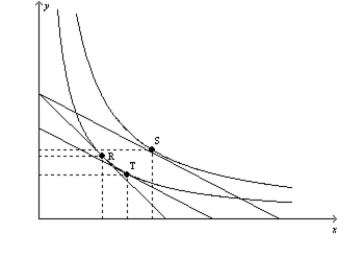 -Refer to Figure 21-21. Suppose that a consumer is originally at point R. Then the price of good X decreases. Which of the following represents the substitution effect of the price decrease?
 (Multiple Choice)
5.0/5 (78)
(78) Figure 21-14 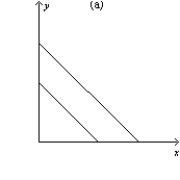
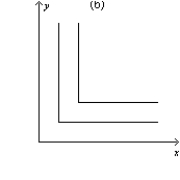
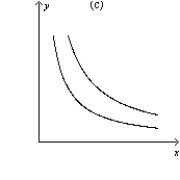 -Refer to Figure 21-14. Which of the following statements is correct?
 (Multiple Choice)
4.8/5 (91)
(91) Figure 21-3
In each case, the budget constraint moves from BC-1 to BC-2. 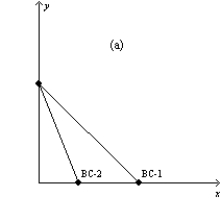
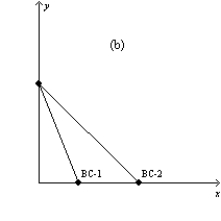
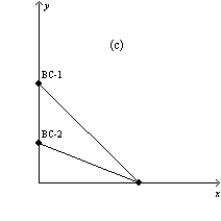
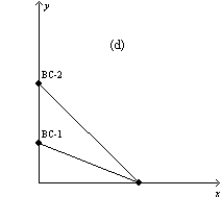 -Refer to Figure 21-3. Which of the graphs in the figure reflects an increase in the price of good Y only?
 (Multiple Choice)
4.9/5 (75)
(75) A consumer consumes two normal goods, coffee and chocolate. The price of coffee rises. The income effect, by itself, suggests that the consumer will consume
(Multiple Choice)
4.8/5 (87)
(87) For a typical consumer, most indifference curves are bowed inward.
(True/False)
4.9/5 (75)
(75) Two economists found empirical evidence that when the price of rice decreased in the Hunan province of China, local residents consumed less rice than before the price decrease. The study provides a real-world example of a(n)
(Multiple Choice)
4.8/5 (89)
(89) Figure 21-32 The figure shows three indifference curves and a budget constraint for a consumer named Hannah. When young, Hannah works and earns income. When old, she is retired and earns no income.
-Refer to Figure 21-32. What is the value of the interest rate that Hannah earns on her saving?
-Refer to Figure 21-32. What is the value of the interest rate that Hannah earns on her saving? (Essay)
4.9/5 (72)
(72) 
Filters
- Essay(0)
- Multiple Choice(0)
- Short Answer(0)
- True False(0)
- Matching(0)