



 Chat with AI
Exam 25: Production and Growth

Exam 1: Ten Principles of Economics455 Questions
Exam 2: Thinking Like an Economist643 Questions
Exam 3: Interdependence and the Gains From Trade547 Questions
Exam 4: The Market Forces of Supply and Demand693 Questions
Exam 5: Elasticity and Its Application626 Questions
Exam 6: Supply, Demand, and Government Policies668 Questions
Exam 7: Consumers, Producers, and the Efficiency of Markets547 Questions
Exam 8: Applications: the Costs of Taxation509 Questions
Exam 9: Application: International Trade521 Questions
Exam 10: Externalities543 Questions
Exam 11: Public Goods and Common Resources452 Questions
Exam 12: The Design of the Tax System664 Questions
Exam 13: The Costs of Production649 Questions
Exam 14: Firms in Competitive Markets604 Questions
Exam 15: Monopoly662 Questions
Exam 16: Monopolistic Competition649 Questions
Exam 17: Oligopoly522 Questions
Exam 18: The Markets for the Factors of Production592 Questions
Exam 19: Earnings and Discrimination511 Questions
Exam 20: Income Inequality and Poverty478 Questions
Exam 21: The Theory of Consumer Choice570 Questions
Exam 22: Frontiers in Microeconomics461 Questions
Exam 23: Measuring a Nation S Income547 Questions
Exam 24: Measuring the Cost of Living565 Questions
Exam 25: Production and Growth527 Questions
Exam 26: Saving, Investment, and the Financial System637 Questions
Exam 27: Tools of Finance534 Questions
Exam 28: Unemployment and Its Natural Rate701 Questions
Exam 29: The Monetary System540 Questions
Exam 30: Money Growth and Inflation504 Questions
Exam 31: Open-Economy Macroeconomics: Basic Concepts540 Questions
Exam 32: A Macroeconomic Theory of the Open Economy511 Questions
Exam 33: Aggregate Demand and Aggregate Supply572 Questions
Exam 34: The Influence of Monetary and Fiscal Policy on Aggregate Demand523 Questions
Exam 35: The Short-Run Tradeoff Between Inflation and Unemployment536 Questions
Exam 36: Six Debates Over Macroeconomic Policy354 Questions
Select questions type


Economist Michael Kremer found that world growth rates fell as population increased.
(True/False)
4.9/5  (74)
(74) Table 25-1.
Athens and Troy both produce only ribs and baked potatoes. 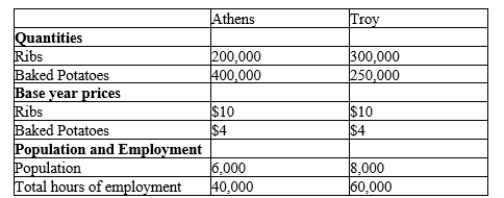 -Refer to Table 25-1. Which of the following is correct?
 (Multiple Choice)
4.8/5 (82)
(82) "When workers already have a large quantity of capital to use in producing goods and services, giving them an additional unit of capital increases their productivity only slightly." This statement
(Multiple Choice)
4.8/5 (68)
(68) The people of Country X save 10 percent of their income, and the people of Country Y save 25 percent of their income. If these respective saving rates persist forever, will one country or the other enjoy a higher rate of income growth forever? Explain.
(Essay)
4.9/5 (80)
(80) Suppose there are constant returns to scale. Now suppose that over time a country doubles its workers, its natural resources, its physical capital, and its human capital, but its technology is unchanged. Which of the following would double?
(Multiple Choice)
4.8/5 (77)
(77) Which of these countries' growth rates of real GDP per person have exceeded the United States' growth rate of real GDP per person over the last century?
(Multiple Choice)
4.8/5 (92)
(92) An organization that tries to encourage the flow of investment to poor countries is the
(Multiple Choice)
4.8/5 (79)
(79) If the best educated and most skilled persons leave a country, then in the short term this country's human capital per worker
(Multiple Choice)
4.8/5 (93)
(93) Figure 25-1 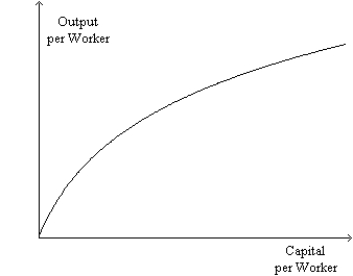 -Refer to Figure 21-1. In order for the figure to make sense, do we have to assume that capital is the only determinant of output? Briefly explain.
 (Essay)
4.8/5 (87)
(87) In medieval Europe an important technological advance was the use of the padded horse collar for plowing. Once this idea was thought of, other people used it. This illustrates that knowledge is generally a
(Multiple Choice)
4.9/5 (82)
(82) The majority of economists believe that future innovations will not be transformational enough to sustain high economic growth rates in the U.S. and western Europe.
(True/False)
4.9/5 (82)
(82) One reason that governments may find it useful to sponsor universities and basic research is that to a large extent knowledge is generally a private good.
(True/False)
4.9/5 (80)
(80) Suppose that the U.S. undertakes a policy to increase its saving rate. This policy will likely
(Multiple Choice)
4.9/5 (78)
(78) Other things equal, relatively poor countries tend to grow
(Multiple Choice)
4.9/5 (92)
(92) Figure 25-1
-Refer to Figure 21-1. "When the amount of capital per worker increases by one unit, a poor country experiences a greater benefit than does a rich country." Does the figure illustrate this notion? Briefly explain.
-Refer to Figure 21-1. "When the amount of capital per worker increases by one unit, a poor country experiences a greater benefit than does a rich country." Does the figure illustrate this notion? Briefly explain. (Essay)
4.9/5 (83)
(83) According to research by Robert Fogel, what proportion of the British population in 1780 was so malnourished that they could not perform manual labor?
(Multiple Choice)
4.8/5 (77)
(77) 
Filters
- Essay(0)
- Multiple Choice(0)
- Short Answer(0)
- True False(0)
- Matching(0)