



 Chat with AI
Exam 25: Production and Growth

Exam 1: Ten Principles of Economics455 Questions
Exam 2: Thinking Like an Economist643 Questions
Exam 3: Interdependence and the Gains From Trade547 Questions
Exam 4: The Market Forces of Supply and Demand693 Questions
Exam 5: Elasticity and Its Application626 Questions
Exam 6: Supply, Demand, and Government Policies668 Questions
Exam 7: Consumers, Producers, and the Efficiency of Markets547 Questions
Exam 8: Applications: the Costs of Taxation509 Questions
Exam 9: Application: International Trade521 Questions
Exam 10: Externalities543 Questions
Exam 11: Public Goods and Common Resources452 Questions
Exam 12: The Design of the Tax System664 Questions
Exam 13: The Costs of Production649 Questions
Exam 14: Firms in Competitive Markets604 Questions
Exam 15: Monopoly662 Questions
Exam 16: Monopolistic Competition649 Questions
Exam 17: Oligopoly522 Questions
Exam 18: The Markets for the Factors of Production592 Questions
Exam 19: Earnings and Discrimination511 Questions
Exam 20: Income Inequality and Poverty478 Questions
Exam 21: The Theory of Consumer Choice570 Questions
Exam 22: Frontiers in Microeconomics461 Questions
Exam 23: Measuring a Nation S Income547 Questions
Exam 24: Measuring the Cost of Living565 Questions
Exam 25: Production and Growth527 Questions
Exam 26: Saving, Investment, and the Financial System637 Questions
Exam 27: Tools of Finance534 Questions
Exam 28: Unemployment and Its Natural Rate701 Questions
Exam 29: The Monetary System540 Questions
Exam 30: Money Growth and Inflation504 Questions
Exam 31: Open-Economy Macroeconomics: Basic Concepts540 Questions
Exam 32: A Macroeconomic Theory of the Open Economy511 Questions
Exam 33: Aggregate Demand and Aggregate Supply572 Questions
Exam 34: The Influence of Monetary and Fiscal Policy on Aggregate Demand523 Questions
Exam 35: The Short-Run Tradeoff Between Inflation and Unemployment536 Questions
Exam 36: Six Debates Over Macroeconomic Policy354 Questions
Select questions type


You sell cupcakes. One day you double the time you spend and double all your inputs, and make twice as many cupcakes. Your cupcake production function has
(Multiple Choice)
4.8/5  (86)
(86) At first patents might seem like a deterrent to growth because in effect they restrict the use of new technology. Yet many economists believe that patents generate growth. Explain why.
(Essay)
5.0/5 (79)
(79) Other things equal, the likelihood that a country will experience a relatively-high level of income is greater if the country
(Multiple Choice)
4.8/5 (74)
(74) Other things the same, when an economy increases its saving rate
(Multiple Choice)
4.9/5 (73)
(73) In determining living standards, productivity plays a key role
(Multiple Choice)
4.8/5 (75)
(75) Both Arnold and Will work 10 hours a day. Arnold can produce six baskets of goods per hour while Will can produce four baskets of the same goods per hour. It follows that Arnold's
(Multiple Choice)
4.7/5 (86)
(86) Table 25-1.
Athens and Troy both produce only ribs and baked potatoes. 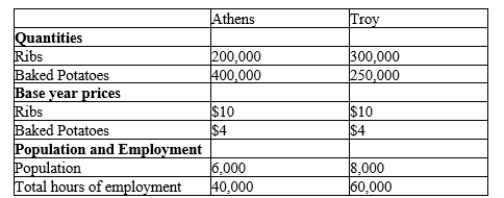 -Refer to Table 25-1. Which of the following is correct?
 (Multiple Choice)
4.8/5 (77)
(77) Electronics firms may be able to get patents on their ideas. Doing so makes their ideas
(Multiple Choice)
4.8/5 (90)
(90) How would an economist typically assess the extent of economic progress in a nation?
(Essay)
4.8/5 (84)
(84) A management professor discovers a way for corporate management to operate more efficiently. He publishes his findings in a journal. His findings are
(Multiple Choice)
4.9/5 (88)
(88) Which of the following is a correct way to measure productivity?
(Multiple Choice)
4.9/5 (67)
(67) Other things the same, domestic investment will increase a country's real GDP by more than foreign investment.
(True/False)
4.8/5 (70)
(70) If it could increase its growth rates slightly, a country with low income would catch up with rich countries in about ten years.
(True/False)
4.8/5 (68)
(68) International data on real GDP per person gives us a sense of how standards of living vary across countries.
(True/False)
5.0/5 (83)
(83) The dictator of a country requires that companies planning to open or expand must pay a large fee to file an application one year prior to building new factories or expanding existing ones. Other things the same, in the long run this requirement would
(Multiple Choice)
4.8/5 (64)
(64) One can argue that the average American today is "richer" than the richest American 100 years ago, given that 100 years ago,
(Multiple Choice)
4.9/5 (66)
(66) Suppose that the U.S. undertakes a policy to increase its saving rate. This policy will likely
(Multiple Choice)
4.9/5 (66)
(66) 
Filters
- Essay(0)
- Multiple Choice(0)
- Short Answer(0)
- True False(0)
- Matching(0)