



 Chat with AI
Exam 25: Production and Growth

Exam 1: Ten Principles of Economics455 Questions
Exam 2: Thinking Like an Economist643 Questions
Exam 3: Interdependence and the Gains From Trade547 Questions
Exam 4: The Market Forces of Supply and Demand693 Questions
Exam 5: Elasticity and Its Application626 Questions
Exam 6: Supply, Demand, and Government Policies668 Questions
Exam 7: Consumers, Producers, and the Efficiency of Markets547 Questions
Exam 8: Applications: the Costs of Taxation509 Questions
Exam 9: Application: International Trade521 Questions
Exam 10: Externalities543 Questions
Exam 11: Public Goods and Common Resources452 Questions
Exam 12: The Design of the Tax System664 Questions
Exam 13: The Costs of Production649 Questions
Exam 14: Firms in Competitive Markets604 Questions
Exam 15: Monopoly662 Questions
Exam 16: Monopolistic Competition649 Questions
Exam 17: Oligopoly522 Questions
Exam 18: The Markets for the Factors of Production592 Questions
Exam 19: Earnings and Discrimination511 Questions
Exam 20: Income Inequality and Poverty478 Questions
Exam 21: The Theory of Consumer Choice570 Questions
Exam 22: Frontiers in Microeconomics461 Questions
Exam 23: Measuring a Nation S Income547 Questions
Exam 24: Measuring the Cost of Living565 Questions
Exam 25: Production and Growth527 Questions
Exam 26: Saving, Investment, and the Financial System637 Questions
Exam 27: Tools of Finance534 Questions
Exam 28: Unemployment and Its Natural Rate701 Questions
Exam 29: The Monetary System540 Questions
Exam 30: Money Growth and Inflation504 Questions
Exam 31: Open-Economy Macroeconomics: Basic Concepts540 Questions
Exam 32: A Macroeconomic Theory of the Open Economy511 Questions
Exam 33: Aggregate Demand and Aggregate Supply572 Questions
Exam 34: The Influence of Monetary and Fiscal Policy on Aggregate Demand523 Questions
Exam 35: The Short-Run Tradeoff Between Inflation and Unemployment536 Questions
Exam 36: Six Debates Over Macroeconomic Policy354 Questions
Select questions type


Which of the following is considered human capital? Knowledge acquired from
(Multiple Choice)
4.9/5  (79)
(79) Last year real GDP per person in the imaginary nation of Olympus was 4,250. The year before it was 4,100. By about what percentage did Olympian real GDP per person grow during the period?
(Multiple Choice)
4.7/5 (84)
(84) Why is productivity related to the standard of living? In your answer be sure to explain what productivity and the standard of living mean. Make a list of things that determine labor productivity.
(Essay)
4.9/5 (90)
(90) Countries that have lower levels of real GDP per person than the United States
(Multiple Choice)
4.8/5 (76)
(76) When Americans invest in Russia, the income of Russians (that is, Russian GNP) rises by more than production in Russia (that is, Russian GDP).
(True/False)
4.9/5 (74)
(74) Suppose a country reduces restrictions on how many hours people can work. If reducing these restrictions increase the total number of hours worked in the economy, but all other factors that determine output are held fixed, then
(Multiple Choice)
4.9/5 (68)
(68) Over the period 1870-2014, the United States experienced an average annual growth rate of real GDP per person of about 1.8 percent per year.
(True/False)
4.9/5 (82)
(82) The president of Suldinia, a developing country, proposes that his country needs to help domestic firms by reducing trade restrictions.
(Multiple Choice)
4.9/5 (88)
(88) The long-run effects of an increase in the saving rate include
(Multiple Choice)
4.8/5 (80)
(80) Over the past century in the United States, real GDP per person has grown, on average, by about
(Multiple Choice)
4.9/5 (81)
(81) Figure 25-1. On the horizontal axis, K/L represents capital (K) per worker (L). On the vertical axis, Y/L represents output (Y) per worker (L). 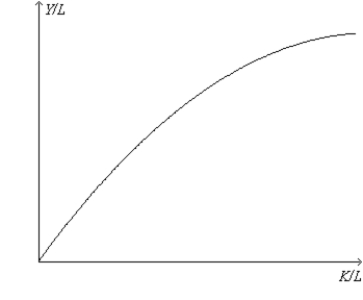 -Refer to Figure 25-1. The shape of the curve is consistent with which of the following statements about the economy to which the curve applies?
 (Multiple Choice)
4.7/5 (88)
(88) Susan and Calvin paint houses. Susan consistently paints about 400 square feet of a house's exterior per hour, while Calvin consistently paints about 300 square feet per hour. Susan's __________ exceeds that of Calvin.
(Short Answer)
4.9/5 (68)
(68) In the U.S., each additional year of schooling has historically raised a person's wage on average by about
(Multiple Choice)
4.8/5 (82)
(82) Which of the following is an example of a produced factor of production?
(Multiple Choice)
4.7/5 (81)
(81) Because of its effect on the amount of capital per worker, in the short term an increase in the working population is likely to
(Multiple Choice)
4.8/5 (77)
(77) Consider the nations of Brazil, Mexico, and Pakistan. Over the past century, which of these three nations has experienced, by far, slower economic growth than the other two nations?
(Essay)
4.9/5 (81)
(81) In the 1800s, Europeans purchased stock in American companies that used the funds to build railroads and factories. The Europeans who did this engaged in
(Multiple Choice)
4.8/5 (81)
(81) Miller's Dairy produces 960 gallons of milk per day. Each milker at the dairy works 8 hours per day and produces the same number of gallons of milk per hour. If the Dairy's productivity is 12 gallons of milk per hour of labor, then how many milkers does the shop employ?
(Multiple Choice)
4.8/5 (85)
(85) 
Filters
- Essay(0)
- Multiple Choice(0)
- Short Answer(0)
- True False(0)
- Matching(0)