



 Chat with AI
Exam 12: The Cell Cycle

Exam 1: Biology and the Tree of Life35 Questions
Exam 2: Water and Carbon: the Chemical Basis of Life53 Questions
Exam 3: Protein Structure and Function40 Questions
Exam 4: Nucleic Acids and the Rna World40 Questions
Exam 5: An Introduction to Carbohydrates42 Questions
Exam 6: Lipids, Membranes, and the First Cells53 Questions
Exam 7: Inside the Cell41 Questions
Exam 8: Energy and Enzymes59 Questions
Exam 9: Cellular Respiration and Fermentation43 Questions
Exam 10: Photosynthesis41 Questions
Exam 11: Cellcell Interactions38 Questions
Exam 12: The Cell Cycle39 Questions
Exam 13: Meiosis40 Questions
Exam 14: Mendel and the Gene47 Questions
Exam 15: Dna and the Gene: Synthesis and Repair39 Questions
Exam 16: How Genes Work39 Questions
Exam 17: Transcription, Rna Processing, and Translation37 Questions
Exam 18: Control of Gene Expression in Bacteria38 Questions
Exam 19: Control of Gene Expression in Eukaryotes40 Questions
Exam 20: The Molecular Revolution: Biotechnology and Beyond39 Questions
Exam 21: Gene Structure and Development39 Questions
Exam 22: Evolution by Natural Selection42 Questions
Exam 23: Evolutionary Processes48 Questions
Exam 24: Speciation40 Questions
Exam 25: Phylogenies and the History of Life37 Questions
Exam 26: Bacteria and Archaea38 Questions
Exam 27: Protists36 Questions
Exam 28: Green Algae and Land Plants54 Questions
Exam 29: Fungi40 Questions
Exam 30: An Introduction to Animals42 Questions
Exam 31: Protostome Animals38 Questions
Exam 32: Deuterostome Animals43 Questions
Exam 33: Viruses35 Questions
Exam 34: Plant Form and Function39 Questions
Exam 35: Water and Sugar Transport in Plants42 Questions
Exam 36: Plant Nutrition37 Questions
Exam 37: Plant Sensory Systems, Signals, and Responses64 Questions
Exam 38: Plant Reproduction and Development44 Questions
Exam 39: Animal Form and Function37 Questions
Exam 40: Water and Electrolyte Balance in Animals41 Questions
Exam 41: Animal Nutrition43 Questions
Exam 42: Gas Exchange and Circulation46 Questions
Exam 43: Animal Nervous Systems40 Questions
Exam 44: Animal Sensory Systems43 Questions
Exam 45: Animal Movement42 Questions
Exam 46: Chemical Signals in Animals38 Questions
Exam 47: Animal Reproduction and Development39 Questions
Exam 48: The Immune System in Animals38 Questions
Exam 49: An Introduction to Ecology40 Questions
Exam 50: Behavioural Ecology39 Questions
Exam 51: Population Ecology49 Questions
Exam 52: Community Ecology38 Questions
Exam 53: Ecosystems and Global Ecology41 Questions
Exam 54: Biodiversity and Conservation Biology38 Questions
Select questions type


At which stage does chromosome organization change from diffuse/uncondensed to a compact/condensed state?
(Multiple Choice)
4.8/5  (72)
(72) A parent cell divides to form two genetically identical daughter cells in the process of mitosis. For mitosis to take place
(Multiple Choice)
4.8/5 (92)
(92) In human and many other eukaryotic species' cells, the nuclear membrane has to disappear in order for what to take place?
(Multiple Choice)
4.9/5 (78)
(78) The microtubular organizing center found in animal cells is an identifiable structure present during all phases of the cell cycle. Specifically, it is known as which of the following?
(Multiple Choice)
4.9/5 (96)
(96) What happens when MPF mitosis- promoting factor) is introduced into immature frog oocytes that are arrested in G2?
(Multiple Choice)
4.8/5 (69)
(69) DNA is composed of four nucleosides: adenosine, cytidine, thymidine, and guanosine. If scientists introduced radioactive thymidine into the growth medium of the cells, it would be incorporated into the DNA molecule
(Multiple Choice)
4.8/5 (71)
(71) Which cytoskeletal proteins are important constituents of the contractile structures that form the cleavage furrows involved in animal cell cytokinesis?
(Multiple Choice)
4.9/5 (84)
(84) FtsZ is a bacterial cytoskeletal protein. It forms a contractile ring involved in bacterial cytokinesis. Its function is analogous to
(Multiple Choice)
4.7/5 (80)
(80) Nerve cells lose their ability to undergo mitosis. Instead, they are permanently stuck in
(Multiple Choice)
4.8/5 (89)
(89) In the process of chromosome separation, how do microtubules maintain contact with the kinetochores and shorten at the same time?
(Multiple Choice)
4.9/5 (79)
(79) The drug cytochalasin B blocks the function of actin. Which of the following aspects of the cell cycle would be most disrupted by cytochalasin B?
(Multiple Choice)
4.7/5 (81)
(81) Researchers pulsed rapidly dividing cultured cells for 30 minutes with radioactive thymidine. The cells were then exposed to a solution containing non- radiolabeled thymidine. Cells were analyzed at 2- hour intervals. At the 2- hour time point, no cells appeared to be dividing. Only after 4 hours did some labeled cells appear to be in M phase. This result can be explained in the following way:
(Multiple Choice)
4.8/5 (87)
(87) Following the attachment of spindle microtubules to kinetochores, chromosomes are moved around by
(Multiple Choice)
4.9/5 (82)
(82) 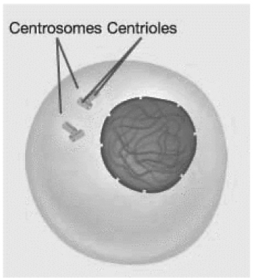 Figure 12.1
-Based on structures present in the figure above, this cell is in which substage of interphase?
Figure 12.1
-Based on structures present in the figure above, this cell is in which substage of interphase? (Multiple Choice)
4.8/5 (81)
(81) Masses of noninvasive cells that remain at their site of origin are known as _ tumours.
(Multiple Choice)
4.8/5 (92)
(92) Regulatory proteins that serve to prevent a cell from entering the S phase under conditions of DNA damage are also known as
(Multiple Choice)
4.8/5 (81)
(81) 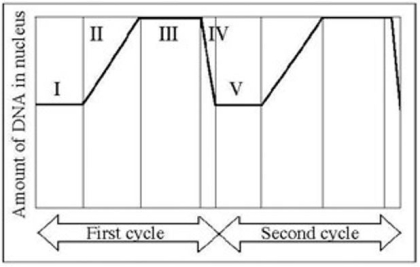 In the figure provided, G1 is represented by which numbered parts) of the cycle?
 (Multiple Choice)
4.8/5 (86)
(86) 
Filters
- Essay(0)
- Multiple Choice(0)
- Short Answer(0)
- True False(0)
- Matching(0)