



 Chat with AI
Exam 13: Meiosis

Exam 1: Biology and the Tree of Life35 Questions
Exam 2: Water and Carbon: the Chemical Basis of Life53 Questions
Exam 3: Protein Structure and Function40 Questions
Exam 4: Nucleic Acids and the Rna World40 Questions
Exam 5: An Introduction to Carbohydrates42 Questions
Exam 6: Lipids, Membranes, and the First Cells53 Questions
Exam 7: Inside the Cell41 Questions
Exam 8: Energy and Enzymes59 Questions
Exam 9: Cellular Respiration and Fermentation43 Questions
Exam 10: Photosynthesis41 Questions
Exam 11: Cellcell Interactions38 Questions
Exam 12: The Cell Cycle39 Questions
Exam 13: Meiosis40 Questions
Exam 14: Mendel and the Gene47 Questions
Exam 15: Dna and the Gene: Synthesis and Repair39 Questions
Exam 16: How Genes Work39 Questions
Exam 17: Transcription, Rna Processing, and Translation37 Questions
Exam 18: Control of Gene Expression in Bacteria38 Questions
Exam 19: Control of Gene Expression in Eukaryotes40 Questions
Exam 20: The Molecular Revolution: Biotechnology and Beyond39 Questions
Exam 21: Gene Structure and Development39 Questions
Exam 22: Evolution by Natural Selection42 Questions
Exam 23: Evolutionary Processes48 Questions
Exam 24: Speciation40 Questions
Exam 25: Phylogenies and the History of Life37 Questions
Exam 26: Bacteria and Archaea38 Questions
Exam 27: Protists36 Questions
Exam 28: Green Algae and Land Plants54 Questions
Exam 29: Fungi40 Questions
Exam 30: An Introduction to Animals42 Questions
Exam 31: Protostome Animals38 Questions
Exam 32: Deuterostome Animals43 Questions
Exam 33: Viruses35 Questions
Exam 34: Plant Form and Function39 Questions
Exam 35: Water and Sugar Transport in Plants42 Questions
Exam 36: Plant Nutrition37 Questions
Exam 37: Plant Sensory Systems, Signals, and Responses64 Questions
Exam 38: Plant Reproduction and Development44 Questions
Exam 39: Animal Form and Function37 Questions
Exam 40: Water and Electrolyte Balance in Animals41 Questions
Exam 41: Animal Nutrition43 Questions
Exam 42: Gas Exchange and Circulation46 Questions
Exam 43: Animal Nervous Systems40 Questions
Exam 44: Animal Sensory Systems43 Questions
Exam 45: Animal Movement42 Questions
Exam 46: Chemical Signals in Animals38 Questions
Exam 47: Animal Reproduction and Development39 Questions
Exam 48: The Immune System in Animals38 Questions
Exam 49: An Introduction to Ecology40 Questions
Exam 50: Behavioural Ecology39 Questions
Exam 51: Population Ecology49 Questions
Exam 52: Community Ecology38 Questions
Exam 53: Ecosystems and Global Ecology41 Questions
Exam 54: Biodiversity and Conservation Biology38 Questions
Select questions type


Hexaploid wheat was produced synthetically by He and coworkers. They mated the diploid species, Aegilops tauschii, and the tetraploid species, T. turgidum. Which of the following is an accurate statement about the relative contribution of each parent to the genome of the hexaploid offspring?
(Multiple Choice)
4.9/5  (84)
(84) Chromosome number of hexaploid wheat, Triticum aestivum, can be represented by which of the following?
(Multiple Choice)
4.9/5 (84)
(84) Genetic recombination takes place in which of the following processes?
(Multiple Choice)
4.9/5 (69)
(69) Somatic cells of roundworms have four chromosomes. How many chromosomes would you find in an ovum from a roundworm?
(Multiple Choice)
4.8/5 (79)
(79) Adaptation to a changing environment is likely to occurs most quickly through which of the following processes?
(Multiple Choice)
4.9/5 (75)
(75) The diploid number of a roundworm species is 4. You have a male and a female roundworm that are planning a family. Assuming random segregation of homologues during meiosis and no crossover, how many different possible combinations of chromosomes might there be in the offspring?
(Multiple Choice)
4.9/5 (59)
(59) Asexual reproduction takes place by which of the following processes?
(Multiple Choice)
5.0/5 (80)
(80) Meiosis involves the creation of haploid cells from diploid cells. The haploid chromosome number is created when
(Multiple Choice)
4.8/5 (84)
(84) In sexual reproduction, the variation among offspring, and the fact that they are genetically different from their parents, is due to which of the following?
(Multiple Choice)
4.7/5 (74)
(74) 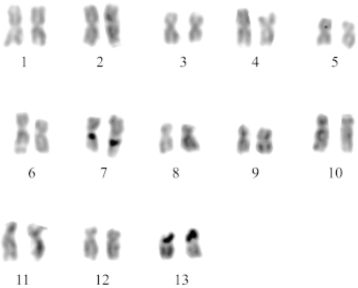 Figure 13.2
-The karyotype shown above is that of a snail, Pomacea patula catemacensis. What is the diploid number for this organism?
Figure 13.2
-The karyotype shown above is that of a snail, Pomacea patula catemacensis. What is the diploid number for this organism? (Multiple Choice)
4.7/5 (75)
(75) 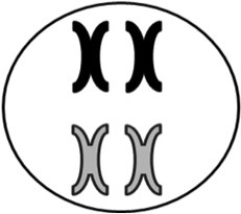 Figure 13.6
-Just prior to meiosis, DNA is replicated. Each resulting piece of replicated DNA is considered to be chromosomes) and is made up of chromatics).
Figure 13.6
-Just prior to meiosis, DNA is replicated. Each resulting piece of replicated DNA is considered to be chromosomes) and is made up of chromatics). (Multiple Choice)
4.7/5 (93)
(93) 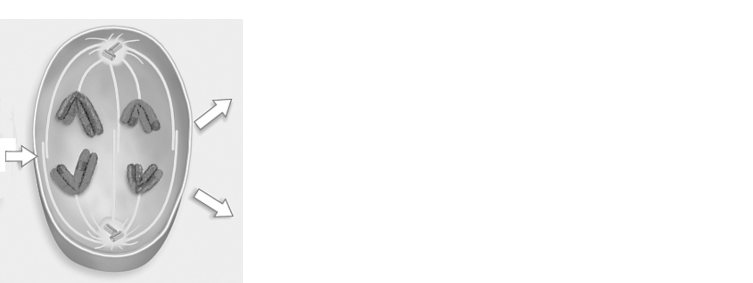 Figure 13.3
-In Figure 13.3, what major event is taking place during this phase of meiosis?
Figure 13.3
-In Figure 13.3, what major event is taking place during this phase of meiosis? (Multiple Choice)
4.7/5 (88)
(88) 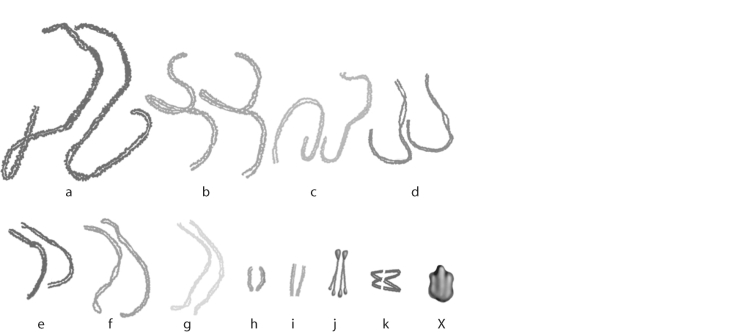 Figure 13.5
-Grasshoppers have 11 pair of autosomes, and one sex chromosome. Which chromosome in Figure 13.5 is the sex chromosome?
Figure 13.5
-Grasshoppers have 11 pair of autosomes, and one sex chromosome. Which chromosome in Figure 13.5 is the sex chromosome? (Multiple Choice)
5.0/5 (86)
(86) Chromosomes and their homologues align at the equator of the cell during
(Multiple Choice)
4.8/5 (82)
(82) 
Filters
- Essay(0)
- Multiple Choice(0)
- Short Answer(0)
- True False(0)
- Matching(0)