



 Chat with AI
Exam 16: How Genes Work

Exam 1: Biology and the Tree of Life35 Questions
Exam 2: Water and Carbon: the Chemical Basis of Life53 Questions
Exam 3: Protein Structure and Function40 Questions
Exam 4: Nucleic Acids and the Rna World40 Questions
Exam 5: An Introduction to Carbohydrates42 Questions
Exam 6: Lipids, Membranes, and the First Cells53 Questions
Exam 7: Inside the Cell41 Questions
Exam 8: Energy and Enzymes59 Questions
Exam 9: Cellular Respiration and Fermentation43 Questions
Exam 10: Photosynthesis41 Questions
Exam 11: Cellcell Interactions38 Questions
Exam 12: The Cell Cycle39 Questions
Exam 13: Meiosis40 Questions
Exam 14: Mendel and the Gene47 Questions
Exam 15: Dna and the Gene: Synthesis and Repair39 Questions
Exam 16: How Genes Work39 Questions
Exam 17: Transcription, Rna Processing, and Translation37 Questions
Exam 18: Control of Gene Expression in Bacteria38 Questions
Exam 19: Control of Gene Expression in Eukaryotes40 Questions
Exam 20: The Molecular Revolution: Biotechnology and Beyond39 Questions
Exam 21: Gene Structure and Development39 Questions
Exam 22: Evolution by Natural Selection42 Questions
Exam 23: Evolutionary Processes48 Questions
Exam 24: Speciation40 Questions
Exam 25: Phylogenies and the History of Life37 Questions
Exam 26: Bacteria and Archaea38 Questions
Exam 27: Protists36 Questions
Exam 28: Green Algae and Land Plants54 Questions
Exam 29: Fungi40 Questions
Exam 30: An Introduction to Animals42 Questions
Exam 31: Protostome Animals38 Questions
Exam 32: Deuterostome Animals43 Questions
Exam 33: Viruses35 Questions
Exam 34: Plant Form and Function39 Questions
Exam 35: Water and Sugar Transport in Plants42 Questions
Exam 36: Plant Nutrition37 Questions
Exam 37: Plant Sensory Systems, Signals, and Responses64 Questions
Exam 38: Plant Reproduction and Development44 Questions
Exam 39: Animal Form and Function37 Questions
Exam 40: Water and Electrolyte Balance in Animals41 Questions
Exam 41: Animal Nutrition43 Questions
Exam 42: Gas Exchange and Circulation46 Questions
Exam 43: Animal Nervous Systems40 Questions
Exam 44: Animal Sensory Systems43 Questions
Exam 45: Animal Movement42 Questions
Exam 46: Chemical Signals in Animals38 Questions
Exam 47: Animal Reproduction and Development39 Questions
Exam 48: The Immune System in Animals38 Questions
Exam 49: An Introduction to Ecology40 Questions
Exam 50: Behavioural Ecology39 Questions
Exam 51: Population Ecology49 Questions
Exam 52: Community Ecology38 Questions
Exam 53: Ecosystems and Global Ecology41 Questions
Exam 54: Biodiversity and Conservation Biology38 Questions
Select questions type


How might a single base substitution in the sequence of a gene affect the amino acid sequence of a protein encoded by the gene, and why?
(Multiple Choice)
4.8/5  (80)
(80) Once researchers identified DNA as the unit of inheritance, they asked how information was transferred from the DNA in the nucleus to the site of protein synthesis in the cytoplasm. What is the mechanism of information transfer?
(Multiple Choice)
4.8/5 (79)
(79)  Figure 16.3
Above is a metabolic pathway for the synthesis of an amino acid E), without which an organism could not live. Enzymes are represented by numbers, and substrates by letters. Use this figure for the next questions.
-According to the figure above, if enzyme 3 was nonfunctional in an organism, which of the following outcomes would you predict?
Figure 16.3
Above is a metabolic pathway for the synthesis of an amino acid E), without which an organism could not live. Enzymes are represented by numbers, and substrates by letters. Use this figure for the next questions.
-According to the figure above, if enzyme 3 was nonfunctional in an organism, which of the following outcomes would you predict? (Multiple Choice)
4.8/5 (79)
(79) All three domains Bacteria, Archaea, and Eukarya) follow the same genetic code. Which of the following statements would most likely be accurate given that information?
(Multiple Choice)
4.8/5 (80)
(80) The proteome is all the proteins produced by an organism. The genome is the totality of all genes of an organism. If the proteome is much larger than the genome, which of the following statements would be accurate?
(Multiple Choice)
4.8/5 (76)
(76) According to the central dogma, what molecule should go in the blank? DNA - _ - Proteins
(Multiple Choice)
4.9/5 (81)
(81) Use the figure to answer the following questions).
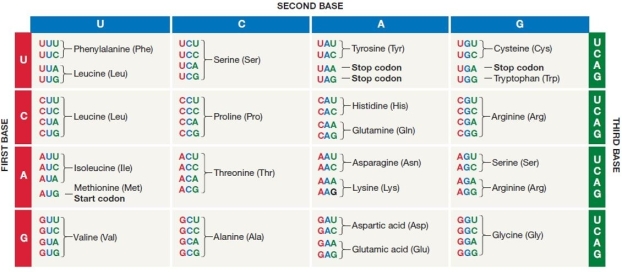 Figure 16.5
-Refer to Figure 16.5. A possible sequence of nucleotides in the template strand of DNA that would code for the polypeptide sequence Phe- Leu- Ile- Val would be
Figure 16.5
-Refer to Figure 16.5. A possible sequence of nucleotides in the template strand of DNA that would code for the polypeptide sequence Phe- Leu- Ile- Val would be (Multiple Choice)
5.0/5 (76)
(76) The term "point" in point mutation is in reference to which of the following?
(Multiple Choice)
4.8/5 (68)
(68) Which of the following observations may have resulted in the hypothesis that a codon is made up of three bases?
(Multiple Choice)
4.8/5 (50)
(50) The synthesis of RNA through complementary base pairing is known as
(Multiple Choice)
4.9/5 (82)
(82) Figure 16.1
Mutant Strain Medium with: Medium with: Medium with: Medium with: No ornithine Ornithine No ornithine No ornithine No citrulline No citrulline Citrulline No citrulline No arginine No arginine No Arginine Arginine argl no growth GROWTH GROWTH GROWTH arg2 no growth no growth GROWTH GROWTH arg3 no growth no growth no growth GROWTH  -According to the table and Figure 16.1, which enzyme is defective in the strain with the arg2 mutation?
 (Multiple Choice)
4.8/5 (70)
(70) What does it mean when we say the genetic code is redundant?
(Multiple Choice)
4.9/5 (87)
(87) The original DNA has the base sequence AGCGTTACCGT; a mutation in the DNA strand results in the base sequence AGGCGTTACCGT. What does this tell you about the mutation?
(Multiple Choice)
4.8/5 (86)
(86) Use the figure to answer the following questions).
Figure 16.5
-Refer to Figure 16.5. If the codon CAC was present in the ribosome A site, which amino acid would be added?
Figure 16.5
-Refer to Figure 16.5. If the codon CAC was present in the ribosome A site, which amino acid would be added? (Multiple Choice)
4.8/5 (81)
(81) 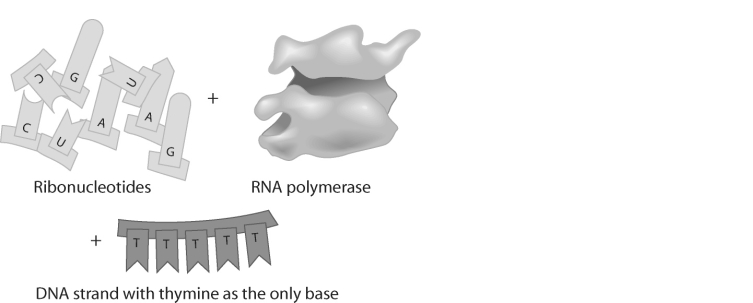 Figure 16.4
-A particular triplet of bases in the template strand of DNA is 5' AGT 3'. The corresponding codon for the mRNA transcribed is
Figure 16.4
-A particular triplet of bases in the template strand of DNA is 5' AGT 3'. The corresponding codon for the mRNA transcribed is (Multiple Choice)
4.9/5 (83)
(83) What feature makes organisms less vulnerable to small mutations in DNA replication that are not corrected?
(Multiple Choice)
4.9/5 (64)
(64) There are three stop codons nonsense codons); all remaining codons specify addition of an amino acid sense codons). How many sense codons are there?
(Multiple Choice)
4.8/5 (81)
(81) 
Filters
- Essay(0)
- Multiple Choice(0)
- Short Answer(0)
- True False(0)
- Matching(0)