



 Chat with AI
Exam 20: The Molecular Revolution: Biotechnology and Beyond

Exam 1: Biology and the Tree of Life35 Questions
Exam 2: Water and Carbon: the Chemical Basis of Life53 Questions
Exam 3: Protein Structure and Function40 Questions
Exam 4: Nucleic Acids and the Rna World40 Questions
Exam 5: An Introduction to Carbohydrates42 Questions
Exam 6: Lipids, Membranes, and the First Cells53 Questions
Exam 7: Inside the Cell41 Questions
Exam 8: Energy and Enzymes59 Questions
Exam 9: Cellular Respiration and Fermentation43 Questions
Exam 10: Photosynthesis41 Questions
Exam 11: Cellcell Interactions38 Questions
Exam 12: The Cell Cycle39 Questions
Exam 13: Meiosis40 Questions
Exam 14: Mendel and the Gene47 Questions
Exam 15: Dna and the Gene: Synthesis and Repair39 Questions
Exam 16: How Genes Work39 Questions
Exam 17: Transcription, Rna Processing, and Translation37 Questions
Exam 18: Control of Gene Expression in Bacteria38 Questions
Exam 19: Control of Gene Expression in Eukaryotes40 Questions
Exam 20: The Molecular Revolution: Biotechnology and Beyond39 Questions
Exam 21: Gene Structure and Development39 Questions
Exam 22: Evolution by Natural Selection42 Questions
Exam 23: Evolutionary Processes48 Questions
Exam 24: Speciation40 Questions
Exam 25: Phylogenies and the History of Life37 Questions
Exam 26: Bacteria and Archaea38 Questions
Exam 27: Protists36 Questions
Exam 28: Green Algae and Land Plants54 Questions
Exam 29: Fungi40 Questions
Exam 30: An Introduction to Animals42 Questions
Exam 31: Protostome Animals38 Questions
Exam 32: Deuterostome Animals43 Questions
Exam 33: Viruses35 Questions
Exam 34: Plant Form and Function39 Questions
Exam 35: Water and Sugar Transport in Plants42 Questions
Exam 36: Plant Nutrition37 Questions
Exam 37: Plant Sensory Systems, Signals, and Responses64 Questions
Exam 38: Plant Reproduction and Development44 Questions
Exam 39: Animal Form and Function37 Questions
Exam 40: Water and Electrolyte Balance in Animals41 Questions
Exam 41: Animal Nutrition43 Questions
Exam 42: Gas Exchange and Circulation46 Questions
Exam 43: Animal Nervous Systems40 Questions
Exam 44: Animal Sensory Systems43 Questions
Exam 45: Animal Movement42 Questions
Exam 46: Chemical Signals in Animals38 Questions
Exam 47: Animal Reproduction and Development39 Questions
Exam 48: The Immune System in Animals38 Questions
Exam 49: An Introduction to Ecology40 Questions
Exam 50: Behavioural Ecology39 Questions
Exam 51: Population Ecology49 Questions
Exam 52: Community Ecology38 Questions
Exam 53: Ecosystems and Global Ecology41 Questions
Exam 54: Biodiversity and Conservation Biology38 Questions
Select questions type


Which of the following questions is asked in functional genomics research?
(Multiple Choice)
5.0/5  (105)
(105) The final step in a DNA sequencing reaction is to run the DNA fragments on a gel. What purpose does this serve?
(Multiple Choice)
4.9/5 (72)
(72) Since dideoxy sequencing is based on the chain termination, why are normal deoxynucleotides also included in the reaction?
(Multiple Choice)
4.9/5 (65)
(65) Imagine that you are searching for the gene associated with nail- patella syndrome, a dominant genetic disorder that causes developmental abnormalities. In a large pedigree, you discover an association between nail- patella syndrome and a genetic marker that occurs in two different alleles, A and B. Fifteen individuals within this pedigree have nail- patella syndrome and are A/B heterozygotes for the marker. Thirty individuals within this pedigree don't suffer from nail- patella syndrome and are homozygous for the A marker allele. One individual within this pedigree has nail- patella syndrome and is also homozygous for the A marker allele. The most likely explanation for this exceptional individual is
(Multiple Choice)
4.8/5 (92)
(92) Imagine that you compare two DNA sequences found in the same location on homologous chromosomes. On one of the homologs, the sequence is AACTACGA. On the other homolog, the sequence is AACTTCGA. Within a population, you discover that each of these sequences is common. These sequences
(Multiple Choice)
4.9/5 (88)
(88) Unequal crossing over during prophase I can result in one sister chromosome with a deletion and another with a duplication. A mutated form of hemoglobin, so- called hemoglobin Lepore, exists in the human population. Hemoglobin Lepore has a deleted series of amino acids. If this mutated form was caused by unequal crossing over, what would be an expected consequence?
(Multiple Choice)
4.9/5 (81)
(81) Use the following information when answering the corresponding questions).
A study by Krings et al. investigated Neanderthal DNA by amplifying 30 000- year- old samples and sequencing it. M. Krings Stone, R.W. Schmitz, H. Krainitzki, M. Stoneking, and S. Pääbo. 1997. Neandertal DNA sequences and the origin of modern humans. Cell 90:19- 30).
Here is part of the lead paragraph in the "Methods" section of the Krings et al. paper:
Protective clothing was worn throughout the sampling procedure. Instruments used were treated with 1 M HCl followed by e rinsing in distilled water. After removal, the sample was immediately put into a sterile tube for transport to Munich. All subse manipulations of the sample, and experimental procedures prior to cycling of PCR reactions, were carried out in laboratories dedicated to the analysis of archaeological specimens, where protective clothing, separate equipment and reagents, UV irradia other measures to...
A concluding paragraph of the Krings et al. paper states:
It must be emphasized that the above conclusions are based on a single individual sequence; the retrieval and analysis of mtD sequences from additional Neanderthal specimens is obviously desirable. If this proves possible, then the potential exists to address several questions concerning Neanderthals that hitherto could be studied exclusively by morphological and archaeological approaches. For example, the genetic relationship between Neanderthal populations in Europe and in western Asia could be explored, as could the demographic history of Neanderthal populations.
-How could the "demographic history of Neanderthal populations" be explored if mitochondrial DNA from other Neanderthal samples could be PCR amplified?
(Multiple Choice)
4.8/5 (88)
(88) When constructing a cDNA library from a particular organism, the choice of tissue is , whereas when constructing a genomic DNA library from the same organism, the choice of tissue is .
(Multiple Choice)
4.7/5 (72)
(72) Many identical copies of genes cloned in bacteria are produced as a result of
(Multiple Choice)
5.0/5 (89)
(89) Name two examples of lateral gene transfer to eukaryotes that involve cellular organelles.
(Multiple Choice)
4.7/5 (76)
(76) The comparison between the number of human genes and those of other animal species has led to many conclusions, including which of the following?
(Multiple Choice)
4.9/5 (73)
(73) The restriction enzymes BamHI and BclI cut at the points indicated by arrows:
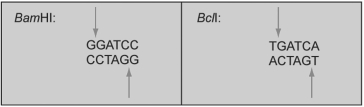 If one sample of DNA was cut with BamHI and another with BclI, and these two samples were mixed and treate DNA ligase, what would occur?
 (Multiple Choice)
4.8/5 (87)
(87) What does bioinformatics include?
I. using computer programs to align DNA sequences
II. creating recombinant DNA from separate species
III. developing computer- based tools for genome analysis
IV. using mathematical tools to make sense of biological systems
(Multiple Choice)
4.8/5 (74)
(74) The general term for the manipulation of organisms to create products or cure disease is
(Multiple Choice)
4.8/5 (85)
(85) In a single PCR cycle consisting of 15 seconds at 94°C, 30 seconds at 50°C, and 1 min at 72°C, what is happening in the step run at 50°C?
(Multiple Choice)
4.7/5 (81)
(81) 
Filters
- Essay(0)
- Multiple Choice(0)
- Short Answer(0)
- True False(0)
- Matching(0)