



 Chat with AI
Exam 27: Protists

Exam 1: Biology and the Tree of Life35 Questions
Exam 2: Water and Carbon: the Chemical Basis of Life53 Questions
Exam 3: Protein Structure and Function40 Questions
Exam 4: Nucleic Acids and the Rna World40 Questions
Exam 5: An Introduction to Carbohydrates42 Questions
Exam 6: Lipids, Membranes, and the First Cells53 Questions
Exam 7: Inside the Cell41 Questions
Exam 8: Energy and Enzymes59 Questions
Exam 9: Cellular Respiration and Fermentation43 Questions
Exam 10: Photosynthesis41 Questions
Exam 11: Cellcell Interactions38 Questions
Exam 12: The Cell Cycle39 Questions
Exam 13: Meiosis40 Questions
Exam 14: Mendel and the Gene47 Questions
Exam 15: Dna and the Gene: Synthesis and Repair39 Questions
Exam 16: How Genes Work39 Questions
Exam 17: Transcription, Rna Processing, and Translation37 Questions
Exam 18: Control of Gene Expression in Bacteria38 Questions
Exam 19: Control of Gene Expression in Eukaryotes40 Questions
Exam 20: The Molecular Revolution: Biotechnology and Beyond39 Questions
Exam 21: Gene Structure and Development39 Questions
Exam 22: Evolution by Natural Selection42 Questions
Exam 23: Evolutionary Processes48 Questions
Exam 24: Speciation40 Questions
Exam 25: Phylogenies and the History of Life37 Questions
Exam 26: Bacteria and Archaea38 Questions
Exam 27: Protists36 Questions
Exam 28: Green Algae and Land Plants54 Questions
Exam 29: Fungi40 Questions
Exam 30: An Introduction to Animals42 Questions
Exam 31: Protostome Animals38 Questions
Exam 32: Deuterostome Animals43 Questions
Exam 33: Viruses35 Questions
Exam 34: Plant Form and Function39 Questions
Exam 35: Water and Sugar Transport in Plants42 Questions
Exam 36: Plant Nutrition37 Questions
Exam 37: Plant Sensory Systems, Signals, and Responses64 Questions
Exam 38: Plant Reproduction and Development44 Questions
Exam 39: Animal Form and Function37 Questions
Exam 40: Water and Electrolyte Balance in Animals41 Questions
Exam 41: Animal Nutrition43 Questions
Exam 42: Gas Exchange and Circulation46 Questions
Exam 43: Animal Nervous Systems40 Questions
Exam 44: Animal Sensory Systems43 Questions
Exam 45: Animal Movement42 Questions
Exam 46: Chemical Signals in Animals38 Questions
Exam 47: Animal Reproduction and Development39 Questions
Exam 48: The Immune System in Animals38 Questions
Exam 49: An Introduction to Ecology40 Questions
Exam 50: Behavioural Ecology39 Questions
Exam 51: Population Ecology49 Questions
Exam 52: Community Ecology38 Questions
Exam 53: Ecosystems and Global Ecology41 Questions
Exam 54: Biodiversity and Conservation Biology38 Questions
Select questions type


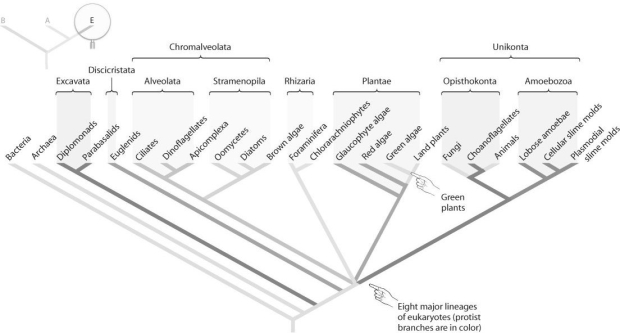 Figure 27.2
-Refer to the figure above and consider the following data: Brown algae protists) include unicellular and multicellular organisms. Red algae protists) include unicellular and multicellular organisms. Amoebae protists) include unicellular and multicellular organisms. Which of the following conclusions is consistent with the data presented?
Figure 27.2
-Refer to the figure above and consider the following data: Brown algae protists) include unicellular and multicellular organisms. Red algae protists) include unicellular and multicellular organisms. Amoebae protists) include unicellular and multicellular organisms. Which of the following conclusions is consistent with the data presented? (Multiple Choice)
4.9/5  (74)
(74) Which of the following characteristics is true of all protists?
(Multiple Choice)
4.9/5 (76)
(76) Which of the following groups is matched with an incorrect anatomical feature?
(Multiple Choice)
4.8/5 (77)
(77) The microsporidian Brachiola gambiae parasitizes the mosquito Anopheles gambiae. Adult female mosquitoes must take blood meals for their eggs to develop, and it is while they take blood that they transmit malarial parasites to humans. Male mosquitoes drink flower nectar. If humans are to safely and effectively use Brachiola gambiae as
A biological control to reduce human deaths from malaria, then how many of the following statements should be
1) Brachiola should kill the mosquitoes before the malarial parasite they carry reaches maturity.
2) The microsporidian should not be harmful to other insects.
3) Microsporidians should infect mosquito larvae, rather than mosquito adults.
4) The subsequent decline in anopheline mosquitoes should not significantly disrupt human food resources or food webs.
5) Brachiola must be harmful to male mosquitoes but not to female mosquitoes.
(Multiple Choice)
4.9/5 (86)
(86) Which of the major lineages of eukaryotes contain pronounced "feeding grooves" for digesting prey or organic debris?
(Multiple Choice)
4.8/5 (76)
(76) According to the endosymbiotic theory, why was it adaptive for the larger host) cell to keep the engulfed cell alive, rather than digesting it as food?
(Multiple Choice)
4.9/5 (89)
(89) Use the following information when answering the corresponding questions).
The mechanism of cell crawling in protist species is not well defined. The textbook states that pseudopodia extension involves interactions between actin and myosin the same molecules that are involved in mammalian muscle contraction). However, p the study described below, no one had provided convincing data that actin and myosin were actually involved in cell crawlin protists. Anatomical studies had identified the cytoskeletal protein actin just below the surface of the cell membrane in severa of protist, but physiological studies had failed to show a functional link between actin, myosin, and cell crawling.
In a study by N. Poulsen et al. Diatom gliding is the result of an actin- myosin motility system, Cell Motility and the Cytoskeleto 1999):23- 22), researchers tested whether motility in a particular species of diatom involves interactions between actin and myosin.
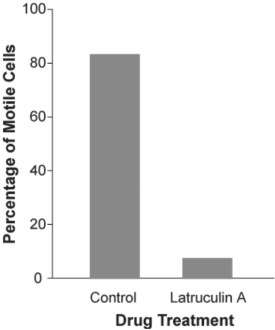 Figure 27.3
-Cultures of the same species of diatom referred to in the previous question were treated with BDM, a reversible inhibitor of myosin function. Which of the following predictions is consistent with the hypothesis that an
Actin- myosin interaction is necessary for motility?
Figure 27.3
-Cultures of the same species of diatom referred to in the previous question were treated with BDM, a reversible inhibitor of myosin function. Which of the following predictions is consistent with the hypothesis that an
Actin- myosin interaction is necessary for motility? (Multiple Choice)
4.9/5 (73)
(73) Use the following information when answering the corresponding questions).
The mechanism of cell crawling in protist species is not well defined. The textbook states that pseudopodia extension involves interactions between actin and myosin the same molecules that are involved in mammalian muscle contraction). However, p the study described below, no one had provided convincing data that actin and myosin were actually involved in cell crawlin protists. Anatomical studies had identified the cytoskeletal protein actin just below the surface of the cell membrane in severa of protist, but physiological studies had failed to show a functional link between actin, myosin, and cell crawling.
In a study by N. Poulsen et al. Diatom gliding is the result of an actin- myosin motility system, Cell Motility and the Cytoskeleto 1999):23- 22), researchers tested whether motility in a particular species of diatom involves interactions between actin and myosin.
Figure 27.3
-The data graphed in Figure 27.3 could be an artifact if latrunculin A kills this species of diatoms i.e., that may be why the cells are not moving). Which of the following would be the best evidence that latrunculin A is not killing the cells?
Figure 27.3
-The data graphed in Figure 27.3 could be an artifact if latrunculin A kills this species of diatoms i.e., that may be why the cells are not moving). Which of the following would be the best evidence that latrunculin A is not killing the cells? (Multiple Choice)
4.9/5 (79)
(79) One of the fish in your aquarium dies. Adding which protist to the water would allow you to avoid flushing the dead fish by speeding its decay?
(Multiple Choice)
4.8/5 (83)
(83) Use the following information to answer the corresponding questions).
Giardia intestinalis can cause disease in several different mammalian species, including humans. Giardia organisms G. intestinalis) that infect humans are similar morphologically to those that infect other mammals; thus, they have been considered a single species, though other species in the Giardia genus infect other organisms. However, G. intestinalis has been divided into different subgroups based on their host and a few other characteristics.
In 1999, a DNA sequence comparison study tested the hypothesis that these subgroups actually constitute different species. T following phylogenetic tree was constructed from the sequence comparison of rRNA from several subgroups of G. intestinalis few other morphologically distinct species of Giardia. The researchers concluded that the subgroups of Giardia are sufficiently different from one another genetically that they could be considered different species. T. Monis et al. 1999. Molecular systematics of the parasitic protozoan Giardia intestinalis. Mol. Biol. Evol. 16[9]:1135- 44.)
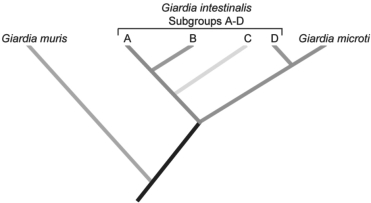 Figure 27.1
-According to the phylogenetic tree in the figure above, Giardia intestinalis constitutes a _ group.
Figure 27.1
-According to the phylogenetic tree in the figure above, Giardia intestinalis constitutes a _ group. (Multiple Choice)
4.7/5 (82)
(82) A particular species of protist lacks the ability to engulf food and does not contain chloroplasts. However, gene sequencing data indicate that this species evolved from a lineage containing many species with the ability to engulf food. What does this information suggest about this species of protist?
(Multiple Choice)
4.8/5 (89)
(89) Which of the following movements are matched correctly with the appendage that facilitates that movement in protists?
(Multiple Choice)
4.9/5 (84)
(84) According to the endosymbiosis theory of the origin of eukaryotic cells, how did mitochondria originate?
(Multiple Choice)
4.8/5 (95)
(95) Consider the following points:
a) All excavates live in environments where oxygen availability is low; b) all excavates lack mitochondria; and c) all excavates have some mitochondrial genes. Based on this information, which of the following statements is true of the excavate lineage?
(Multiple Choice)
4.9/5 (67)
(67) You isolate a previously undescribed protist species from the soil outside your residence. Which of the following techniques) would provide useful data for describing, classifying, and naming this new species?
(Multiple Choice)
4.8/5 (74)
(74) 
Filters
- Essay(0)
- Multiple Choice(0)
- Short Answer(0)
- True False(0)
- Matching(0)