



 Chat with AI
Exam 31: Protostome Animals

Exam 1: Biology and the Tree of Life35 Questions
Exam 2: Water and Carbon: the Chemical Basis of Life53 Questions
Exam 3: Protein Structure and Function40 Questions
Exam 4: Nucleic Acids and the Rna World40 Questions
Exam 5: An Introduction to Carbohydrates42 Questions
Exam 6: Lipids, Membranes, and the First Cells53 Questions
Exam 7: Inside the Cell41 Questions
Exam 8: Energy and Enzymes59 Questions
Exam 9: Cellular Respiration and Fermentation43 Questions
Exam 10: Photosynthesis41 Questions
Exam 11: Cellcell Interactions38 Questions
Exam 12: The Cell Cycle39 Questions
Exam 13: Meiosis40 Questions
Exam 14: Mendel and the Gene47 Questions
Exam 15: Dna and the Gene: Synthesis and Repair39 Questions
Exam 16: How Genes Work39 Questions
Exam 17: Transcription, Rna Processing, and Translation37 Questions
Exam 18: Control of Gene Expression in Bacteria38 Questions
Exam 19: Control of Gene Expression in Eukaryotes40 Questions
Exam 20: The Molecular Revolution: Biotechnology and Beyond39 Questions
Exam 21: Gene Structure and Development39 Questions
Exam 22: Evolution by Natural Selection42 Questions
Exam 23: Evolutionary Processes48 Questions
Exam 24: Speciation40 Questions
Exam 25: Phylogenies and the History of Life37 Questions
Exam 26: Bacteria and Archaea38 Questions
Exam 27: Protists36 Questions
Exam 28: Green Algae and Land Plants54 Questions
Exam 29: Fungi40 Questions
Exam 30: An Introduction to Animals42 Questions
Exam 31: Protostome Animals38 Questions
Exam 32: Deuterostome Animals43 Questions
Exam 33: Viruses35 Questions
Exam 34: Plant Form and Function39 Questions
Exam 35: Water and Sugar Transport in Plants42 Questions
Exam 36: Plant Nutrition37 Questions
Exam 37: Plant Sensory Systems, Signals, and Responses64 Questions
Exam 38: Plant Reproduction and Development44 Questions
Exam 39: Animal Form and Function37 Questions
Exam 40: Water and Electrolyte Balance in Animals41 Questions
Exam 41: Animal Nutrition43 Questions
Exam 42: Gas Exchange and Circulation46 Questions
Exam 43: Animal Nervous Systems40 Questions
Exam 44: Animal Sensory Systems43 Questions
Exam 45: Animal Movement42 Questions
Exam 46: Chemical Signals in Animals38 Questions
Exam 47: Animal Reproduction and Development39 Questions
Exam 48: The Immune System in Animals38 Questions
Exam 49: An Introduction to Ecology40 Questions
Exam 50: Behavioural Ecology39 Questions
Exam 51: Population Ecology49 Questions
Exam 52: Community Ecology38 Questions
Exam 53: Ecosystems and Global Ecology41 Questions
Exam 54: Biodiversity and Conservation Biology38 Questions
Select questions type


Use the following information when answering the corresponding questions).
Many terrestrial arthropods exchange gases with their environments by using tracheae, tubes that lead from openings called spiracles) in the animal's exoskeleton or cuticle directly to the animal's tissues. Some arthropods can control whether their spir opened or closed; opening the spiracles allows the carbon dioxide produced in the tissues to travel down the tracheae and be released outside the animal. Klok et al. measured the carbon dioxide emitted over time represented by VCO2) by several species of centipedes. Figure 31.2 presents graphs of their results for two species, Cormocephalus morsitans and Scutigerina weberi. C. J. Klok, R. D. Mercer, and S. L. Chown. 2002. Discontinuous gas- exchange in centipedes and its convergent evolution in tracheated arthropods. 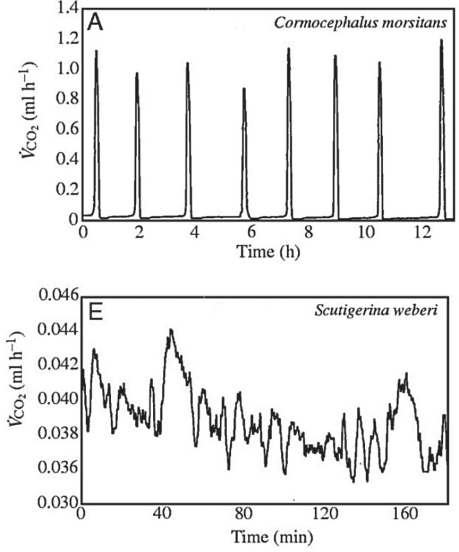 Figure 31.2
-Look at the graph for Cormocephalus morsitans. What is the best interpretation of these results?
Figure 31.2
-Look at the graph for Cormocephalus morsitans. What is the best interpretation of these results? (Multiple Choice)
4.8/5  (76)
(76) In arthropods, the hemocoel performs which of the following functions?
(Multiple Choice)
4.9/5 (80)
(80) The presence of a lophophore in a newly discovered species would suggest which of the following?
(Multiple Choice)
4.7/5 (76)
(76) What is the only group of Mollusca that does not have a radula?
(Multiple Choice)
4.8/5 (65)
(65) If you wanted to identify an unfamiliar protostome with a limbless, wormlike body, which characteristic would not be helpful in differentiating one species from another?
(Multiple Choice)
4.7/5 (76)
(76) The protostome developmental sequence arose just once in evolutionary history, resulting in two main subgroups-Lophotrochozoa and Ecdysozoa. What does this finding suggest?
(Multiple Choice)
4.8/5 (76)
(76) The common ancestor of the protostomes had a coelom. What does this suggest?
(Multiple Choice)
5.0/5 (81)
(81) Which mollusc group can be described as having several calcium carbonate plates along their dorsal side?
(Multiple Choice)
5.0/5 (87)
(87) The body cavity type for arthropods and molluscs can best be described as
(Multiple Choice)
4.8/5 (75)
(75) Which adaptation is unique to insects among all protostomes?
(Multiple Choice)
4.9/5 (83)
(83) Use the following information when answering the corresponding questions).
Many terrestrial arthropods exchange gases with their environments by using tracheae, tubes that lead from openings called spiracles) in the animal's exoskeleton or cuticle directly to the animal's tissues. Some arthropods can control whether their spir opened or closed; opening the spiracles allows the carbon dioxide produced in the tissues to travel down the tracheae and be released outside the animal. Klok et al. measured the carbon dioxide emitted over time represented by VCO2) by several species of centipedes. Figure 31.2 presents graphs of their results for two species, Cormocephalus morsitans and Scutigerina weberi. C. J. Klok, R. D. Mercer, and S. L. Chown. 2002. Discontinuous gas- exchange in centipedes and its convergent evolution in tracheated arthropods.
Figure 31.2
-Compare the graphs in Figure 31.2 of CO2 emission for Cormocephalus morsitans and Scutigerina weberi. What hypothesis can you make about each centipede's habitat?
Figure 31.2
-Compare the graphs in Figure 31.2 of CO2 emission for Cormocephalus morsitans and Scutigerina weberi. What hypothesis can you make about each centipede's habitat? (Multiple Choice)
4.7/5 (77)
(77) As stated in the text, "DNA sequence data indicated that two major subgroups existed within the protostomes." This finding contradicts the long- held hypothesis that the protostomes are a monophyletic group.
(True/False)
4.8/5 (85)
(85) You find what you believe is a new species of animal. Which of the following characteristics would enable you to argue that it is more closely related to a flatworm than it is to a roundworm?
(Multiple Choice)
4.9/5 (83)
(83) 
Filters
- Essay(0)
- Multiple Choice(0)
- Short Answer(0)
- True False(0)
- Matching(0)