



 Chat with AI
Exam 33: Viruses

Exam 1: Biology and the Tree of Life35 Questions
Exam 2: Water and Carbon: the Chemical Basis of Life53 Questions
Exam 3: Protein Structure and Function40 Questions
Exam 4: Nucleic Acids and the Rna World40 Questions
Exam 5: An Introduction to Carbohydrates42 Questions
Exam 6: Lipids, Membranes, and the First Cells53 Questions
Exam 7: Inside the Cell41 Questions
Exam 8: Energy and Enzymes59 Questions
Exam 9: Cellular Respiration and Fermentation43 Questions
Exam 10: Photosynthesis41 Questions
Exam 11: Cellcell Interactions38 Questions
Exam 12: The Cell Cycle39 Questions
Exam 13: Meiosis40 Questions
Exam 14: Mendel and the Gene47 Questions
Exam 15: Dna and the Gene: Synthesis and Repair39 Questions
Exam 16: How Genes Work39 Questions
Exam 17: Transcription, Rna Processing, and Translation37 Questions
Exam 18: Control of Gene Expression in Bacteria38 Questions
Exam 19: Control of Gene Expression in Eukaryotes40 Questions
Exam 20: The Molecular Revolution: Biotechnology and Beyond39 Questions
Exam 21: Gene Structure and Development39 Questions
Exam 22: Evolution by Natural Selection42 Questions
Exam 23: Evolutionary Processes48 Questions
Exam 24: Speciation40 Questions
Exam 25: Phylogenies and the History of Life37 Questions
Exam 26: Bacteria and Archaea38 Questions
Exam 27: Protists36 Questions
Exam 28: Green Algae and Land Plants54 Questions
Exam 29: Fungi40 Questions
Exam 30: An Introduction to Animals42 Questions
Exam 31: Protostome Animals38 Questions
Exam 32: Deuterostome Animals43 Questions
Exam 33: Viruses35 Questions
Exam 34: Plant Form and Function39 Questions
Exam 35: Water and Sugar Transport in Plants42 Questions
Exam 36: Plant Nutrition37 Questions
Exam 37: Plant Sensory Systems, Signals, and Responses64 Questions
Exam 38: Plant Reproduction and Development44 Questions
Exam 39: Animal Form and Function37 Questions
Exam 40: Water and Electrolyte Balance in Animals41 Questions
Exam 41: Animal Nutrition43 Questions
Exam 42: Gas Exchange and Circulation46 Questions
Exam 43: Animal Nervous Systems40 Questions
Exam 44: Animal Sensory Systems43 Questions
Exam 45: Animal Movement42 Questions
Exam 46: Chemical Signals in Animals38 Questions
Exam 47: Animal Reproduction and Development39 Questions
Exam 48: The Immune System in Animals38 Questions
Exam 49: An Introduction to Ecology40 Questions
Exam 50: Behavioural Ecology39 Questions
Exam 51: Population Ecology49 Questions
Exam 52: Community Ecology38 Questions
Exam 53: Ecosystems and Global Ecology41 Questions
Exam 54: Biodiversity and Conservation Biology38 Questions
Select questions type


Use the following information when answering the corresponding questions).
It has been shown that there are two distinct variants of the HIV virus Bleul et al. 1997. The HIV coreceptors CXCR4 and CCR differentially regulated on human T- lymphocytes. Proceedings of the National Academy of Science 94:1925- 30). One virus preferentially infects macrophages and is called M- tropic. The other preferentially infects T cells and is called T- tropic. The M- tropic viruses use CCR5 and CD4 as coreceptors, and the T- tropic viruses use CXCR4 and CD4 as coreceptors. The
M- tropic viruses are found early in HIV infections; the T- tropic viruses are found late in infections, when AIDS symptoms are prevalent. T- tropic viruses are associated with a drastic decrease in T cells. Macrophages go to the site of wounds, where they are used to fight infections. T cells circulate in the body and fight infections at many sites.
-What would the result be if a drug that blocks the action of RNA polymerase was introduced into a virus- infected organism?
(Multiple Choice)
4.9/5  (79)
(79) Does treating a viral infection with antibiotics affect the course of the infection?
(Multiple Choice)
4.9/5 (89)
(89) 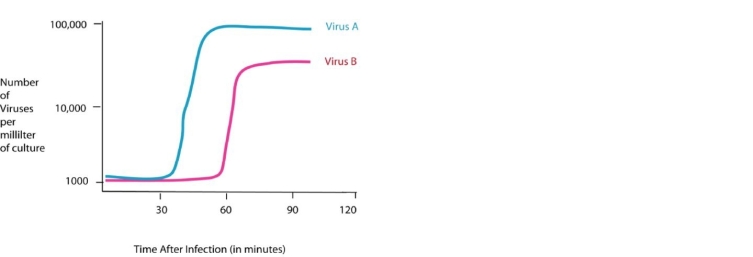 Figure 33.1
-Cells were infected with approximately 1000 copies of either virus A or virus B at the 0 time point. At 5- minute intervals, a sample of the virus and cell mixture was removed. The intact cells were removed from the sample, and the number of viruses per milliliter of culture was determined.
Using the data in Figure 33.1, how long does it take for virus A to go through one lytic cycle?
Figure 33.1
-Cells were infected with approximately 1000 copies of either virus A or virus B at the 0 time point. At 5- minute intervals, a sample of the virus and cell mixture was removed. The intact cells were removed from the sample, and the number of viruses per milliliter of culture was determined.
Using the data in Figure 33.1, how long does it take for virus A to go through one lytic cycle? (Multiple Choice)
4.8/5 (93)
(93) What is the main structural difference between enveloped and nonenveloped viruses?
(Multiple Choice)
4.9/5 (95)
(95) You have isolated the genome from a novel virus and would like to determine its composition. You have three tu each containing one of these substances:
1) a protein that degrades dsDNA DNase, tube 1)
2) a protein that degrades ssRNA RNase, tube 2)
3) a protease that degrades viral proteins tube 3)
You add some of your novel genome to tubes 1, 2, and 3. The genome is degraded in tube 2, but not in tube 1 or t
3) Based on your knowledge of genome types that have been found in viruses, what could the genome's composition be?
(Multiple Choice)
5.0/5 (89)
(89) In doing gene therapy, researchers frequently use attenuated viruses. The goal of gene therapy is to insert a normal copy of the mutated, disease- causing gene into the patient's genome, so that they will start producing normal protein. Which type of virus is suited to this application?
(Multiple Choice)
4.9/5 (79)
(79) It is believed that HIV has passed from chimps to humans more than once. This is very telling since it suggests that animal- to- human viral transmissions may be more common than previously thought. What is the best evidence in support of the conclusion that HIV made the chimp- to- human leap more than once?
(Multiple Choice)
4.8/5 (86)
(86) The first class of drugs developed to treat AIDS-such as AZT-were known as reverse transcriptase inhibitors. What was the mechanism by which they worked to treat HIV infections?
(Multiple Choice)
4.9/5 (69)
(69) Which of the following is the most important reason that developing treatments and vaccines, as well as staging an effective immune response for HIV infections, has been so difficult compared with other viruses?
(Multiple Choice)
4.8/5 (83)
(83) To make a vaccine against mumps, measles, or rabies, which type of viruses would be useful?
(Multiple Choice)
4.8/5 (91)
(91) You just discovered a new virus. This virus infects heart muscle, where it causes inflammation. This virus has a very high mutation rate. Which of the following is the best strategy for finding a treatment for this virus?
(Multiple Choice)
4.9/5 (81)
(81) What is a significant difference between lytic and lysogenic viral growth?
(Multiple Choice)
4.9/5 (79)
(79) Which of the following plays an important role in the ability of an enveloped virus to fuse with the host cell?
(Multiple Choice)
4.9/5 (77)
(77) You have isolated the genome from a novel virus and would like to determine its composition. You have three tu each containing one of these substances:
1) a protein that degrades dsDNA DNase, tube 1)
2) a protein that degrades ssRNA RNase, tube 2)
3) a protein that degrades other proteins protease, tube 3)
You add some of your novel genome to tubes 1, 2, and 3. The genome is not degraded in tube 1, 2, or 3. Based on your knowledge of genome types that have been found in viruses, what could the genome's composition be?
(Multiple Choice)
5.0/5 (66)
(66) Some viruses can be crystallized and their structures analyzed. One such virus is yellow mottle virus, which infects beans. This virus has a single- stranded RNA genome containing about 6300 nucleotides. Its capsid is 25
-30 nanometres in diameter and contains 180 identical capsomeres. If the yellow mottle virus begins its infection of a cell by using its genome as mRNA, which of the following would you expect to be able to measure?
(Multiple Choice)
4.7/5 (93)
(93) 
Filters
- Essay(0)
- Multiple Choice(0)
- Short Answer(0)
- True False(0)
- Matching(0)