



 Chat with AI
Exam 8: Energy and Enzymes

Exam 1: Biology and the Tree of Life35 Questions
Exam 2: Water and Carbon: the Chemical Basis of Life53 Questions
Exam 3: Protein Structure and Function40 Questions
Exam 4: Nucleic Acids and the Rna World40 Questions
Exam 5: An Introduction to Carbohydrates42 Questions
Exam 6: Lipids, Membranes, and the First Cells53 Questions
Exam 7: Inside the Cell41 Questions
Exam 8: Energy and Enzymes59 Questions
Exam 9: Cellular Respiration and Fermentation43 Questions
Exam 10: Photosynthesis41 Questions
Exam 11: Cellcell Interactions38 Questions
Exam 12: The Cell Cycle39 Questions
Exam 13: Meiosis40 Questions
Exam 14: Mendel and the Gene47 Questions
Exam 15: Dna and the Gene: Synthesis and Repair39 Questions
Exam 16: How Genes Work39 Questions
Exam 17: Transcription, Rna Processing, and Translation37 Questions
Exam 18: Control of Gene Expression in Bacteria38 Questions
Exam 19: Control of Gene Expression in Eukaryotes40 Questions
Exam 20: The Molecular Revolution: Biotechnology and Beyond39 Questions
Exam 21: Gene Structure and Development39 Questions
Exam 22: Evolution by Natural Selection42 Questions
Exam 23: Evolutionary Processes48 Questions
Exam 24: Speciation40 Questions
Exam 25: Phylogenies and the History of Life37 Questions
Exam 26: Bacteria and Archaea38 Questions
Exam 27: Protists36 Questions
Exam 28: Green Algae and Land Plants54 Questions
Exam 29: Fungi40 Questions
Exam 30: An Introduction to Animals42 Questions
Exam 31: Protostome Animals38 Questions
Exam 32: Deuterostome Animals43 Questions
Exam 33: Viruses35 Questions
Exam 34: Plant Form and Function39 Questions
Exam 35: Water and Sugar Transport in Plants42 Questions
Exam 36: Plant Nutrition37 Questions
Exam 37: Plant Sensory Systems, Signals, and Responses64 Questions
Exam 38: Plant Reproduction and Development44 Questions
Exam 39: Animal Form and Function37 Questions
Exam 40: Water and Electrolyte Balance in Animals41 Questions
Exam 41: Animal Nutrition43 Questions
Exam 42: Gas Exchange and Circulation46 Questions
Exam 43: Animal Nervous Systems40 Questions
Exam 44: Animal Sensory Systems43 Questions
Exam 45: Animal Movement42 Questions
Exam 46: Chemical Signals in Animals38 Questions
Exam 47: Animal Reproduction and Development39 Questions
Exam 48: The Immune System in Animals38 Questions
Exam 49: An Introduction to Ecology40 Questions
Exam 50: Behavioural Ecology39 Questions
Exam 51: Population Ecology49 Questions
Exam 52: Community Ecology38 Questions
Exam 53: Ecosystems and Global Ecology41 Questions
Exam 54: Biodiversity and Conservation Biology38 Questions
Select questions type


An important group of peripheral membrane proteins are enzymes such as the phospholipases that cleave the head groups of phospholipids. What properties must these enzymes exhibit?
(Multiple Choice)
4.9/5  (74)
(74) A solution of starch at room temperature does not readily decompose to form a solution of simple sugars because
(Multiple Choice)
4.7/5 (72)
(72) The following questions) are based on the reaction A + B -C + D shown in the figure provided.
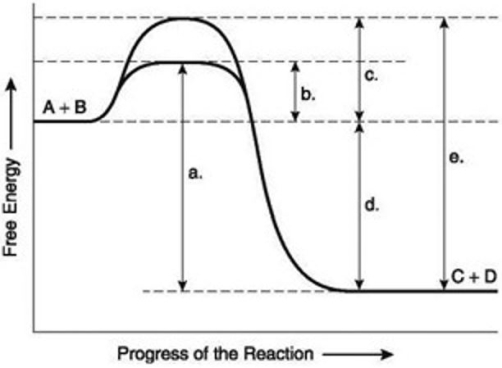 -Which of the following represents the OG of the reaction in the figure?
 (Multiple Choice)
4.8/5 (74)
(74) The lock- and- key analogy for enzymes applies to the specificity of enzymes
(Multiple Choice)
4.8/5 (92)
(92) Living organisms increase in complexity as they grow, resulting in a decrease in the entropy of an organism. How does this relate to the second law of thermodynamics?
(Multiple Choice)
4.8/5 (78)
(78) 
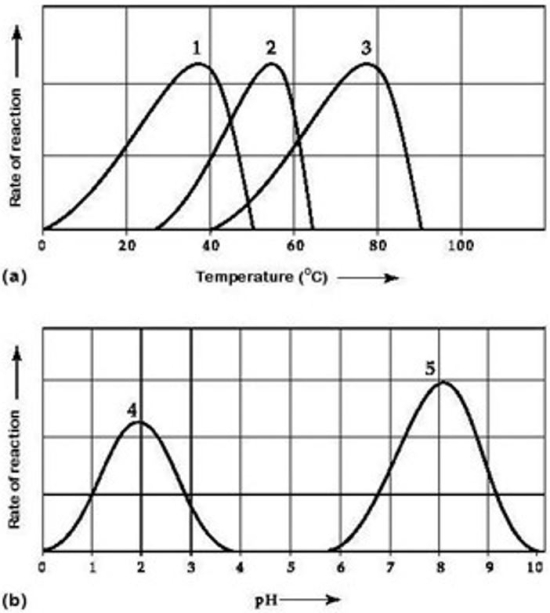 Activity of various enzymes at various temperatures a) and at various pH b). Use the image above to answer the following
questions).
-Which curves on the graphs provided may represent the temperature and pH profiles of an enzyme taken from a bacterium that lives in a mildly alkaline hot springs at temperatures of 70°C or higher?
Activity of various enzymes at various temperatures a) and at various pH b). Use the image above to answer the following
questions).
-Which curves on the graphs provided may represent the temperature and pH profiles of an enzyme taken from a bacterium that lives in a mildly alkaline hot springs at temperatures of 70°C or higher? (Multiple Choice)
4.8/5 (75)
(75) A chemical reaction that has a positive OG is best described as
(Multiple Choice)
4.8/5 (86)
(86) You have isolated a previously unstudied protein, identified its complete structure in detail, and determined that it catalyzes the breakdown of a large substrate. You notice it has two binding sites. One of these is large, apparently the binding site for the large substrate; the other is small, possibly a binding site for a regulatory molecule. What do these findings tell you about the mechanism of this protein?
(Multiple Choice)
4.8/5 (81)
(81) The following questions) are based on the reaction A + B -C + D shown in the figure provided.
-Which of the following represents the activation energy required for a noncatalyzed reaction in the figure?
-Which of the following represents the activation energy required for a noncatalyzed reaction in the figure? (Multiple Choice)
4.9/5 (73)
(73) Which of the following is a statement of the first law of thermodynamics?
(Multiple Choice)
5.0/5 (88)
(88) When ATP releases some energy, it also releases inorganic phosphate. What happens to the inorganic phosphate in the cell?
(Multiple Choice)
4.8/5 (79)
(79) Use the following information to answer the corresponding questions).
A series of enzymes catalyze the reaction X -Y -Z -A. Product A binds to the enzyme that converts X to Y at a position remote from its active site. This binding decreases the activity of the enzyme.
-With respect to the enzyme that converts X to Y, substance A functions as
(Multiple Choice)
4.9/5 (83)
(83) You have discovered an enzyme that can catalyze two different chemical reactions. Which of the following is most likely to be correct?
(Multiple Choice)
4.8/5 (59)
(59) Some bacteria are metabolically active in hot springs because
(Multiple Choice)
4.9/5 (64)
(64) Which of the following statements is a logical consequence of the second law of thermodynamics?
(Multiple Choice)
4.8/5 (82)
(82) 
Filters
- Essay(0)
- Multiple Choice(0)
- Short Answer(0)
- True False(0)
- Matching(0)