



 Chat with AI
Exam 4: Carbon and the Molecular Diversity of Life

Exam 1: Evolution, the Themes of Biology, and Scientific Inquiry51 Questions
Exam 2: The Chemical Context of Life61 Questions
Exam 3: Water and Life55 Questions
Exam 4: Carbon and the Molecular Diversity of Life58 Questions
Exam 5: The Structure and Function of Large Biological Molecules70 Questions
Exam 6: A Tour of the Cell66 Questions
Exam 7: Membrane Structure and Function68 Questions
Exam 8: An Introduction to Metabolism67 Questions
Exam 9: Cellular Respiration and Fermentation68 Questions
Exam 10: Photosynthesis65 Questions
Exam 11: Cell Communication65 Questions
Exam 12: The Cell Cycle66 Questions
Exam 13: Meiosis and Sexual Life Cycles64 Questions
Exam 14: Mendel and the Gene Idea62 Questions
Exam 15: The Chromosomal Basis of Inheritance58 Questions
Exam 16: The Molecular Basis of Inheritance65 Questions
Exam 17: Gene Expression: From Gene to Protein67 Questions
Exam 18: Regulation of Gene Expression66 Questions
Exam 19: Viruses54 Questions
Exam 20: Dna Tools and Biotechnology57 Questions
Exam 21: Genomes and Their Evolution44 Questions
Exam 22: Descent With Modification: a Darwinian View of Life60 Questions
Exam 23: The Evolution of Populations64 Questions
Exam 24: The Origin of Species67 Questions
Exam 25: The History of Life on Earth59 Questions
Exam 26: Phylogeny and the Tree of Life75 Questions
Exam 27: Bacteria and Archaea75 Questions
Exam 28: Protists79 Questions
Exam 29: Plant Diversity I: How Plants Colonised Land82 Questions
Exam 30: Plant Diversity Ii: the Evolution of Seed Plants80 Questions
Exam 31: Fungi70 Questions
Exam 32: An Overview of Animal Diversity67 Questions
Exam 33: An Introduction to Invertebrates83 Questions
Exam 34: The Origin and Evolution of Vertebrates82 Questions
Exam 35: Vascular Plant Structure, Growth, and Development65 Questions
Exam 36: Resource Acquisition and Transport in Vascular Plants74 Questions
Exam 37: Soil and Plant Nutrition52 Questions
Exam 38: Angiosperm Reproduction and Biotechnology60 Questions
Exam 39: Plant Responses to Internal and External Signals61 Questions
Exam 40: Basic Principles of Animal Form and Function68 Questions
Exam 41: Animal Nutrition64 Questions
Exam 42: Circulation and Gas Exchange67 Questions
Exam 43: The Immune System69 Questions
Exam 44: Osmoregulation and Excretion64 Questions
Exam 45: Hormones and the Endocrine System66 Questions
Exam 46: Animal Reproduction68 Questions
Exam 47: Animal Development70 Questions
Exam 48: Neurons, Synapses, and Signalling68 Questions
Exam 49: Nervous Systems65 Questions
Exam 50: Sensory and Motor Mechanisms67 Questions
Select questions type


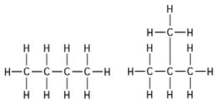 The two molecules shown in the figures are best described as ________.
 (Multiple Choice)
4.7/5  (79)
(79)  Which functional group is not present in this molecule?
A. B.
 C.
 D.
 - Which molecule shown above contains a functional group that is a part of the molecule known as the "energy currency of living organisms"?
B.
C.
D.
- Which molecule shown above contains a functional group that is a part of the molecule known as the "energy currency of living organisms"? (Multiple Choice)
4.9/5 (74)
(74) A.
B.  C.
D.
- Which of the groups is an acidic functional group that can dissociate and release H? into a solution?
C.
D.
- Which of the groups is an acidic functional group that can dissociate and release H? into a solution? (Multiple Choice)
4.7/5 (80)
(80) The complexity and variety of organic molecules is due to ________.
(Multiple Choice)
4.8/5 (89)
(89) 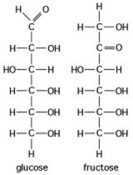 - The figure shows the structures of glucose and fructose. These two molecules differ in the ________.
 (Multiple Choice)
4.9/5 (69)
(69) Differences among organisms are caused by differences in the ________.
(Multiple Choice)
4.8/5 (81)
(81) A. B.
 C.
 D.
 -Which molecule has at least one carbon atom attached to three different chemical groups?
B.
C.
D.
-Which molecule has at least one carbon atom attached to three different chemical groups? (Multiple Choice)
4.9/5 (81)
(81) Miller's classic experiment demonstrated that a discharge of sparks through a mixture of gases could result in the formation of a large variety of organic compounds. Miller did not use ________ as one of the gases in his experiment.
(Multiple Choice)
4.8/5 (81)
(81) Stanley Miller's 1953 experiments supported the hypothesis that ________.
(Multiple Choice)
4.8/5 (72)
(72) Organic molecules with only hydrogens and five carbon atoms cannot ________.
(Multiple Choice)
4.9/5 (73)
(73) A.
B.
C.
D.
- Which of the functional groups shown is present in ethanol but not in ethane?
C.
D.
- Which of the functional groups shown is present in ethanol but not in ethane? (Multiple Choice)
4.8/5 (88)
(88) Use the figures to answer the question. A. B.
 C.
 D.
 Which molecule(s) shown is (are) ionised in a cell?
B.
C.
D. Which molecule(s) shown is (are) ionised in a cell? (Multiple Choice)
5.0/5 (84)
(84) In an ethane (C2H6) molecule, each carbon atom is bonded to ________ hydrogen atoms.
(Multiple Choice)
4.9/5 (61)
(61) 
Filters
- Essay(0)
- Multiple Choice(0)
- Short Answer(0)
- True False(0)
- Matching(0)