



 Chat with AI
Exam 14: Mendel and the Gene Idea

Exam 1: Evolution, the Themes of Biology, and Scientific Inquiry51 Questions
Exam 2: The Chemical Context of Life61 Questions
Exam 3: Water and Life55 Questions
Exam 4: Carbon and the Molecular Diversity of Life58 Questions
Exam 5: The Structure and Function of Large Biological Molecules70 Questions
Exam 6: A Tour of the Cell66 Questions
Exam 7: Membrane Structure and Function68 Questions
Exam 8: An Introduction to Metabolism67 Questions
Exam 9: Cellular Respiration and Fermentation68 Questions
Exam 10: Photosynthesis65 Questions
Exam 11: Cell Communication65 Questions
Exam 12: The Cell Cycle66 Questions
Exam 13: Meiosis and Sexual Life Cycles64 Questions
Exam 14: Mendel and the Gene Idea62 Questions
Exam 15: The Chromosomal Basis of Inheritance58 Questions
Exam 16: The Molecular Basis of Inheritance65 Questions
Exam 17: Gene Expression: From Gene to Protein67 Questions
Exam 18: Regulation of Gene Expression66 Questions
Exam 19: Viruses54 Questions
Exam 20: Dna Tools and Biotechnology57 Questions
Exam 21: Genomes and Their Evolution44 Questions
Exam 22: Descent With Modification: a Darwinian View of Life60 Questions
Exam 23: The Evolution of Populations64 Questions
Exam 24: The Origin of Species67 Questions
Exam 25: The History of Life on Earth59 Questions
Exam 26: Phylogeny and the Tree of Life75 Questions
Exam 27: Bacteria and Archaea75 Questions
Exam 28: Protists79 Questions
Exam 29: Plant Diversity I: How Plants Colonised Land82 Questions
Exam 30: Plant Diversity Ii: the Evolution of Seed Plants80 Questions
Exam 31: Fungi70 Questions
Exam 32: An Overview of Animal Diversity67 Questions
Exam 33: An Introduction to Invertebrates83 Questions
Exam 34: The Origin and Evolution of Vertebrates82 Questions
Exam 35: Vascular Plant Structure, Growth, and Development65 Questions
Exam 36: Resource Acquisition and Transport in Vascular Plants74 Questions
Exam 37: Soil and Plant Nutrition52 Questions
Exam 38: Angiosperm Reproduction and Biotechnology60 Questions
Exam 39: Plant Responses to Internal and External Signals61 Questions
Exam 40: Basic Principles of Animal Form and Function68 Questions
Exam 41: Animal Nutrition64 Questions
Exam 42: Circulation and Gas Exchange67 Questions
Exam 43: The Immune System69 Questions
Exam 44: Osmoregulation and Excretion64 Questions
Exam 45: Hormones and the Endocrine System66 Questions
Exam 46: Animal Reproduction68 Questions
Exam 47: Animal Development70 Questions
Exam 48: Neurons, Synapses, and Signalling68 Questions
Exam 49: Nervous Systems65 Questions
Exam 50: Sensory and Motor Mechanisms67 Questions
Select questions type


W. Affected individuals are indicated by a dark square or circle. 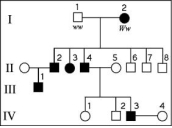 - What is the likelihood that the offspring of IV-3 and IV-4 will have the trait?
 (Multiple Choice)
4.8/5  (70)
(70) Phenylketonuria (PKU) is a recessive human disorder in which an individual cannot appropriately metabolise the amino acid phenylalanine. This amino acid is not naturally produced by humans. Which of the following treatments would be most effective for people with PKU?
(Multiple Choice)
4.8/5 (77)
(77) An obstetrician knows that one of her patients is a pregnant woman whose foetus is at risk for a serious disorder that is detectable biochemically in foetal cells. The obstetrician would most reasonably offer which of the following procedures to her patient?
(Multiple Choice)
4.9/5 (87)
(87) Dark-shaded symbols represent individuals with one of the two major types of colon cancer. Numbers under the symbols are the individual's age at the time of diagnosis. Males are represented by squares, females by circles. 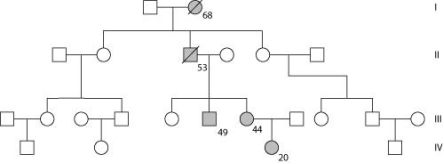 From this pedigree, this trait seems to be inherited ________.
 (Multiple Choice)
4.9/5 (81)
(81) In some parts of Africa, the frequency of heterozygosity for the sickle-cell anaemia allele is unusually high, presumably because this reduces the frequency of malaria. Such a relationship is related to which of the following?
(Multiple Choice)
4.8/5 (78)
(78) In a particular plant, leaf colour is controlled by gene locus D. Plants with at least one allele D have dark green leaves, and plants with the homozygous recessive dd genotype have light green leaves. A true-breeding, dark-leafed plant is crossed with a light-leafed one, and the F1 offspring is allowed to self-pollinate. The predicted outcome of the F2 is diagrammed in the Punnett square shown in the figure, where 1, 2, 3 and 4 represent the genotypes corresponding to each box within the square. 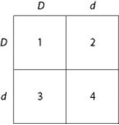 -
Which of the boxes marked 1-4 correspond to plants that will be true-breeding?
-
Which of the boxes marked 1-4 correspond to plants that will be true-breeding? (Multiple Choice)
4.8/5 (80)
(80) In rabbits, the homozygous genotype LCLC has normal legs, LCLc results in deformed legs, and LcLc results in very short legs. The genotype FBFB produces black fur, FBFb brown fur, and FbFb white fur. If a cross is made between brown rabbits with deformed legs and white rabbits with deformed legs, what percentage of the offspring would be expected to have deformed legs and white fur?
(Multiple Choice)
4.9/5 (81)
(81) Suppose two individuals with the genotype AaBbCc are mated. Assuming that the genes are not linked, what fraction of the offspring are expected to be homozygous recessive for the three traits?
(Multiple Choice)
4.8/5 (72)
(72) Marfan syndrome in humans is caused by an abnormality of the connective tissue protein fibrillin. Patients are usually very tall and thin, with long spindly fingers, curvature of the spine, sometimes weakened arterial walls, and sometimes eye problems, such as lens dislocation. Which of the following would you conclude about Marfan syndrome from this information?
(Multiple Choice)
4.9/5 (78)
(78) Hydrangea plants of the same genotype are planted in a large flower garden. Some of the plants produce blue flowers and others pink flowers. This can be best explained by which of the following?
(Multiple Choice)
4.8/5 (86)
(86) Albinism (without melanin pigmentation) is a recessive trait. A man and woman both show normal pigmentation, but both have one parent who has albinism. What is the probability that their first child will have albinism?
(Multiple Choice)
4.8/5 (77)
(77) W. Affected individuals are indicated by a dark square or circle.
- What is the genotype of individual II-5?
- What is the genotype of individual II-5? (Multiple Choice)
4.9/5 (73)
(73) Assuming independent assortment for all gene pairs, what is the probability that a cross between the following parents, AABbCc × AaBbCc, will produce an AaBbCc offspring?
(Multiple Choice)
4.8/5 (83)
(83) In cattle, roan coat colour (mixed red and white hairs) occurs in the heterozygous (CRCW) offspring of red (CRCR) and white (CWCW) homozygotes. Which of the following crosses would produce offspring in the ratio of 1 red:2 roan:1 white?
(Multiple Choice)
4.9/5 (87)
(87) In pea plants, the tall phenotype is dominant to the dwarf phenotype. If a heterozygous pea plant is crossed with a homozygous tall pea plant, what is the probability that the offspring will be dwarf in size?
(Multiple Choice)
4.9/5 (78)
(78) Feather colour in budgies is determined by two different genes: Y for pigment on the outside of the feather, and B for pigment on the inside of the feather. YYBB, YyBB, or YYBb is green; yyBB or yyBb is blue; YYbb or Yybb is yellow; and yybb is white. A blue budgie is crossed with a white budgie. Which of the following results in the offspring is most possible?
(Multiple Choice)
4.9/5 (94)
(94) Gene S controls the sharpness of spines in a type of cactus. Cacti with the dominant allele, S, have sharp spines, whereas homozygous recessive ss cacti have dull spines. At the same time, a second gene, N, determines whether or not cacti have spines. Homozygous recessive nn cacti have no spines at all. If cacti heterozygous for both traits, SsNn, were allowed to self-pollinate, the offspring would segregate into which of the following phenotype ratios?
(Multiple Choice)
4.9/5 (82)
(82) Mendel continued some of his experiments into the F2 or F3 generation in order to ________.
(Multiple Choice)
4.9/5 (89)
(89) Phenylketonuria is an inherited disease caused by a recessive autosomal allele. If a woman and her husband are both carriers, what is the probability that their first child will be a phenotypically normal girl?
(Multiple Choice)
4.7/5 (77)
(77) Radish flowers may be red, purple or white. A cross between a red-flowered plant and a white-flowered plant yields all-purple offspring. The flower colour trait in radishes is an example of which of the following inheritance patterns?
(Multiple Choice)
4.8/5 (64)
(64) 
Filters
- Essay(0)
- Multiple Choice(0)
- Short Answer(0)
- True False(0)
- Matching(0)