



 Chat with AI
Exam 14: Mendel and the Gene Idea

Exam 1: Evolution, the Themes of Biology, and Scientific Inquiry51 Questions
Exam 2: The Chemical Context of Life61 Questions
Exam 3: Water and Life55 Questions
Exam 4: Carbon and the Molecular Diversity of Life58 Questions
Exam 5: The Structure and Function of Large Biological Molecules70 Questions
Exam 6: A Tour of the Cell66 Questions
Exam 7: Membrane Structure and Function68 Questions
Exam 8: An Introduction to Metabolism67 Questions
Exam 9: Cellular Respiration and Fermentation68 Questions
Exam 10: Photosynthesis65 Questions
Exam 11: Cell Communication65 Questions
Exam 12: The Cell Cycle66 Questions
Exam 13: Meiosis and Sexual Life Cycles64 Questions
Exam 14: Mendel and the Gene Idea62 Questions
Exam 15: The Chromosomal Basis of Inheritance58 Questions
Exam 16: The Molecular Basis of Inheritance65 Questions
Exam 17: Gene Expression: From Gene to Protein67 Questions
Exam 18: Regulation of Gene Expression66 Questions
Exam 19: Viruses54 Questions
Exam 20: Dna Tools and Biotechnology57 Questions
Exam 21: Genomes and Their Evolution44 Questions
Exam 22: Descent With Modification: a Darwinian View of Life60 Questions
Exam 23: The Evolution of Populations64 Questions
Exam 24: The Origin of Species67 Questions
Exam 25: The History of Life on Earth59 Questions
Exam 26: Phylogeny and the Tree of Life75 Questions
Exam 27: Bacteria and Archaea75 Questions
Exam 28: Protists79 Questions
Exam 29: Plant Diversity I: How Plants Colonised Land82 Questions
Exam 30: Plant Diversity Ii: the Evolution of Seed Plants80 Questions
Exam 31: Fungi70 Questions
Exam 32: An Overview of Animal Diversity67 Questions
Exam 33: An Introduction to Invertebrates83 Questions
Exam 34: The Origin and Evolution of Vertebrates82 Questions
Exam 35: Vascular Plant Structure, Growth, and Development65 Questions
Exam 36: Resource Acquisition and Transport in Vascular Plants74 Questions
Exam 37: Soil and Plant Nutrition52 Questions
Exam 38: Angiosperm Reproduction and Biotechnology60 Questions
Exam 39: Plant Responses to Internal and External Signals61 Questions
Exam 40: Basic Principles of Animal Form and Function68 Questions
Exam 41: Animal Nutrition64 Questions
Exam 42: Circulation and Gas Exchange67 Questions
Exam 43: The Immune System69 Questions
Exam 44: Osmoregulation and Excretion64 Questions
Exam 45: Hormones and the Endocrine System66 Questions
Exam 46: Animal Reproduction68 Questions
Exam 47: Animal Development70 Questions
Exam 48: Neurons, Synapses, and Signalling68 Questions
Exam 49: Nervous Systems65 Questions
Exam 50: Sensory and Motor Mechanisms67 Questions
Select questions type


When Mendel crossed yellow-seeded and green-seeded pea plants, all the offspring were yellow-seeded. When he took these F1 yellow-seeded plants and crossed them to green-seeded plants, what genotypic ratio was expected?
(Multiple Choice)
4.9/5  (66)
(66) How many unique gametes could be produced through independent assortment by an individual with the genotype AaBbCCDdEE?
(Multiple Choice)
4.8/5 (73)
(73) The individual with genotype AaBbCCDdEE can make many kinds of gametes. Which of the following correctly describes why this situation is possible?
(Multiple Choice)
5.0/5 (77)
(77) Black fur in mice (B) is dominant to brown fur (b). Short tails (T) are dominant to long tails (t). What fraction of the progeny of crosses BbTt × BBtt will be expected to have black fur and long tails?
(Multiple Choice)
4.9/5 (75)
(75) Which of the following scenarios describes an example of epistasis?
(Multiple Choice)
4.8/5 (95)
(95) Which of the following phenotypes is an example of polygenic inheritance?
(Multiple Choice)
4.9/5 (91)
(91) A man has extra digits (six fingers on each hand and six toes on each foot). His wife and their daughter have the normal number of digits (five fingers on each hand and five toes on each foot.) Having extra digits is a dominant trait. The couple's second child has extra digits. What is the probability that their next (third) child will have extra digits?
(Multiple Choice)
4.9/5 (76)
(76) Skin colour in a certain species of fish is inherited by a single gene with four different alleles. How many different types of gametes would be possible in this organism?
(Multiple Choice)
4.8/5 (92)
(92) The pattern of inheritance can be predicted from data if one is given the parent or offspring genotypes or phenotypes. Two organisms, with genotypes BbDD and BBDd, are mated. Assuming independent assortment of the B/b and D/d genes, determine the genotypic ratios in offspring that would occur.
(Multiple Choice)
4.9/5 (80)
(80) In human blood types, Rh positive is a trait that shows simple dominance over Rh negative. A woman who has blood type A positive has a daughter who is type O positive and a son who is type B negative. Which of the following phenotypes is possible for the father?
(Multiple Choice)
4.7/5 (76)
(76) Skin colour in a certain species of fish is inherited via a single gene with four different alleles. One fish of this type has alleles 1 and 3 (S1S3), and its mate has alleles 2 and 4 (S2S4). If each allele confers a unit of colour darkness such that S1 has one unit, S2 has two units, and so on, then what proportion of their offspring would be expected to have five units of colour?
(Multiple Choice)
4.8/5 (63)
(63) Two true-breeding stocks of pea plants are crossed. One parent has red, axial flowers and the other has white, terminal flowers; all F1 individuals have red, axial flowers. The genes for flower colour and location assort independently. Among the F2 offspring, what is the probability of producing plants with white axial flowers?
(Multiple Choice)
4.9/5 (78)
(78) Hutchinson-Gilford progeria is an exceedingly rare human genetic disorder in which there is very early senility and death, usually from coronary artery disease, at an average age of 13 years. Patients, who look very old even as children, do not live to reproduce. Which of the following statements represents the most likely assumption regarding this disorder?
(Multiple Choice)
4.7/5 (84)
(84) Which of the following statements is correct in describing the terms monohybrid cross and dihybrid cross?
(Multiple Choice)
4.8/5 (78)
(78) What was the most significant conclusion that Gregor Mendel (1822-84) drew from his experiments with pea plants?
(Multiple Choice)
4.8/5 (71)
(71) Which of the following statements is a correct explanation for the observation that all offspring exhibit a phenotype for a particular trait that appears to be a blend of the two parental varieties?
(Multiple Choice)
5.0/5 (73)
(73) Grey seed colour in peas is dominant to white. Assume that Mendel conducted a series of experiments where plants with grey seeds were crossed among themselves, and the following progeny were produced: 302 grey and 98 white. What is the most probable genotype of each parent?
(Multiple Choice)
4.7/5 (86)
(86) One of two major forms of a human condition called neurofibromatosis (NF1) is inherited as a dominant gene, although it may range from mildly to very severely expressed. Which of the following is the best explanation for why a young, affected child is the first in her family to be diagnosed?
(Multiple Choice)
4.9/5 (82)
(82) W. Affected individuals are indicated by a dark square or circle. 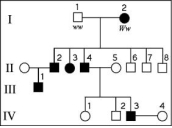 - What is the probability that individual III-1 is Ww?
 (Multiple Choice)
4.8/5 (72)
(72) In a particular plant, leaf colour is controlled by gene locus D. Plants with at least one allele D have dark green leaves, and plants with the homozygous recessive dd genotype have light green leaves. A true-breeding, dark-leafed plant is crossed with a light-leafed one, and the F1 offspring is allowed to self-pollinate. The predicted outcome of the F2 is diagrammed in the Punnett square shown in the figure, where 1, 2, 3 and 4 represent the genotypes corresponding to each box within the square. 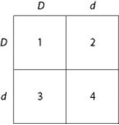 -
Which of the boxes marked 1-4 correspond to plants with dark leaves?
-
Which of the boxes marked 1-4 correspond to plants with dark leaves? (Multiple Choice)
4.8/5 (72)
(72) 
Filters
- Essay(0)
- Multiple Choice(0)
- Short Answer(0)
- True False(0)
- Matching(0)