



 Chat with AI
Exam 29: Plant Diversity I: How Plants Colonised Land

Exam 1: Evolution, the Themes of Biology, and Scientific Inquiry51 Questions
Exam 2: The Chemical Context of Life61 Questions
Exam 3: Water and Life55 Questions
Exam 4: Carbon and the Molecular Diversity of Life58 Questions
Exam 5: The Structure and Function of Large Biological Molecules70 Questions
Exam 6: A Tour of the Cell66 Questions
Exam 7: Membrane Structure and Function68 Questions
Exam 8: An Introduction to Metabolism67 Questions
Exam 9: Cellular Respiration and Fermentation68 Questions
Exam 10: Photosynthesis65 Questions
Exam 11: Cell Communication65 Questions
Exam 12: The Cell Cycle66 Questions
Exam 13: Meiosis and Sexual Life Cycles64 Questions
Exam 14: Mendel and the Gene Idea62 Questions
Exam 15: The Chromosomal Basis of Inheritance58 Questions
Exam 16: The Molecular Basis of Inheritance65 Questions
Exam 17: Gene Expression: From Gene to Protein67 Questions
Exam 18: Regulation of Gene Expression66 Questions
Exam 19: Viruses54 Questions
Exam 20: Dna Tools and Biotechnology57 Questions
Exam 21: Genomes and Their Evolution44 Questions
Exam 22: Descent With Modification: a Darwinian View of Life60 Questions
Exam 23: The Evolution of Populations64 Questions
Exam 24: The Origin of Species67 Questions
Exam 25: The History of Life on Earth59 Questions
Exam 26: Phylogeny and the Tree of Life75 Questions
Exam 27: Bacteria and Archaea75 Questions
Exam 28: Protists79 Questions
Exam 29: Plant Diversity I: How Plants Colonised Land82 Questions
Exam 30: Plant Diversity Ii: the Evolution of Seed Plants80 Questions
Exam 31: Fungi70 Questions
Exam 32: An Overview of Animal Diversity67 Questions
Exam 33: An Introduction to Invertebrates83 Questions
Exam 34: The Origin and Evolution of Vertebrates82 Questions
Exam 35: Vascular Plant Structure, Growth, and Development65 Questions
Exam 36: Resource Acquisition and Transport in Vascular Plants74 Questions
Exam 37: Soil and Plant Nutrition52 Questions
Exam 38: Angiosperm Reproduction and Biotechnology60 Questions
Exam 39: Plant Responses to Internal and External Signals61 Questions
Exam 40: Basic Principles of Animal Form and Function68 Questions
Exam 41: Animal Nutrition64 Questions
Exam 42: Circulation and Gas Exchange67 Questions
Exam 43: The Immune System69 Questions
Exam 44: Osmoregulation and Excretion64 Questions
Exam 45: Hormones and the Endocrine System66 Questions
Exam 46: Animal Reproduction68 Questions
Exam 47: Animal Development70 Questions
Exam 48: Neurons, Synapses, and Signalling68 Questions
Exam 49: Nervous Systems65 Questions
Exam 50: Sensory and Motor Mechanisms67 Questions
Select questions type


Breeuwer et al. (2008) measured the effect of different temperature regimes on the growth of different Sphagnum species. The growth of S. fuscum at four temperatures is shown. Use the information in the graph to answer the following question. 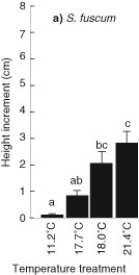 Which of the following statements accurately reflects the effect of temperature on the growth of S. fuscum?
 (Multiple Choice)
4.9/5  (85)
(85) A biology student hiking in a forest happens upon an erect, 15-centimetre-tall plant that bears microphylls and a strobilus at its tallest point. When disturbed, the cone emits a dense cloud of brownish dust. A pocket magnifying glass reveals the dust to be composed of tiny spheres with a high oil content.
-Besides oil, what other chemical should be detected in substantial amounts upon chemical analysis of these small spheres?
(Multiple Choice)
4.9/5 (78)
(78) Suppose an efficient conducting system evolved in a moss that could transport water and other materials as high as a tall tree. Which of the following statements about "trees" of such a species would be accurate?
(Multiple Choice)
4.9/5 (91)
(91) Retaining the zygote on the living gametophyte of land plants ________.
(Multiple Choice)
5.0/5 (88)
(88) Which of the following could occur only after plants moved from the oceans to land?
(Multiple Choice)
4.8/5 (79)
(79) A student encounters a pondweed that appears to be a charophyte. Which of the following features would help the student determine whether the sample comes from a charophyte or from some other type of green alga?
(Multiple Choice)
4.8/5 (89)
(89) A biology student hiking in a forest happens upon an erect, 15-centimetre-tall plant that bears microphylls and a strobilus at its tallest point. When disturbed, the cone emits a dense cloud of brownish dust. A pocket magnifying glass reveals the dust to be composed of tiny spheres with a high oil content.
-This student has probably found a ________.
(Multiple Choice)
4.8/5 (83)
(83) Arrange the following terms from most inclusive to least inclusive.
(Multiple Choice)
4.8/5 (85)
(85) According to the fossil record, plants colonised terrestrial habitats ________.
(Multiple Choice)
4.7/5 (82)
(82) Why have biologists hypothesised that the first land plants had a low, sprawling growth habit?
(Multiple Choice)
4.9/5 (78)
(78) Breeuwer et al. (2008) measured the effect of different temperature regimes on the growth of different Sphagnum species. The growth of S. fuscum at four temperatures is shown. Use the information in the graph to answer the following question. 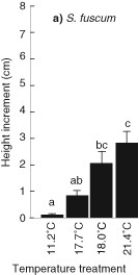 What would you expect to happen to the geographic range of S. fuscum as the temperature of Earth warms?
 (Multiple Choice)
4.9/5 (85)
(85) In the Great Australian Desert, rainfall averages about 30 centimetres per year. Yet, it is not uncommon when hiking in this extremely arid zone to encounter mosses and ferns. One such plant is called "flower of stone". It is not a flowering plant, nor does it produce seeds. Under arid conditions, its leaflike structures curl up. However, when it rains, it unfurls its leaves, which form a bright green rosette on the desert floor. Consequently, it is sometimes called the "resurrection plant". At first glance, it could be a fern, a true moss, or a spike moss.
-Which of the following characteristics is (are) possessed in common by true mosses, ferns, and spike mosses, and therefore becomes useless at helping to determine to which of these groups "flower of stone" belongs?
(Multiple Choice)
4.8/5 (69)
(69) The coal and oil that we currently use as fuel sources ________.
(Multiple Choice)
4.9/5 (90)
(90) If you were asked to design a bryophyte that could be successful in a bare, moist area, which of the following possible adaptations would you include?
(Multiple Choice)
4.9/5 (86)
(86) Compared to nonvascular plants, the ancient relatives of vascular plants ________.
(Multiple Choice)
4.8/5 (82)
(82) Liverworts, hornworts, and mosses are grouped together as bryophytes. Besides not having vascular tissue, what do they all have in common?
(Multiple Choice)
4.7/5 (76)
(76) The 1-metre height attainable by Dawsonia moss is at the upper end of the size range reached by mosses. What accounts for the relative tallness of Dawsonia?
(Multiple Choice)
4.7/5 (92)
(92) 
Filters
- Essay(0)
- Multiple Choice(0)
- Short Answer(0)
- True False(0)
- Matching(0)