



 Chat with AI
Exam 29: Plant Diversity I: How Plants Colonised Land

Exam 1: Evolution, the Themes of Biology, and Scientific Inquiry51 Questions
Exam 2: The Chemical Context of Life61 Questions
Exam 3: Water and Life55 Questions
Exam 4: Carbon and the Molecular Diversity of Life58 Questions
Exam 5: The Structure and Function of Large Biological Molecules70 Questions
Exam 6: A Tour of the Cell66 Questions
Exam 7: Membrane Structure and Function68 Questions
Exam 8: An Introduction to Metabolism67 Questions
Exam 9: Cellular Respiration and Fermentation68 Questions
Exam 10: Photosynthesis65 Questions
Exam 11: Cell Communication65 Questions
Exam 12: The Cell Cycle66 Questions
Exam 13: Meiosis and Sexual Life Cycles64 Questions
Exam 14: Mendel and the Gene Idea62 Questions
Exam 15: The Chromosomal Basis of Inheritance58 Questions
Exam 16: The Molecular Basis of Inheritance65 Questions
Exam 17: Gene Expression: From Gene to Protein67 Questions
Exam 18: Regulation of Gene Expression66 Questions
Exam 19: Viruses54 Questions
Exam 20: Dna Tools and Biotechnology57 Questions
Exam 21: Genomes and Their Evolution44 Questions
Exam 22: Descent With Modification: a Darwinian View of Life60 Questions
Exam 23: The Evolution of Populations64 Questions
Exam 24: The Origin of Species67 Questions
Exam 25: The History of Life on Earth59 Questions
Exam 26: Phylogeny and the Tree of Life75 Questions
Exam 27: Bacteria and Archaea75 Questions
Exam 28: Protists79 Questions
Exam 29: Plant Diversity I: How Plants Colonised Land82 Questions
Exam 30: Plant Diversity Ii: the Evolution of Seed Plants80 Questions
Exam 31: Fungi70 Questions
Exam 32: An Overview of Animal Diversity67 Questions
Exam 33: An Introduction to Invertebrates83 Questions
Exam 34: The Origin and Evolution of Vertebrates82 Questions
Exam 35: Vascular Plant Structure, Growth, and Development65 Questions
Exam 36: Resource Acquisition and Transport in Vascular Plants74 Questions
Exam 37: Soil and Plant Nutrition52 Questions
Exam 38: Angiosperm Reproduction and Biotechnology60 Questions
Exam 39: Plant Responses to Internal and External Signals61 Questions
Exam 40: Basic Principles of Animal Form and Function68 Questions
Exam 41: Animal Nutrition64 Questions
Exam 42: Circulation and Gas Exchange67 Questions
Exam 43: The Immune System69 Questions
Exam 44: Osmoregulation and Excretion64 Questions
Exam 45: Hormones and the Endocrine System66 Questions
Exam 46: Animal Reproduction68 Questions
Exam 47: Animal Development70 Questions
Exam 48: Neurons, Synapses, and Signalling68 Questions
Exam 49: Nervous Systems65 Questions
Exam 50: Sensory and Motor Mechanisms67 Questions
Select questions type


The following question refers to the generalised life cycle for land plants shown in the figure. Each number within a circle or square represents a specific plant or plant part, and each number over an arrow represents meiosis, mitosis, or fertilisation. 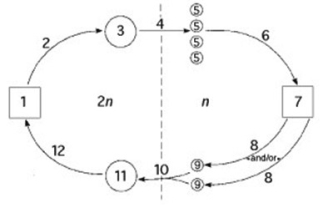 - In the figure, which number represents the mature gametophyte?
 (Multiple Choice)
4.7/5  (73)
(73) If the kingdom Plantae is someday expanded to include the charophytes (stoneworts), then the shared derived characteristics of the kingdom will include ________.
(Multiple Choice)
4.8/5 (80)
(80) Which of the following statements is accurate with regard to the life cycle of mosses?
(Multiple Choice)
4.8/5 (72)
(72) If animals had alternation of generations like plants, ________.
(Multiple Choice)
4.9/5 (85)
(85) Assuming equal spore production rates, what is the likely consequence in a bryophyte with both asexual and sexual reproduction versus one with only sexual reproduction?
(Multiple Choice)
4.7/5 (85)
(85) Which of the following characteristics of plants is absent in their closest relatives, the charophyte algae?
(Multiple Choice)
4.9/5 (92)
(92) Which of the following environmental factors probably helped early plants to successfully colonise land?
(Multiple Choice)
4.8/5 (81)
(81) In the Great Australian Desert, rainfall averages about 30 centimetres per year. Yet, it is not uncommon when hiking in this extremely arid zone to encounter mosses and ferns. One such plant is called "flower of stone". It is not a flowering plant, nor does it produce seeds. Under arid conditions, its leaflike structures curl up. However, when it rains, it unfurls its leaves, which form a bright green rosette on the desert floor. Consequently, it is sometimes called the "resurrection plant". At first glance, it could be a fern, a true moss, or a spike moss.
-Which of the following features is most important for true mosses and ferns to reproduce in the desert?
(Multiple Choice)
4.9/5 (83)
(83) If humans had been present to build log structures during the Carboniferous period (they were not), which plant types would have been suitable sources of logs?
(Multiple Choice)
4.9/5 (83)
(83) As you stroll through a moist forest, you are most likely to see a ________.
(Multiple Choice)
4.9/5 (79)
(79) Which of the following is an accurate statement about plant reproduction?
(Multiple Choice)
4.9/5 (86)
(86) The fact that both charophytes and green plants contain chlorophylls a and b demonstrates which of the following?
(Multiple Choice)
4.8/5 (71)
(71) Which of the following statements about the transition from ocean to land by plants is most likely to be accurate?
(Multiple Choice)
4.9/5 (68)
(68) If you walk through an area with mosses and ferns, you are seeing ________.
(Multiple Choice)
4.8/5 (99)
(99) Increasing the number of stomata per unit surface area of a leaf when atmospheric carbon dioxide levels decline is most analogous to a human ________.
(Multiple Choice)
4.8/5 (82)
(82) Which of the following statements about the zygotes of plants is most likely to be accurate?
(Multiple Choice)
4.8/5 (81)
(81) Two small, poorly drained lakes lie close to each other in a northern forest. The basins of both lakes are composed of the same geologic substratum. One lake is surrounded by a dense Sphagnum mat; the other is not. Compared to the pond with Sphagnum, the pond lacking the moss mat should have ________.
(Multiple Choice)
4.7/5 (86)
(86) 
Filters
- Essay(0)
- Multiple Choice(0)
- Short Answer(0)
- True False(0)
- Matching(0)