



 Chat with AI
Exam 33: An Introduction to Invertebrates

Exam 1: Evolution, the Themes of Biology, and Scientific Inquiry51 Questions
Exam 2: The Chemical Context of Life61 Questions
Exam 3: Water and Life55 Questions
Exam 4: Carbon and the Molecular Diversity of Life58 Questions
Exam 5: The Structure and Function of Large Biological Molecules70 Questions
Exam 6: A Tour of the Cell66 Questions
Exam 7: Membrane Structure and Function68 Questions
Exam 8: An Introduction to Metabolism67 Questions
Exam 9: Cellular Respiration and Fermentation68 Questions
Exam 10: Photosynthesis65 Questions
Exam 11: Cell Communication65 Questions
Exam 12: The Cell Cycle66 Questions
Exam 13: Meiosis and Sexual Life Cycles64 Questions
Exam 14: Mendel and the Gene Idea62 Questions
Exam 15: The Chromosomal Basis of Inheritance58 Questions
Exam 16: The Molecular Basis of Inheritance65 Questions
Exam 17: Gene Expression: From Gene to Protein67 Questions
Exam 18: Regulation of Gene Expression66 Questions
Exam 19: Viruses54 Questions
Exam 20: Dna Tools and Biotechnology57 Questions
Exam 21: Genomes and Their Evolution44 Questions
Exam 22: Descent With Modification: a Darwinian View of Life60 Questions
Exam 23: The Evolution of Populations64 Questions
Exam 24: The Origin of Species67 Questions
Exam 25: The History of Life on Earth59 Questions
Exam 26: Phylogeny and the Tree of Life75 Questions
Exam 27: Bacteria and Archaea75 Questions
Exam 28: Protists79 Questions
Exam 29: Plant Diversity I: How Plants Colonised Land82 Questions
Exam 30: Plant Diversity Ii: the Evolution of Seed Plants80 Questions
Exam 31: Fungi70 Questions
Exam 32: An Overview of Animal Diversity67 Questions
Exam 33: An Introduction to Invertebrates83 Questions
Exam 34: The Origin and Evolution of Vertebrates82 Questions
Exam 35: Vascular Plant Structure, Growth, and Development65 Questions
Exam 36: Resource Acquisition and Transport in Vascular Plants74 Questions
Exam 37: Soil and Plant Nutrition52 Questions
Exam 38: Angiosperm Reproduction and Biotechnology60 Questions
Exam 39: Plant Responses to Internal and External Signals61 Questions
Exam 40: Basic Principles of Animal Form and Function68 Questions
Exam 41: Animal Nutrition64 Questions
Exam 42: Circulation and Gas Exchange67 Questions
Exam 43: The Immune System69 Questions
Exam 44: Osmoregulation and Excretion64 Questions
Exam 45: Hormones and the Endocrine System66 Questions
Exam 46: Animal Reproduction68 Questions
Exam 47: Animal Development70 Questions
Exam 48: Neurons, Synapses, and Signalling68 Questions
Exam 49: Nervous Systems65 Questions
Exam 50: Sensory and Motor Mechanisms67 Questions
Select questions type


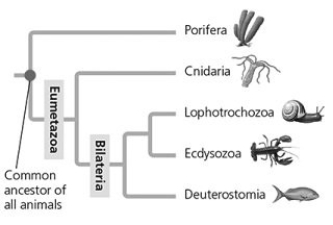 In the figure, which two main clades branch from the most recent common ancestor of the eumetazoans?
 (Multiple Choice)
4.9/5  (89)
(89) A farm dam, usually dry during winter, has plenty of water and aquatic pond life during the summer. One summer, Sarah returns to the family farm from university. Observing the pond, she is fascinated by some six-legged organisms that can crawl about on submerged surfaces or, when disturbed, seemingly "jet" through the water. Watching further, she is able to conclude that the "mystery organisms" are ambush predators, and their prey includes everything from insects to small fish and tadpoles.
-If the pond organisms are larvae, rather than adults, Sarah should expect them to have all of the following structures, except ________.
(Multiple Choice)
4.8/5 (88)
(88) A farm dam, usually dry during winter, has plenty of water and aquatic pond life during the summer. One summer, Sarah returns to the family farm from university. Observing the pond, she is fascinated by some six-legged organisms that can crawl about on submerged surfaces or, when disturbed, seemingly "jet" through the water. Watching further, she is able to conclude that the "mystery organisms" are ambush predators, and their prey includes everything from insects to small fish and tadpoles.
-Sarah observed that the mystery pond organisms never come up to the pond's surface. If she catches one of these organisms and observes closely, perhaps dissecting the organism, she should find ________.
(Multiple Choice)
5.0/5 (75)
(75) Which of the following statements about bryozoans (ectoprocts) is correct?
(Multiple Choice)
4.9/5 (81)
(81) While sampling marine plankton in a lab, a student encounters large numbers of fertilised eggs. The student rears some of the eggs in the laboratory for further study and finds that the blastopore becomes the mouth. The embryo develops into a trochophore larva and eventually has a true coelom. These eggs probably belonged to a(n) ________.
(Multiple Choice)
4.9/5 (69)
(69) Which of the following changes would lead to an increase in surface-area-to-volume ratios?
(Multiple Choice)
4.8/5 (77)
(77) Nudibranchs, a type of predatory sea slug, can have various protuberances (that is, extensions) on their dorsal surfaces. Rhinophores are paired structures, located close to the head, which bear many chemoreceptors. Dorsal plumules, usually located posteriorly, perform respiratory gas exchange. Cerata usually cover much of the dorsal surface and contain nematocysts at their tips.
-The stingers of honeybees have a function most similar to that of ________.
(Multiple Choice)
4.9/5 (91)
(91) Which of the following can be found in the mesohyl of a sponge?
(Multiple Choice)
4.9/5 (91)
(91) As you are walking along a beach, you find an animal and believe that it belongs to the class Asteroidea. Which of the following characteristics would support your hypothesis that the animal is a sea star and not another type of echinoderm?
(Multiple Choice)
4.9/5 (85)
(85) Which of the following combinations of phylum and description is incorrect?
(Multiple Choice)
4.9/5 (67)
(67) Planarians lack dedicated respiratory and circulatory systems. This deficiency does not cause a problem because ________.
(Multiple Choice)
4.9/5 (75)
(75) Many terrestrial arthropods exchange gases with their environments by using tracheae, tubes that lead from openings (called spiracles) in the animal's exoskeleton or cuticle directly to the animal's tissues. Some arthropods can control whether their spiracles are opened or closed; opening the spiracles allows the carbon dioxide produced in the tissues to travel down the tracheae and be released outside the animal. Klok et al. measured the carbon dioxide emitted over time (represented by VCO₂) by several species of centipedes. The figures present graphs of their results for two species, Cormocephalus morsitans and Scutigerina weberi. (C. J. Klok, R. D. Mercer, and S. L. Chown. 2002. Discontinuous gas-exchange in centipedes and its convergent evolution in tracheated arthropods. Journal of Experimental Biology 205:1019-29.) Copyright 2002 The Company of Biologists and the Journal of Experimental Biology.  Look at the graph for Scutigerina weberi (note the scale of the y-axis) in the figure.
- What is the best interpretation of these results?
Look at the graph for Scutigerina weberi (note the scale of the y-axis) in the figure.
- What is the best interpretation of these results? (Multiple Choice)
4.7/5 (81)
(81) Many terrestrial arthropods exchange gases with their environments by using tracheae, tubes that lead from openings (called spiracles) in the animal's exoskeleton or cuticle directly to the animal's tissues. Some arthropods can control whether their spiracles are opened or closed; opening the spiracles allows the carbon dioxide produced in the tissues to travel down the tracheae and be released outside the animal. Klok et al. measured the carbon dioxide emitted over time (represented by VCO₂) by several species of centipedes. The figures present graphs of their results for two species, Cormocephalus morsitans and Scutigerina weberi. (C. J. Klok, R. D. Mercer, and S. L. Chown. 2002. Discontinuous gas-exchange in centipedes and its convergent evolution in tracheated arthropods. Journal of Experimental Biology 205:1019-29.) Copyright 2002 The Company of Biologists and the Journal of Experimental Biology.  Look at the graph for Cormocephalus morsitans in the figure. What is the best interpretation of these results?
 (Multiple Choice)
4.7/5 (71)
(71) Nudibranchs, a type of predatory sea slug, can have various protuberances (that is, extensions) on their dorsal surfaces. Rhinophores are paired structures, located close to the head, which bear many chemoreceptors. Dorsal plumules, usually located posteriorly, perform respiratory gas exchange. Cerata usually cover much of the dorsal surface and contain nematocysts at their tips.
-The spiracles and tracheae of insects have a function most similar to that of ________.
(Multiple Choice)
4.9/5 (67)
(67) Molecular studies have changed many of the phylogenetic relationships previously identified by morphological studies. An example of such a change is ________.
(Multiple Choice)
4.8/5 (78)
(78) The increase in plant species diversity allowed which of the following events?
(Multiple Choice)
4.8/5 (71)
(71) The presence of a lophophore in a newly discovered species would suggest that the species ________.
(Multiple Choice)
4.8/5 (79)
(79) The phylum Cycliophora was discovered in 1995. They are tiny organisms that live in large numbers on the outsides of the mouthparts and appendages of lobsters. The feeding stage permanently attaches to the lobster via an adhesive disk and collects scraps of food from its host's feeding by capturing the scraps in a current created by a ring of cilia. The body is saclike and has a U-shaped intestine that brings the anus close to the mouth. Cycliophorans are coelomates, do not moult (though their host does), and their embryos undergo spiral cleavage.
-Basing your inferences on information in the paragraph, to which clades should cycliophorans belong?
(Multiple Choice)
4.7/5 (80)
(80)  Which of the following factors, when used to label the horizontal axis of the graph, would account most directly for the shape of the plot?
 (Multiple Choice)
4.7/5 (71)
(71) 
Filters
- Essay(0)
- Multiple Choice(0)
- Short Answer(0)
- True False(0)
- Matching(0)