



 Chat with AI
Exam 33: An Introduction to Invertebrates

Exam 1: Evolution, the Themes of Biology, and Scientific Inquiry51 Questions
Exam 2: The Chemical Context of Life61 Questions
Exam 3: Water and Life55 Questions
Exam 4: Carbon and the Molecular Diversity of Life58 Questions
Exam 5: The Structure and Function of Large Biological Molecules70 Questions
Exam 6: A Tour of the Cell66 Questions
Exam 7: Membrane Structure and Function68 Questions
Exam 8: An Introduction to Metabolism67 Questions
Exam 9: Cellular Respiration and Fermentation68 Questions
Exam 10: Photosynthesis65 Questions
Exam 11: Cell Communication65 Questions
Exam 12: The Cell Cycle66 Questions
Exam 13: Meiosis and Sexual Life Cycles64 Questions
Exam 14: Mendel and the Gene Idea62 Questions
Exam 15: The Chromosomal Basis of Inheritance58 Questions
Exam 16: The Molecular Basis of Inheritance65 Questions
Exam 17: Gene Expression: From Gene to Protein67 Questions
Exam 18: Regulation of Gene Expression66 Questions
Exam 19: Viruses54 Questions
Exam 20: Dna Tools and Biotechnology57 Questions
Exam 21: Genomes and Their Evolution44 Questions
Exam 22: Descent With Modification: a Darwinian View of Life60 Questions
Exam 23: The Evolution of Populations64 Questions
Exam 24: The Origin of Species67 Questions
Exam 25: The History of Life on Earth59 Questions
Exam 26: Phylogeny and the Tree of Life75 Questions
Exam 27: Bacteria and Archaea75 Questions
Exam 28: Protists79 Questions
Exam 29: Plant Diversity I: How Plants Colonised Land82 Questions
Exam 30: Plant Diversity Ii: the Evolution of Seed Plants80 Questions
Exam 31: Fungi70 Questions
Exam 32: An Overview of Animal Diversity67 Questions
Exam 33: An Introduction to Invertebrates83 Questions
Exam 34: The Origin and Evolution of Vertebrates82 Questions
Exam 35: Vascular Plant Structure, Growth, and Development65 Questions
Exam 36: Resource Acquisition and Transport in Vascular Plants74 Questions
Exam 37: Soil and Plant Nutrition52 Questions
Exam 38: Angiosperm Reproduction and Biotechnology60 Questions
Exam 39: Plant Responses to Internal and External Signals61 Questions
Exam 40: Basic Principles of Animal Form and Function68 Questions
Exam 41: Animal Nutrition64 Questions
Exam 42: Circulation and Gas Exchange67 Questions
Exam 43: The Immune System69 Questions
Exam 44: Osmoregulation and Excretion64 Questions
Exam 45: Hormones and the Endocrine System66 Questions
Exam 46: Animal Reproduction68 Questions
Exam 47: Animal Development70 Questions
Exam 48: Neurons, Synapses, and Signalling68 Questions
Exam 49: Nervous Systems65 Questions
Exam 50: Sensory and Motor Mechanisms67 Questions
Select questions type


A terrestrial animal species is discovered with the following larval characteristics: exoskeleton, system of tubes for gas exchange, and modified segmentation. A knowledgeable zoologist should predict that the adults of this species would also feature ________.
(Multiple Choice)
4.8/5  (74)
(74) Compared to insects with incomplete metamorphosis, insects with complete metamorphosis ________.
(Multiple Choice)
4.9/5 (80)
(80) Parasitism is one of the most widespread lifestyles ever to evolve. Which of the following is consistent with this finding?
(Multiple Choice)
4.8/5 (96)
(96) Many terrestrial arthropods exchange gases with their environments by using tracheae, tubes that lead from openings (called spiracles) in the animal's exoskeleton or cuticle directly to the animal's tissues. Some arthropods can control whether their spiracles are opened or closed; opening the spiracles allows the carbon dioxide produced in the tissues to travel down the tracheae and be released outside the animal. Klok et al. measured the carbon dioxide emitted over time (represented by VCO₂) by several species of centipedes. The figures present graphs of their results for two species, Cormocephalus morsitans and Scutigerina weberi. (C. J. Klok, R. D. Mercer, and S. L. Chown. 2002. Discontinuous gas-exchange in centipedes and its convergent evolution in tracheated arthropods. Journal of Experimental Biology 205:1019-29.) Copyright 2002 The Company of Biologists and the Journal of Experimental Biology. 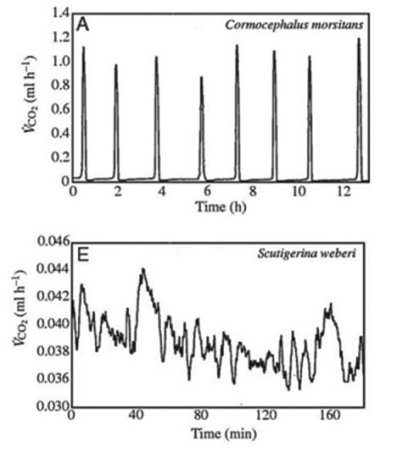 Compare the graphs in the figure of carbon dioxide (CO₂) emission for Cormocephalus morsitans and Scutigerina weberi.
-What hypothesis can you make about each centipede's habitat?
Compare the graphs in the figure of carbon dioxide (CO₂) emission for Cormocephalus morsitans and Scutigerina weberi.
-What hypothesis can you make about each centipede's habitat? (Multiple Choice)
4.9/5 (82)
(82) A primary school science teacher decided to liven up the classroom with a saltwater aquarium. Knowing that saltwater aquaria can be quite a hassle, the teacher proceeded stepwise. First, the teacher conditioned the water. Next, the teacher decided to stock the tank with various marine invertebrates, including a polychaete, a siliceous sponge, several bivalves, a shrimp, several sea anemones of different types, a colonial hydra, a few coral species, an ectoproct, a sea star, and several herbivorous gastropod varieties. Lastly, she added some vertebrates-a parrot fish and a clown fish. She arranged for daily feedings of copepods and feeder fish.
If the teacher wanted to show the students what a lophophore is and how it works, the teacher would point out a feeding ________.
(Multiple Choice)
4.9/5 (82)
(82) The nontaxonomic term sea slug encompasses a wide variety of marine gastropods. One feature they share as adults is the lack of a shell. One might think, therefore, that they represent defenceless morsels for predators. In fact, sea slugs have multiple defences. Some sea slugs prey on sponges and concentrate sponge toxins in their tissues. Others feed on cnidarians, digesting everything except the nematocysts, which they then transfer to their own skins. Whereas the most brightly coloured sea slugs are often highly toxic, others are nontoxic and mimic the colouration of the toxic species. Their colours are mostly derived from pigments in their prey. There are also sea slugs that use their colouration to blend into their environments.
This nudibranch, a type of sea slug, has many reddish cerata on its dorsal surface, as well as two white-tipped rhinophores located on the head. 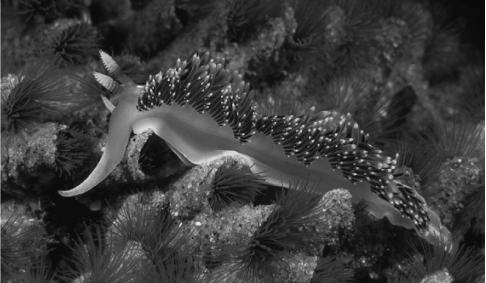 -The nematocysts of sea slugs should be most effective at protecting individual sea slugs from predation if the predators ________.
 (Multiple Choice)
4.8/5 (74)
(74) Against which hard structure do the circular and longitudinal muscles of annelids work?
(Multiple Choice)
4.7/5 (72)
(72) The sea slug Pteraeolidia ianthina can harbour living dinoflagellates (photosynthetic protists) in its skin. These endosymbiotic dinoflagellates reproduce quickly enough to maintain their populations. Low populations do not affect the sea slugs very much, but high populations (> 5 × 10⁵ cells/mg of sea slug protein) can promote sea slug survival. 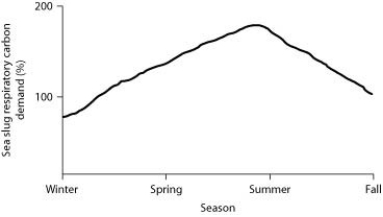 Percent of sea slug respiratory carbon demand provided by indwelling dinoflagellates.
-If the dinoflagellate-containing sea slug P. ianthina preys on coral animals, then it would be most surprising to find that ________.
Percent of sea slug respiratory carbon demand provided by indwelling dinoflagellates.
-If the dinoflagellate-containing sea slug P. ianthina preys on coral animals, then it would be most surprising to find that ________. (Multiple Choice)
5.0/5 (80)
(80) Which of the following statements is correct with respect to the evolutionary relationship between chordates and invertebrates?
(Multiple Choice)
4.8/5 (94)
(94) Healthy corals are brightly coloured because they ________.
(Multiple Choice)
4.9/5 (70)
(70) Which of the following organisms would you expect to have the largest surface-area-to-volume ratio? Assume that all of the following are the same total length.
(Multiple Choice)
4.9/5 (83)
(83) One should expect to find cilia associated with the feeding apparatus of ________.
(Multiple Choice)
4.7/5 (86)
(86) A primary school science teacher decided to liven up the classroom with a saltwater aquarium. Knowing that saltwater aquaria can be quite a hassle, the teacher proceeded stepwise. First, the teacher conditioned the water. Next, the teacher decided to stock the tank with various marine invertebrates, including a polychaete, a siliceous sponge, several bivalves, a shrimp, several sea anemones of different types, a colonial hydra, a few coral species, an ectoproct, a sea star, and several herbivorous gastropod varieties. Lastly, she added some vertebrates-a parrot fish and a clown fish. She arranged for daily feedings of copepods and feeder fish.
-Normally, the clown fish readily swims among the tentacles of the sea anemones; the parrot fish avoids them. One hypothesis for the clown fish's apparent immunity is that they slowly build a tolerance to the sea anemone's toxin. A second hypothesis is that a chemical in the mucus that coats the clown fish prevents the nematocysts from being triggered. Which of the following graphs supports the first, but not the second, of these hypotheses?
(Multiple Choice)
4.9/5 (81)
(81) The nontaxonomic term sea slug encompasses a wide variety of marine gastropods. One feature they share as adults is the lack of a shell. One might think, therefore, that they represent defenceless morsels for predators. In fact, sea slugs have multiple defences. Some sea slugs prey on sponges and concentrate sponge toxins in their tissues. Others feed on cnidarians, digesting everything except the nematocysts, which they then transfer to their own skins. Whereas the most brightly coloured sea slugs are often highly toxic, others are nontoxic and mimic the colouration of the toxic species. Their colours are mostly derived from pigments in their prey. There are also sea slugs that use their colouration to blend into their environments.
This nudibranch, a type of sea slug, has many reddish cerata on its dorsal surface, as well as two white-tipped rhinophores located on the head.
-Which structure do sea slugs use to feed on their prey?
-Which structure do sea slugs use to feed on their prey? (Multiple Choice)
4.8/5 (92)
(92) Which characteristic is shared by cnidarians and flatworms?
(Multiple Choice)
4.9/5 (83)
(83) Molecular studies have changed many of the phylogenetic relationships previously identified by morphological studies. These changes indicate that ________.
(Multiple Choice)
4.7/5 (81)
(81) Soft-shell crab is a prized dish in many seaside resorts. Why are the crabs' shells soft?
(Multiple Choice)
5.0/5 (78)
(78) 
Filters
- Essay(0)
- Multiple Choice(0)
- Short Answer(0)
- True False(0)
- Matching(0)