



 Chat with AI
Exam 53: Animal Behavior

Exam 1: Studying Life 97 Questions
Exam 2: Small Molecules and the Chemistry of Life145 Questions
Exam 3: Proteins, Carbohydrates, and Lipids145 Questions
Exam 4: Nucleic Acids and the Origin of Life117 Questions
Exam 5: Cells: the Working Units of Life153 Questions
Exam 6: Cell Membranes136 Questions
Exam 7: Cell Signaling and Communication150 Questions
Exam 8: Energy, Enzymes, and Metabolism153 Questions
Exam 9: Pathways That Harvest Chemical Energy154 Questions
Exam 10: Photosynthesis: Energy From Sunlight158 Questions
Exam 11: The Cell Cycle and Cell Division176 Questions
Exam 12: Inheritance, Genes, and Chromosomes150 Questions
Exam 13: Dna and Its Role in Heredity155 Questions
Exam 14: From Dna to Protein: Gene Expression151 Questions
Exam 15: Gene Mutation and Molecular Medicine141 Questions
Exam 16: Regulation of Gene Expression151 Questions
Exam 17: Genomes145 Questions
Exam 18: Recombinent Dna and Biotechnology141 Questions
Exam 19: Differential Gene Expression in Development147 Questions
Exam 20: Development and Evolutionary Change120 Questions
Exam 21: Evidence and Mechanisms of Evolution151 Questions
Exam 22: Reconstructing and Using Phylogenies137 Questions
Exam 23: Species and Their Formation140 Questions
Exam 24: Evolution of Genes and Genomes141 Questions
Exam 25: The History of Life on Earth145 Questions
Exam 26: Bacteria and Archaea: the Prokaryotic Domains156 Questions
Exam 27: The Origin and Diversification of Eukaryotes148 Questions
Exam 28: Plants Without Seeds: From Water to Land144 Questions
Exam 29: The Evolution of Seed Plants141 Questions
Exam 30: Fungi: Recyclers, Pathogens, Parasites, and Plant Partners144 Questions
Exam 31: Animal Origins and the Evolution of Body Plans122 Questions
Exam 32: Protostome Animals146 Questions
Exam 33: Deuterostome Animals150 Questions
Exam 34: The Plant Body132 Questions
Exam 35: Transport in Plants133 Questions
Exam 36: Plant Nutrition134 Questions
Exam 37: Regulation of Plant Growth137 Questions
Exam 38: Reproduction in Flowering Plants140 Questions
Exam 39: Plant Responses to Environmental Challenges131 Questions
Exam 40: Physiology, Homeostasis, and Temperature Regulation146 Questions
Exam 41: Animal Hormones147 Questions
Exam 42: Immunology: Animal Defense Systems150 Questions
Exam 43: Animal Reproduction150 Questions
Exam 44: Animal Development147 Questions
Exam 45: Neurons and Nervous Systems145 Questions
Exam 46: Sensory Systems150 Questions
Exam 47: The Mammalian Nervous System: Structure and Higher Function150 Questions
Exam 48: Musculoskeletal Systems150 Questions
Exam 49: Gas Exchange in Animals149 Questions
Exam 50: Circulatory Systems150 Questions
Exam 51: Nutrition, Digestion, and Absorption149 Questions
Exam 52: Salt and Water Balance and Nitrogen145 Questions
Exam 53: Animal Behavior149 Questions
Exam 54: Ecology and the Distribution of Life150 Questions
Exam 55: Population Ecology123 Questions
Exam 56: Species Interaction and Coevolution131 Questions
Exam 57: Community Ecology133 Questions
Exam 58: Ecosystems and Global Ecology142 Questions
Exam 59: Conservation Biology116 Questions
Select questions type


Which of the following statements about animal behavior is true?
(Multiple Choice)
4.8/5  (77)
(77) In birds, the reduced risk of predation associated with the practice of gathering in flocks can be considered the behavior's
(Multiple Choice)
4.8/5 (79)
(79) An animal that is maintained in constant conditions whose circadian clock is running according to its natural period is said to be _______.
(Short Answer)
4.8/5 (71)
(71) For each of the two y-axes in the following graph, draw a labeled curve that correctly summarizes observations made on goshawks attacking wood pigeons, as described in the textbook. 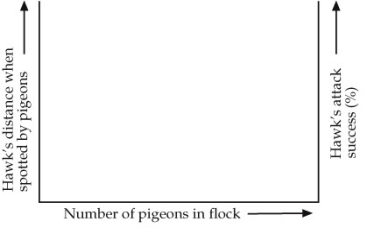
(Essay)
4.9/5 (69)
(69) The ultimate causes of a behavior are those that have shaped the behavior's _______.
(Short Answer)
4.8/5 (75)
(75) Which of the following statements about the development of singing behavior in white-crowned sparrows is false?
(Multiple Choice)
4.8/5 (92)
(92) Use the following to answer questions :
Match the correct answer from the list below with each description that follows.
-In diploid organisms, the percent of alleles that individuals share with the offspring of their siblings
(Multiple Choice)
4.8/5 (70)
(70) Animals exhibit daily rhythms in their behavior and physiology. Which of the following statements about circadian rhythms is false?
(Multiple Choice)
4.8/5 (85)
(85) A bird is trained to feed from the south end of a circular cage. The bird is then placed in a light-controlled room and is phase-advanced by 6 hours. If the bird is returned to the circular cage at noon, where will it search for food?
(Multiple Choice)
4.8/5 (83)
(83) Which of the following has provided the strongest evidence to date that pigeons use magnetic cues for orientation?
(Multiple Choice)
4.8/5 (85)
(85) By facilitating the reproductive success of its non-descendant kin, an animal can increase its _______ fitness.
(Short Answer)
4.8/5 (60)
(60) A mosquito feeding on a mammal benefits nutritionally but also places itself in danger. The insect's chance of being killed by that mammal is an example of a(n) _______ cost.
(Multiple Choice)
4.9/5 (82)
(82) Biologists can show the effect of a single gene on particular behaviors by performing gene _______ experiments.
(Short Answer)
4.8/5 (75)
(75) Bicoordinate navigation, also known as _______ navigation, requires knowledge of the latitude and longitude of one's current position and one's destination.
(True/False)
4.9/5 (88)
(88) In which of the following animals would you expect circannual rhythms to be most pronounced?
(Multiple Choice)
4.9/5 (71)
(71) The ability of honeybees to return to the hive after traveling long distances in search of food is based on a navigational capacity called
(Multiple Choice)
4.8/5 (77)
(77) Throughout the animal kingdom, males, rather than females, usually initiate courtship, largely because
(Multiple Choice)
4.9/5 (76)
(76) Which of the following statements about visual signals is true (in general)?
(Multiple Choice)
4.9/5 (71)
(71) 
Filters
- Essay(0)
- Multiple Choice(0)
- Short Answer(0)
- True False(0)
- Matching(0)