



 Chat with AI
Exam 44: The Nervous System

Exam 1: The Science of Biology67 Questions
Exam 2: The Nature of Molecules73 Questions
Exam 3: The Chemical Building Blocks of Life70 Questions
Exam 4: Cell Structure72 Questions
Exam 5: Membranes58 Questions
Exam 6: Energy and Metabolism68 Questions
Exam 7: How Cells Harvest Energy76 Questions
Exam 8: Photosynthesis72 Questions
Exam 9: Cell Communication57 Questions
Exam 10: How Cells Divide71 Questions
Exam 11: Sexual Reproduction and Meiosis58 Questions
Exam 12: Patterns of Inheritance62 Questions
Exam 13: Chromosomes Mapping and the Meiosis - Inheritance Connection57 Questions
Exam 14: Dna: the Genetic Material64 Questions
Exam 15: Genes and How They Work96 Questions
Exam 16: Control of Gene Expression65 Questions
Exam 17: Biotechnology70 Questions
Exam 18: Genomics59 Questions
Exam 19: Cellular Mechanisms of Development60 Questions
Exam 20: Genes Within Populations71 Questions
Exam 21: The Evidence for Evolution59 Questions
Exam 22: The Origin of Species61 Questions
Exam 23: Systematics and the Phylogenetic Revolution60 Questions
Exam 24: Genome Evolution53 Questions
Exam 25: Evolution of Development46 Questions
Exam 26: The Tree of Life68 Questions
Exam 27: Viruses63 Questions
Exam 28: Prokaryotes67 Questions
Exam 29: Protists61 Questions
Exam 30: Overview of Green Plants75 Questions
Exam 31: Fungi61 Questions
Exam 32: Overview of Animal Diversity56 Questions
Exam 33: Noncoelomate Invertebrates58 Questions
Exam 34: Coelomate Invertebrates106 Questions
Exam 35: Vertebrates94 Questions
Exam 36: Plant Form63 Questions
Exam 37: Vegetative Plant Development54 Questions
Exam 38: Transport in Plants54 Questions
Exam 39: Plant Nutrition and Soils53 Questions
Exam 40: Plant Defense Responses45 Questions
Exam 41: Sensory Systems in Plants62 Questions
Exam 42: Plant Reproduction57 Questions
Exam 43: The Animal Body and Principles of Regulation54 Questions
Exam 44: The Nervous System65 Questions
Exam 45: Sensory Systems65 Questions
Exam 46: The Endocrine System86 Questions
Exam 47: The Musculoskeletal System54 Questions
Exam 48: The Digestive System73 Questions
Exam 49: The Respiratory System58 Questions
Exam 50: The Circulatory System59 Questions
Exam 51: Osmotic Regulation and the Urinary System54 Questions
Exam 52: The Immune System71 Questions
Exam 53: The Reproductive System77 Questions
Exam 54: Animal Development72 Questions
Exam 55: Behavioral Biology76 Questions
Exam 56: Population Ecology65 Questions
Exam 57: Community of Ecology74 Questions
Exam 58: Dynamics of Ecosystems69 Questions
Exam 59: The Biosphere79 Questions
Exam 60: Conservation Biology62 Questions
Select questions type


The autonomic nervous system regulates the activity of all of the following except
(Multiple Choice)
4.9/5  (81)
(81) The site of primary sensory integration in the brain is called the
(Multiple Choice)
4.8/5 (79)
(79) Which of the following is not part of the peripheral nervous system?
(Multiple Choice)
4.9/5 (74)
(74) Nerve impulses are electrical signals produced by which of the following?
(Multiple Choice)
4.7/5 (84)
(84) A(n)_______________ diffuses across a narrow synaptic cleft between the presynaptic axon and the postsynaptic cell to transmit a nerve impulse.
(Multiple Choice)
4.8/5 (92)
(92) The junction between a neuron and another neuronal cell,muscle cell,or with a gland cell is called a(n)
(Multiple Choice)
4.9/5 (83)
(83) During the resting membrane potential,when combining concentration and electrical gradients of K+,the overall effect is for K+ to ___________ the cell.
(Multiple Choice)
4.8/5 (85)
(85) In a typical cell,which of the following has the highest leakage?
(Multiple Choice)
4.9/5 (89)
(89) In the brain,the _______ receive(s)sensory information from ascending nerve tracts and motor commands from the cerebral cortex and cerebellum.
(Multiple Choice)
4.7/5 (77)
(77) In vertebrates more advanced than the fishes,the processing of information is increasingly centered in the
(Multiple Choice)
4.8/5 (70)
(70) __________ neural excitations are the electrical forms in which short-term memories are stored.
(Multiple Choice)
4.9/5 (77)
(77) 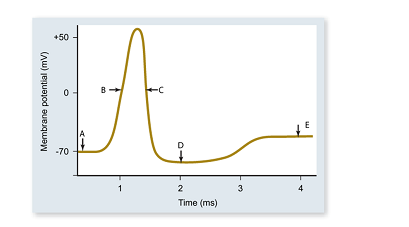 -In the diagram,which arrow best represents the point in time where the permeability of the axon to sodium is the highest?
 (Multiple Choice)
4.9/5 (84)
(84) Acetylcholine stimulates the opening of chemically-regulated ion channels,causing a depolarization called a(n)
(Multiple Choice)
4.9/5 (72)
(72) Action potentials are regenerated along an axon as one action potential serves as the
(Multiple Choice)
4.9/5 (92)
(92)
-In the diagram,which arrow best represents the point in time where the voltage-gated sodium channels are inactivated?
-In the diagram,which arrow best represents the point in time where the voltage-gated sodium channels are inactivated? (Multiple Choice)
4.8/5 (75)
(75) 
Filters
- Essay(0)
- Multiple Choice(0)
- Short Answer(0)
- True False(0)
- Matching(0)