



 Chat with AI
Exam 50: The Circulatory System

Exam 1: The Science of Biology67 Questions
Exam 2: The Nature of Molecules73 Questions
Exam 3: The Chemical Building Blocks of Life70 Questions
Exam 4: Cell Structure72 Questions
Exam 5: Membranes58 Questions
Exam 6: Energy and Metabolism68 Questions
Exam 7: How Cells Harvest Energy76 Questions
Exam 8: Photosynthesis72 Questions
Exam 9: Cell Communication57 Questions
Exam 10: How Cells Divide71 Questions
Exam 11: Sexual Reproduction and Meiosis58 Questions
Exam 12: Patterns of Inheritance62 Questions
Exam 13: Chromosomes Mapping and the Meiosis - Inheritance Connection57 Questions
Exam 14: Dna: the Genetic Material64 Questions
Exam 15: Genes and How They Work96 Questions
Exam 16: Control of Gene Expression65 Questions
Exam 17: Biotechnology70 Questions
Exam 18: Genomics59 Questions
Exam 19: Cellular Mechanisms of Development60 Questions
Exam 20: Genes Within Populations71 Questions
Exam 21: The Evidence for Evolution59 Questions
Exam 22: The Origin of Species61 Questions
Exam 23: Systematics and the Phylogenetic Revolution60 Questions
Exam 24: Genome Evolution53 Questions
Exam 25: Evolution of Development46 Questions
Exam 26: The Tree of Life68 Questions
Exam 27: Viruses63 Questions
Exam 28: Prokaryotes67 Questions
Exam 29: Protists61 Questions
Exam 30: Overview of Green Plants75 Questions
Exam 31: Fungi61 Questions
Exam 32: Overview of Animal Diversity56 Questions
Exam 33: Noncoelomate Invertebrates58 Questions
Exam 34: Coelomate Invertebrates106 Questions
Exam 35: Vertebrates94 Questions
Exam 36: Plant Form63 Questions
Exam 37: Vegetative Plant Development54 Questions
Exam 38: Transport in Plants54 Questions
Exam 39: Plant Nutrition and Soils53 Questions
Exam 40: Plant Defense Responses45 Questions
Exam 41: Sensory Systems in Plants62 Questions
Exam 42: Plant Reproduction57 Questions
Exam 43: The Animal Body and Principles of Regulation54 Questions
Exam 44: The Nervous System65 Questions
Exam 45: Sensory Systems65 Questions
Exam 46: The Endocrine System86 Questions
Exam 47: The Musculoskeletal System54 Questions
Exam 48: The Digestive System73 Questions
Exam 49: The Respiratory System58 Questions
Exam 50: The Circulatory System59 Questions
Exam 51: Osmotic Regulation and the Urinary System54 Questions
Exam 52: The Immune System71 Questions
Exam 53: The Reproductive System77 Questions
Exam 54: Animal Development72 Questions
Exam 55: Behavioral Biology76 Questions
Exam 56: Population Ecology65 Questions
Exam 57: Community of Ecology74 Questions
Exam 58: Dynamics of Ecosystems69 Questions
Exam 59: The Biosphere79 Questions
Exam 60: Conservation Biology62 Questions
Select questions type


_________,the liquid portion of blood contains metabolites,wastes,hormones,ions,and a variety of proteins.
(Multiple Choice)
4.8/5  (87)
(87) One mechanism that involves the blood supply that can be utilized by some animals to limit heat loss in cold environments is
(Multiple Choice)
4.8/5 (84)
(84) Which of the following type of cell is not correctly matched to its function?
(Multiple Choice)
4.8/5 (67)
(67) The blood cells that have some kind of protective function are all of the following except
(Multiple Choice)
4.9/5 (75)
(75) In spite of very low pressure in the veins,blood flow back to the lungs is ensured by all of the following mechanisms except
(Multiple Choice)
4.9/5 (86)
(86) During circulation blood is filtered out of capillaries without any proteins.This fluid bathes the tissues and is called
(Multiple Choice)
4.8/5 (89)
(89) Even though the atria and ventricles are separated by connective tissue,the depolarization can slowly pass through a slender connection of cardiac muscle cells called the
(Multiple Choice)
4.9/5 (90)
(90) Which of the following animals is likely to have the circulatory pattern shown in the figure? 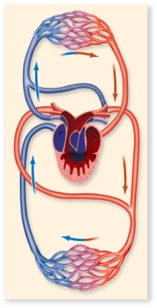
(Multiple Choice)
4.7/5 (70)
(70) A closed circulatory system as opposed to an open system permits
(Multiple Choice)
4.9/5 (85)
(85) A major innovation from the fish to the amphibian/reptilian circulation is the advent of lungs and allowing no mixing of oxygenated and __________ blood by the help of incomplete divisions of the heart.
(Multiple Choice)
4.9/5 (81)
(81) Which of the following values would be considered hypertensive?
(Multiple Choice)
4.8/5 (73)
(73) Blood is pumped from the heart into the arterial system,which branches from arteries into fine __________.
(Multiple Choice)
4.7/5 (82)
(82) All of the following are functions of the circulatory system except
(Multiple Choice)
4.8/5 (79)
(79) Exchange of gases and metabolites between the blood and tissues occurs in the
(Multiple Choice)
4.8/5 (79)
(79) The cells that lack a nucleus and have a relatively short life span are
(Multiple Choice)
4.9/5 (77)
(77) 
Filters
- Essay(0)
- Multiple Choice(0)
- Short Answer(0)
- True False(0)
- Matching(0)