



 Chat with AI
Exam 57: Community of Ecology

Exam 1: The Science of Biology67 Questions
Exam 2: The Nature of Molecules73 Questions
Exam 3: The Chemical Building Blocks of Life70 Questions
Exam 4: Cell Structure72 Questions
Exam 5: Membranes58 Questions
Exam 6: Energy and Metabolism68 Questions
Exam 7: How Cells Harvest Energy76 Questions
Exam 8: Photosynthesis72 Questions
Exam 9: Cell Communication57 Questions
Exam 10: How Cells Divide71 Questions
Exam 11: Sexual Reproduction and Meiosis58 Questions
Exam 12: Patterns of Inheritance62 Questions
Exam 13: Chromosomes Mapping and the Meiosis - Inheritance Connection57 Questions
Exam 14: Dna: the Genetic Material64 Questions
Exam 15: Genes and How They Work96 Questions
Exam 16: Control of Gene Expression65 Questions
Exam 17: Biotechnology70 Questions
Exam 18: Genomics59 Questions
Exam 19: Cellular Mechanisms of Development60 Questions
Exam 20: Genes Within Populations71 Questions
Exam 21: The Evidence for Evolution59 Questions
Exam 22: The Origin of Species61 Questions
Exam 23: Systematics and the Phylogenetic Revolution60 Questions
Exam 24: Genome Evolution53 Questions
Exam 25: Evolution of Development46 Questions
Exam 26: The Tree of Life68 Questions
Exam 27: Viruses63 Questions
Exam 28: Prokaryotes67 Questions
Exam 29: Protists61 Questions
Exam 30: Overview of Green Plants75 Questions
Exam 31: Fungi61 Questions
Exam 32: Overview of Animal Diversity56 Questions
Exam 33: Noncoelomate Invertebrates58 Questions
Exam 34: Coelomate Invertebrates106 Questions
Exam 35: Vertebrates94 Questions
Exam 36: Plant Form63 Questions
Exam 37: Vegetative Plant Development54 Questions
Exam 38: Transport in Plants54 Questions
Exam 39: Plant Nutrition and Soils53 Questions
Exam 40: Plant Defense Responses45 Questions
Exam 41: Sensory Systems in Plants62 Questions
Exam 42: Plant Reproduction57 Questions
Exam 43: The Animal Body and Principles of Regulation54 Questions
Exam 44: The Nervous System65 Questions
Exam 45: Sensory Systems65 Questions
Exam 46: The Endocrine System86 Questions
Exam 47: The Musculoskeletal System54 Questions
Exam 48: The Digestive System73 Questions
Exam 49: The Respiratory System58 Questions
Exam 50: The Circulatory System59 Questions
Exam 51: Osmotic Regulation and the Urinary System54 Questions
Exam 52: The Immune System71 Questions
Exam 53: The Reproductive System77 Questions
Exam 54: Animal Development72 Questions
Exam 55: Behavioral Biology76 Questions
Exam 56: Population Ecology65 Questions
Exam 57: Community of Ecology74 Questions
Exam 58: Dynamics of Ecosystems69 Questions
Exam 59: The Biosphere79 Questions
Exam 60: Conservation Biology62 Questions
Select questions type


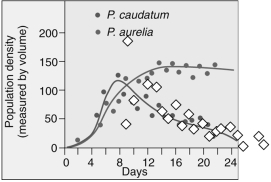

In this relationship,one organism serves as a host to another organism,usually to the host's disadvantage.
(Multiple Choice)
4.9/5  (86)
(86) The dynamic processes that are of critical importance in succession involve all of the following except
(Multiple Choice)
4.7/5 (72)
(72) In studies of two species of barnacles in the marine intertidal zone it was observed that Chthamalus can live in the upper intertidal zone and the lower intertidal zone if Semibalanus is absent,and Semibalanus can only live in the lower zone because it is more subject to dehydration.Based on this,which of the following statements is false?
(Multiple Choice)
4.8/5 (67)
(67) The way in which an organism utilizes its environment may be called
(Multiple Choice)
4.9/5 (71)
(71) A species that interacts in critical ways with many other elements of an ecosystem is called a ___________ species.
(Multiple Choice)
4.9/5 (76)
(76) Succession happens because species in the habitat alter that habitat in ways that assist other species.There are three dynamic concepts that are of critical importance for succession to take place.They are
(Multiple Choice)
4.9/5 (87)
(87) Cattle egrets follow African ungulates such as African buffalo around and catch insects that the buffalo flush.Oxpeckers perch on the backs of buffalo and feed on ectoparasites that infest the buffalo.Which one of the following shows the ecological interaction that the buffalo has with each bird?
(Multiple Choice)
4.9/5 (86)
(86) Animals defend themselves against predators by all of the following except
(Multiple Choice)
4.7/5 (80)
(80) Which statement is the correct interpretation of the graph? 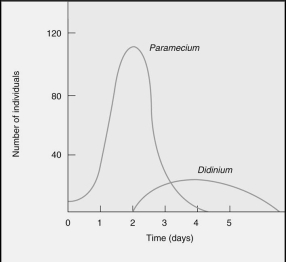
(Multiple Choice)
5.0/5 (91)
(91) Which of the following statements about the fundamental and realized niche is false?
(Multiple Choice)
4.7/5 (83)
(83) You collect data on growth of two different species (A and B)when grown by themselves and with each other.Which one of the following comparisons would best show the effect of only interspecific on species B?
(Multiple Choice)
4.8/5 (71)
(71) Alligators excavate holes in the bottom of bodies of water.During times of severe drought these holes act as refugia for various aquatic organisms that might perish if there were no water available.Thus,alligators in this system can be classified as a(n)
(Multiple Choice)
4.9/5 (75)
(75) No two species can occupy the same niche indefinitely without competition driving one to _________.
(Multiple Choice)
5.0/5 (81)
(81) The difference in the fundamental niche and the realized niche is
(Multiple Choice)
4.8/5 (81)
(81) The pattern of living or the function of an organism in a community is called its
(Multiple Choice)
4.7/5 (72)
(72) Two of Darwin's finches display a character displacement when they occur as sympatric species.Which of the statements correctly interprets the graph? 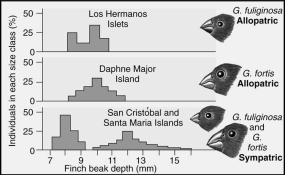
(Multiple Choice)
4.8/5 (81)
(81) Cardiac glycosides,molecules causing a drastic effect on vertebrate heart function,are produced as defense chemicals by plants,which belong to
(Multiple Choice)
4.9/5 (72)
(72) 
Filters
- Essay(0)
- Multiple Choice(0)
- Short Answer(0)
- True False(0)
- Matching(0)