



 Chat with AI
Exam 20: Hemolytic Anemia: Nonimmune Defects

Exam 1: Introduction30 Questions
Exam 2: Cellular Homeostasis40 Questions
Exam 3: Structure and Function of Hematopoietic Organs35 Questions
Exam 4: Hematopoiesis35 Questions
Exam 5: The Erythrocyte37 Questions
Exam 6: Hemoglobin40 Questions
Exam 7: Granulocytes and Monocytes30 Questions
Exam 8: Lymphocytes25 Questions
Exam 9: The Platelet16 Questions
Exam 10: The Complete Blood Count and Peripheral Blood Smear Evaluation35 Questions
Exam 11: Introduction to Anemia35 Questions
Exam 12: Anemias of Disordered Iron Metabolism and Heme Synthesis36 Questions
Exam 13: Hemoglobinopathies: Qualitative Defects33 Questions
Exam 14: Thalassemia32 Questions
Exam 15: Megaloblastic and Nonmegaloblastic Macrocytic Anemias34 Questions
Exam 16: Hypoproliferative Anemias32 Questions
Exam 17: Hemolytic Anemia: Membrane Defects36 Questions
Exam 18: Hemolytic Anemia: Enzyme Deficiencies36 Questions
Exam 19: Hemolytic Anemia: Immune Anemias30 Questions
Exam 20: Hemolytic Anemia: Nonimmune Defects30 Questions
Exam 21: Nonmalignant Disorders of Leukocytes: Granulocytes and Monocytes35 Questions
Exam 22: Nonmalignant Lymphocyte Disorders32 Questions
Exam 23: Introduction to Hematopoietic Neoplasms34 Questions
Exam 24: Myeloproliferative Neoplasms44 Questions
Exam 25: Myelodysplastic Syndromes34 Questions
Exam 26: Acute Myeloid Leukemias35 Questions
Exam 27: Precursor Lymphoid Neoplasms34 Questions
Exam 28: Mature Lymphoid Neoplasms39 Questions
Exam 29: Hematopoietic Stem Cell Transplantation41 Questions
Exam 30: Morphologic Analysis of Body Fluids in the Hematology Laboratory39 Questions
Exam 31: Primary Hemostasis35 Questions
Exam 32: Secondary Hemostasis and Fibrinolysis33 Questions
Exam 33: Disorders of Primary Hemostasis35 Questions
Exam 34: Disorders of Secondary Hemostasis34 Questions
Exam 35: Thrombophilia34 Questions
Exam 36: Hemostasis: Laboratory Testing and Instrumentation41 Questions
Exam 37: Hematology Procedures46 Questions
Exam 38: Bone Marrow Examination34 Questions
Exam 39: Automation in Hematology38 Questions
Exam 40: Flow Cytometry34 Questions
Exam 41: Chromosome Analysis of Hematopoietic and Lymphoid Disorders35 Questions
Exam 42: Molecular Analysis of Hematologic Diseases18 Questions
Select questions type


Which of the following conditions is not characterized by the presence of schistocytes?
(Multiple Choice)
4.9/5  (97)
(97) A mother brings her 3-year-old daughter to the emergency department because she is having trouble urinating.The child is not feverish.She has otherwise been healthy except for a bout of diarrhea about 10 days ago.Laboratory test results are as follows: 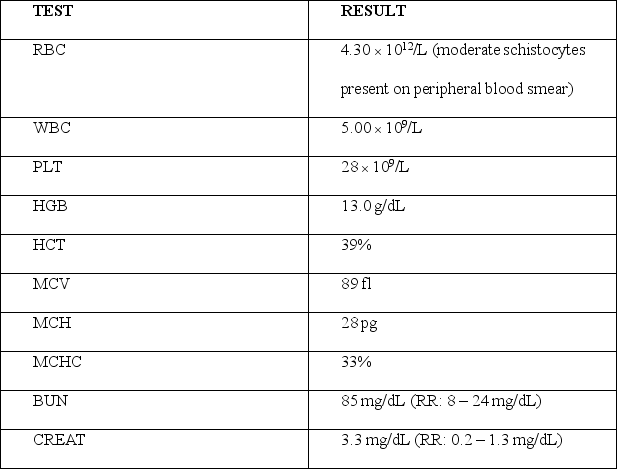 Based on the history and the laboratory results,what is the most likely diagnosis?
 (Multiple Choice)
4.9/5 (88)
(88) Explain why infections with Clostridium perfringens lead to hemolysis of the RBCs.
(Essay)
5.0/5 (86)
(86) A 7-year-old girl is brought to a physician because she has a swollen hand with an ischemic lesion.The physician suspects a brown recluse spider bite.What is the suspected mechanism of erythrocyte damage caused by venom of this spider?
(Multiple Choice)
4.9/5 (66)
(66) Which of the following laboratory findings occur in both HUS and TTP?
(Multiple Choice)
4.8/5 (89)
(89) Bone marrow response in MAHA is reflected in the peripheral blood smear by the presence of:
(Multiple Choice)
4.9/5 (84)
(84) Which of the following results are typically found in HUS?
PT aPTT
(Multiple Choice)
4.8/5 (69)
(69) Plasmodium falciparum infection is accompanied by a severe form of anemia from what factor?
(Multiple Choice)
4.7/5 (89)
(89) A patient who presents with DIC would most likely have which of the following sets of coagulation test results?
PT aPTT D-dimer Fibrinogen
(Multiple Choice)
4.7/5 (72)
(72) 
Filters
- Essay(0)
- Multiple Choice(0)
- Short Answer(0)
- True False(0)
- Matching(0)