



 Chat with AI
Exam 13: Hemoglobinopathies: Qualitative Defects

Exam 1: Introduction30 Questions
Exam 2: Cellular Homeostasis40 Questions
Exam 3: Structure and Function of Hematopoietic Organs35 Questions
Exam 4: Hematopoiesis35 Questions
Exam 5: The Erythrocyte37 Questions
Exam 6: Hemoglobin40 Questions
Exam 7: Granulocytes and Monocytes30 Questions
Exam 8: Lymphocytes25 Questions
Exam 9: The Platelet16 Questions
Exam 10: The Complete Blood Count and Peripheral Blood Smear Evaluation35 Questions
Exam 11: Introduction to Anemia35 Questions
Exam 12: Anemias of Disordered Iron Metabolism and Heme Synthesis36 Questions
Exam 13: Hemoglobinopathies: Qualitative Defects33 Questions
Exam 14: Thalassemia32 Questions
Exam 15: Megaloblastic and Nonmegaloblastic Macrocytic Anemias34 Questions
Exam 16: Hypoproliferative Anemias32 Questions
Exam 17: Hemolytic Anemia: Membrane Defects36 Questions
Exam 18: Hemolytic Anemia: Enzyme Deficiencies36 Questions
Exam 19: Hemolytic Anemia: Immune Anemias30 Questions
Exam 20: Hemolytic Anemia: Nonimmune Defects30 Questions
Exam 21: Nonmalignant Disorders of Leukocytes: Granulocytes and Monocytes35 Questions
Exam 22: Nonmalignant Lymphocyte Disorders32 Questions
Exam 23: Introduction to Hematopoietic Neoplasms34 Questions
Exam 24: Myeloproliferative Neoplasms44 Questions
Exam 25: Myelodysplastic Syndromes34 Questions
Exam 26: Acute Myeloid Leukemias35 Questions
Exam 27: Precursor Lymphoid Neoplasms34 Questions
Exam 28: Mature Lymphoid Neoplasms39 Questions
Exam 29: Hematopoietic Stem Cell Transplantation41 Questions
Exam 30: Morphologic Analysis of Body Fluids in the Hematology Laboratory39 Questions
Exam 31: Primary Hemostasis35 Questions
Exam 32: Secondary Hemostasis and Fibrinolysis33 Questions
Exam 33: Disorders of Primary Hemostasis35 Questions
Exam 34: Disorders of Secondary Hemostasis34 Questions
Exam 35: Thrombophilia34 Questions
Exam 36: Hemostasis: Laboratory Testing and Instrumentation41 Questions
Exam 37: Hematology Procedures46 Questions
Exam 38: Bone Marrow Examination34 Questions
Exam 39: Automation in Hematology38 Questions
Exam 40: Flow Cytometry34 Questions
Exam 41: Chromosome Analysis of Hematopoietic and Lymphoid Disorders35 Questions
Exam 42: Molecular Analysis of Hematologic Diseases18 Questions
Select questions type


Disease that results from a molecular defect in hemoglobin synthesis in RBCs is termed:

Free
(Multiple Choice)
4.9/5  (90)
(90) Correct Answer: Verified
B
Evolution dictates that patients with sickle cell disease have an inherent resistance to which of the following?
Free
(Multiple Choice)
4.9/5 (90)
(90) Correct Answer:Verified
VerifiedD
Patients with sickle cell disease and those with sickle cell trait differ greatly in clinical presentation.List at least two features in clinical presentation,and explain why they differ.
Free
(Essay)
4.8/5 (77)
(77) Correct Answer:Verified
VerifiedPatients with sickle cell disease report to the health care provider because of symptoms related to vaso-occlusive crises.These include tingling fingers and toes,cyanosis,shortness of breath,and joint pain.Patients with sickle cell trait are often asymptomatic and learn of their condition as a result of routine blood examination.
If a patient had hemoglobin S and hemoglobin A identified by electrophoresis and a positive hemoglobin solubility test,what is the patient's most likely condition?
(Multiple Choice)
5.0/5 (87)
(87) Both hemoglobin D and G migrate with which hemoglobin on alkaline gel electrophoresis?
(Multiple Choice)
4.9/5 (84)
(84) Other than hemoglobin S,name two abnormal hemoglobins that produce a positive sickle solubility test.Explain how they could be differentiated from HbS.
(Essay)
4.8/5 (80)
(80) Use this case to answer the following questions:
A 2-year-old black male was being evaluated at County Clinic for swollen hands and feet that were extremely painful.Upon physical examination,the child was found to have a fever and hepatosplenomegaly and was physically small for his age.The child was of Jamaican descent.
Patient history revealed that the child's birth weight was normal,but since then,he had been consistently underweight and undersized for his age group.Family history was not readily available.The physician had the child admitted to the hospital for workup and ordered the following CBC. 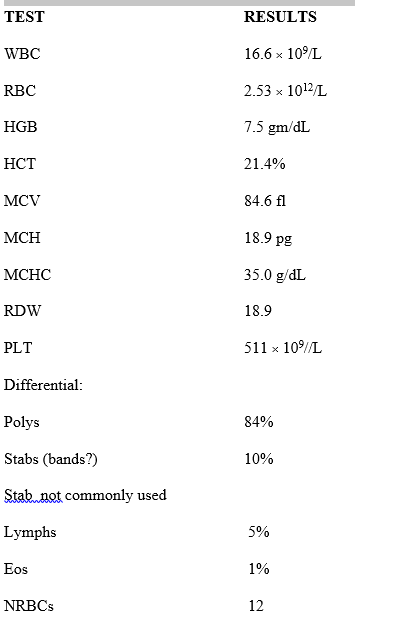 -Based on these findings,what test would be the logical next step?
 (Multiple Choice)
4.8/5 (89)
(89) Use this case to answer the following questions:
A 2-year-old black male was being evaluated at County Clinic for swollen hands and feet that were extremely painful.Upon physical examination,the child was found to have a fever and hepatosplenomegaly and was physically small for his age.The child was of Jamaican descent.
Patient history revealed that the child's birth weight was normal,but since then,he had been consistently underweight and undersized for his age group.Family history was not readily available.The physician had the child admitted to the hospital for workup and ordered the following CBC.
-All of the following parameters of the complete blood count are abnormal except:
-All of the following parameters of the complete blood count are abnormal except: (Multiple Choice)
4.7/5 (77)
(77) The net decrease in negative charge in the hemoglobin S molecule is responsible for which laboratory finding?
(Multiple Choice)
4.9/5 (75)
(75) Electrophoresis at an acid pH using a citrate agar gel separates what hemoglobin variants that travel together on cellulose acetate at pH 8.6?
(Multiple Choice)
4.9/5 (85)
(85) In hemoglobin C disease,the cell's life span is decreased to what length?
(Multiple Choice)
4.7/5 (73)
(73) Use this case to answer the following questions:
A 2-year-old black male was being evaluated at County Clinic for swollen hands and feet that were extremely painful.Upon physical examination,the child was found to have a fever and hepatosplenomegaly and was physically small for his age.The child was of Jamaican descent.
Patient history revealed that the child's birth weight was normal,but since then,he had been consistently underweight and undersized for his age group.Family history was not readily available.The physician had the child admitted to the hospital for workup and ordered the following CBC.
-This patient presented with swollen hands and feet.This patient suffering from what kind of crisis?
-This patient presented with swollen hands and feet.This patient suffering from what kind of crisis? (Multiple Choice)
4.8/5 (69)
(69) The strength and type of charge on a hemoglobin molecule enables the separation of hemoglobin variants by electrophoresis.What other significant factor controls this separation?
(Multiple Choice)
4.8/5 (80)
(80) The defect in the following choices that will produce hemoglobin C disease are:
(Multiple Choice)
4.8/5 (79)
(79) Sickle cell trait is not as severe as sickle cell anemia,so why is the sickle cell trait important to diagnose?
(Multiple Choice)
4.7/5 (78)
(78) What preoperative therapy is effective in a diagnosed sickle cell patient?
(Multiple Choice)
4.9/5 (79)
(79) Hemoglobin C disease has altered solubility properties similar to hemoglobin S disease.What accounts for this altered solubility?
(Multiple Choice)
4.7/5 (79)
(79) Patients with sickle cell disease suffer from vaso-occlusive crises because:
(Multiple Choice)
4.9/5 (80)
(80) 
Filters
- Essay(0)
- Multiple Choice(0)
- Short Answer(0)
- True False(0)
- Matching(0)