



 Chat with AI
Exam 12: Anemias of Disordered Iron Metabolism and Heme Synthesis

Exam 1: Introduction30 Questions
Exam 2: Cellular Homeostasis40 Questions
Exam 3: Structure and Function of Hematopoietic Organs35 Questions
Exam 4: Hematopoiesis35 Questions
Exam 5: The Erythrocyte37 Questions
Exam 6: Hemoglobin40 Questions
Exam 7: Granulocytes and Monocytes30 Questions
Exam 8: Lymphocytes25 Questions
Exam 9: The Platelet16 Questions
Exam 10: The Complete Blood Count and Peripheral Blood Smear Evaluation35 Questions
Exam 11: Introduction to Anemia35 Questions
Exam 12: Anemias of Disordered Iron Metabolism and Heme Synthesis36 Questions
Exam 13: Hemoglobinopathies: Qualitative Defects33 Questions
Exam 14: Thalassemia32 Questions
Exam 15: Megaloblastic and Nonmegaloblastic Macrocytic Anemias34 Questions
Exam 16: Hypoproliferative Anemias32 Questions
Exam 17: Hemolytic Anemia: Membrane Defects36 Questions
Exam 18: Hemolytic Anemia: Enzyme Deficiencies36 Questions
Exam 19: Hemolytic Anemia: Immune Anemias30 Questions
Exam 20: Hemolytic Anemia: Nonimmune Defects30 Questions
Exam 21: Nonmalignant Disorders of Leukocytes: Granulocytes and Monocytes35 Questions
Exam 22: Nonmalignant Lymphocyte Disorders32 Questions
Exam 23: Introduction to Hematopoietic Neoplasms34 Questions
Exam 24: Myeloproliferative Neoplasms44 Questions
Exam 25: Myelodysplastic Syndromes34 Questions
Exam 26: Acute Myeloid Leukemias35 Questions
Exam 27: Precursor Lymphoid Neoplasms34 Questions
Exam 28: Mature Lymphoid Neoplasms39 Questions
Exam 29: Hematopoietic Stem Cell Transplantation41 Questions
Exam 30: Morphologic Analysis of Body Fluids in the Hematology Laboratory39 Questions
Exam 31: Primary Hemostasis35 Questions
Exam 32: Secondary Hemostasis and Fibrinolysis33 Questions
Exam 33: Disorders of Primary Hemostasis35 Questions
Exam 34: Disorders of Secondary Hemostasis34 Questions
Exam 35: Thrombophilia34 Questions
Exam 36: Hemostasis: Laboratory Testing and Instrumentation41 Questions
Exam 37: Hematology Procedures46 Questions
Exam 38: Bone Marrow Examination34 Questions
Exam 39: Automation in Hematology38 Questions
Exam 40: Flow Cytometry34 Questions
Exam 41: Chromosome Analysis of Hematopoietic and Lymphoid Disorders35 Questions
Exam 42: Molecular Analysis of Hematologic Diseases18 Questions
Select questions type


Name the molecule that is responsible for oxidizing ferrous iron to ferric iron to be combined with transferrin.

Free
(Multiple Choice)
4.8/5  (95)
(95) Correct Answer: Verified
D
What is the typical PB picture in a patient with stage 1 IDA?
Free
(Multiple Choice)
4.9/5 (76)
(76) Correct Answer:Verified
VerifiedA
Hypochromic,microcytic anemia is found in which stage of iron deficiency?
Free
(Multiple Choice)
4.9/5 (74)
(74) Correct Answer:Verified
VerifiedC
What measurements are used in the percent saturation calculation?
(Multiple Choice)
4.8/5 (77)
(77) Use this case to answer the following questions: Hugo brought his 2-year-old son to the doctor for a checkup.He had recently moved to upstate New York from a poor neighborhood in Los Angeles.Hugo commented that his son had been very cranky lately.He attributed this condition to teething.He had a habit of chewing on his favorite painted wooden toys,which were family heirlooms.The well-baby clinic referred Hugo's son to the hospital laboratory because he was lethargic and pale.A CBC was ordered. 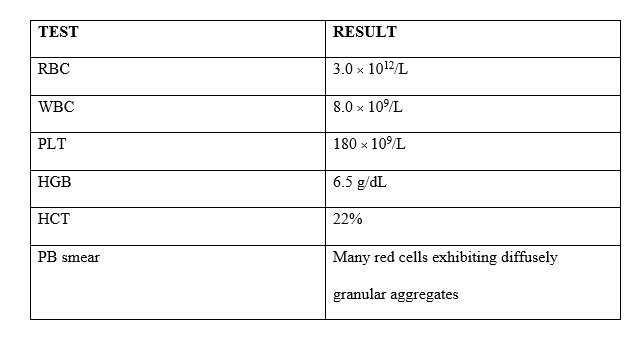 -What is the most probable diagnosis based on these clinical findings and patient history?
 (Multiple Choice)
4.9/5 (70)
(70) Which laboratory test measures the maximum amount of iron able to be bound to transferrin in the serum?
(Multiple Choice)
5.0/5 (79)
(79) Iron-deficiency anemia can occur from what three mechanisms?
(Multiple Choice)
4.9/5 (99)
(99) A defect in the HFE gene would cause which of the following to occur?
(Multiple Choice)
4.7/5 (77)
(77) Regulation of iron entering the body occurs mainly through which mechanism?
(Multiple Choice)
4.9/5 (74)
(74) Which laboratory test would be most helpful in differentiating iron-deficiency anemia from anemia of chronic disease?
(Multiple Choice)
4.9/5 (77)
(77) Use this case to answer the following questions: Hugo brought his 2-year-old son to the doctor for a checkup.He had recently moved to upstate New York from a poor neighborhood in Los Angeles.Hugo commented that his son had been very cranky lately.He attributed this condition to teething.He had a habit of chewing on his favorite painted wooden toys,which were family heirlooms.The well-baby clinic referred Hugo's son to the hospital laboratory because he was lethargic and pale.A CBC was ordered.
-What reflex laboratory tests would be helpful to identify the cause of this anemia?
-What reflex laboratory tests would be helpful to identify the cause of this anemia? (Multiple Choice)
4.9/5 (73)
(73) Note the text states 200 mcg/L in premenopausal females and 300 µg/L in men and postmenopausal women (page 220).Iron overload exists when ferritin levels are higher than:
(Multiple Choice)
4.7/5 (81)
(81) Which of the following is the correct progression of iron-deficiency anemia?
(Multiple Choice)
4.8/5 (65)
(65) Explain the absorption and assimilation of nonheme iron into hemoglobin in the RBC.
(Short Answer)
4.9/5 (91)
(91) Use this case to answer the following questions: Hugo brought his 2-year-old son to the doctor for a checkup.He had recently moved to upstate New York from a poor neighborhood in Los Angeles.Hugo commented that his son had been very cranky lately.He attributed this condition to teething.He had a habit of chewing on his favorite painted wooden toys,which were family heirlooms.The well-baby clinic referred Hugo's son to the hospital laboratory because he was lethargic and pale.A CBC was ordered.
-The patient was found to have normal serum iron studies.What other reflex test(s)should be done?
-The patient was found to have normal serum iron studies.What other reflex test(s)should be done? (Multiple Choice)
4.9/5 (73)
(73) How is sideroblastic anemia confirmed by laboratory analysis?
Explain your answer.
(Essay)
5.0/5 (85)
(85) 
Filters
- Essay(0)
- Multiple Choice(0)
- Short Answer(0)
- True False(0)
- Matching(0)